

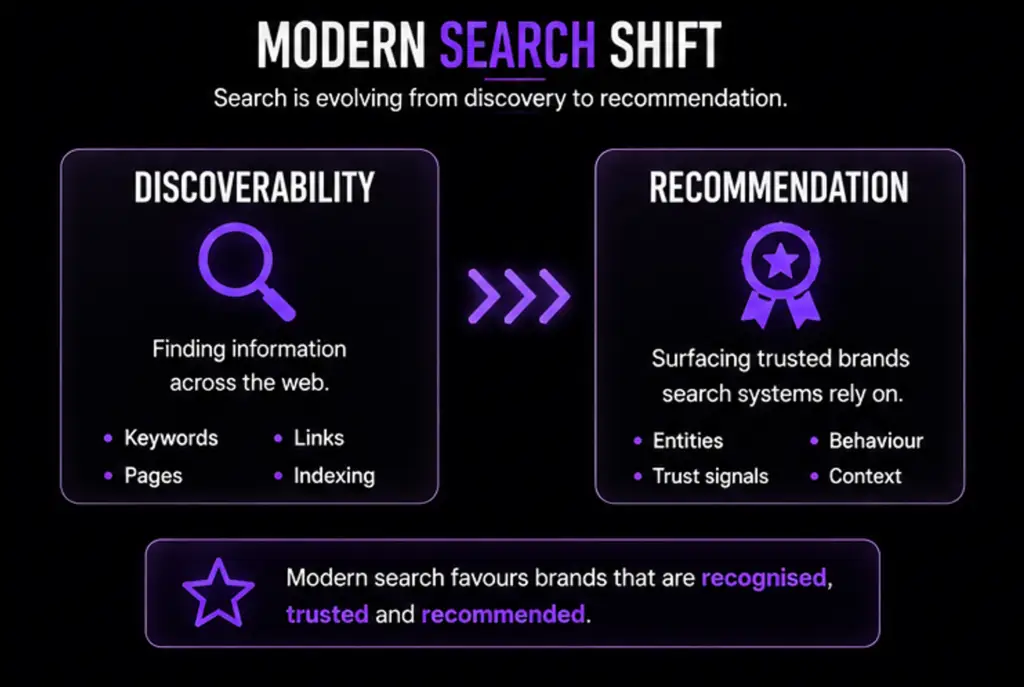
SEO used to focus heavily on helping pages get discovered.
Pages were created. Keywords were targeted. Links were built. Rankings improved.
Visibility mostly lived inside search results.
That model still matters.
But modern search increasingly spends less time simply locating information and more time deciding what deserves to be surfaced.
Especially across AI search, conversational interfaces and recommendation-driven discovery.
That shift changes how visibility works.
Because systems are no longer only organising information.
Increasingly, they are selecting what to present directly inside answers.
And that is where brand retrieval starts becoming important.
Brand retrieval is not really about indexing.
Or crawling.
Or even rankings alone.
It is about whether search systems confidently surface a business when users ask for help, recommendations, expertise or solutions.
That distinction matters more than most businesses currently realise.
Because modern search increasingly behaves less like a directory of websites and more like recommendation infrastructure.
The system is constantly narrowing options.
Filtering candidates.
Selecting what feels most useful, most trustworthy and easiest to recommend.
Honestly, this is where a lot of older SEO thinking starts feeling a bit limited.
For years, visibility mostly meant:
“Can this page rank?”
Increasingly, visibility also means:
“Will this business be surfaced when systems generate answers?”
Those are not the same thing.
A page can exist. A page can even rank.
But if the wider ecosystem does not reinforce strong understanding around the business behind it, retrieval becomes much harder.
Especially in conversational search.
Because conversational systems compress discovery.
Users no longer always compare ten blue links.
Sometimes they receive:
- one answer
- three recommendations
- a summarised shortlist
- a generated response
- a surfaced provider
That changes exposure.
And the businesses that get surfaced repeatedly start gaining disproportionate visibility.
Not purely because they created content.
Because systems already understand where to place them.
That confidence matters.
Especially when systems need to generate fast answers.
The future of SEO increasingly feels tied to retrieval.
Not just discoverability.
Summary
- Modern search increasingly decides what to surface, not just what to index.
- AI search and conversational interfaces often reduce how many businesses users actually see.
- Retrieval is about surfacing probability and recommendation confidence.
- Businesses usually become easier to surface after repeated exposure across the wider web.
- Recognition helps systems remember a business.
Retrieval influences who gets included when answers are generated.
- Modern SEO visibility increasingly depends on becoming a business systems naturally associate with a topic or need.
Brand Retrieval Is Really About Surfacing Probability
One of the biggest misconceptions around retrieval is that people often describe it as another version of rankings.
It is not.
Brand retrieval is much closer to recommendation behaviour.
The system is effectively deciding:
- Which businesses come to mind first?
- Which names feel easiest to recommend?
- Which businesses naturally come to mind for this topic?
- Which businesses seem like an obvious fit for this situation?
That process increasingly happens across:
- AI-generated answers
- conversational search
- recommendation systems
- local discovery
- summarised search experiences
- voice interfaces
- platform suggestions
The retrieval question is not simply:
“Does this page exist?”
It becomes something closer to:
“Would this business make sense to surface here?”
That is a very different visibility model.
And honestly, it explains why some businesses seem to appear everywhere online even when competitors publish similar content.
The systems already seem to understand where they fit.
People already seem to connect them to that area.
The association already feels familiar.
The systems keep encountering the same patterns around them.
So brand retrieval becomes easier.
Recognition still matters.
But retrieval is what determines who actually gets surfaced.
Search Systems Are Constantly Narrowing Candidates
Modern search systems process huge amounts of possible information.
Far more than users ever see.
The visible layer is heavily filtered.
Especially inside conversational search.
When somebody asks:
“Who is the best accountant for ecommerce businesses in London?”
or:
“What’s the best CRM for small estate agencies?”
or:
“Which SEO consultant specialises in local businesses?”
the system has to narrow candidates.
That narrowing process is retrieval.
Not every business becomes equally retrievable.
Some businesses become easier to surface because the surrounding ecosystem repeatedly reinforces the same associations.
The systems encounter:
- reviews
- citations
- discussions
- interviews
- creator mentions
- podcast appearances
- topical content
- repeated recommendations
- recognisable positioning
over and over again.
Eventually the business becomes easier to retrieve contextually.
Not simply easier to find.
Easier to recall.
That distinction feels increasingly important.
Because AI systems are increasingly built around contextual retrieval behaviour.
The businesses that feel easiest to associate with a topic often become easier to surface inside answers.
Conversational Search Compresses Visibility
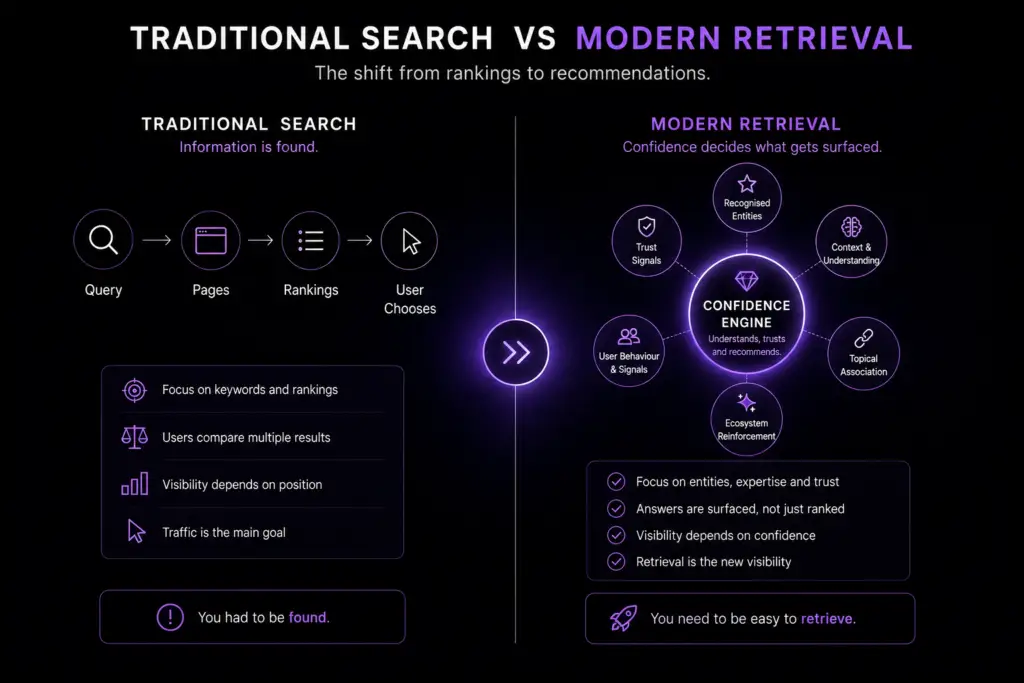
Traditional search encouraged exploration.
Users opened tabs. Compared pages. Browsed forums. Checked reviews. Looked at multiple providers.
Conversational search compresses much of that behaviour.
The answer increasingly arrives before the exploration.
That changes how businesses gain visibility.
Research from Nielsen Norman Group has repeatedly shown that users naturally gravitate toward experiences that reduce friction and simplify decision-making, which helps explain why conversational interfaces are changing how discovery works online.
Sometimes the exposure is no longer:
- the ranking
- the click
- the page title
Sometimes the exposure is simply:
being included.
Being surfaced inside the answer itself.
That is a major shift.
Because conversational systems naturally reduce the number of visible options.
And fewer visible options increases the importance of retrieval probability.
This is partly why recognised brands often feel disproportionately visible across AI search.
The systems already understand:
- what they do
- where they fit
- which topics connect to them
- which contexts feel relevant
- why users may trust them
That understanding reduces uncertainty.
And recommendation systems tend to prefer low-uncertainty candidates.
Search systems follow confidence.
Especially when generating direct answers.
AI Search Makes Retrieval More Obvious
Retrieval behaviour existed long before AI chat interfaces became mainstream.
Google has always retrieved entities.
Maps constantly retrieves businesses it feels confident recommending.
YouTube repeatedly surfaces creators it already understands clearly.
Amazon heavily prioritises recommendation behaviour.
TikTok retrieval behaviour is driven heavily by reinforcement loops.
Modern discovery has been shifting toward recommendation systems for years.
AI search simply makes the process easier to see.
Because the recommendation layer becomes visible directly inside the interface.
Users can now ask:
- “Who should I hire?”
- “Which software is best for this?”
- “Who specialises in this problem?”
- “Which agencies are well known for this?”
And the system responds conversationally.
That changes what visibility actually means.
The businesses included inside generated responses gain exposure before the user ever reaches a website.
Which means retrieval increasingly shapes discovery itself.
Not just rankings.
That part still does not get discussed enough inside SEO conversations.
A lot of businesses still think visibility starts at the click.
Increasingly, visibility starts earlier.
At the recommendation stage.
Repeated Exposure Strengthens Recall Probability
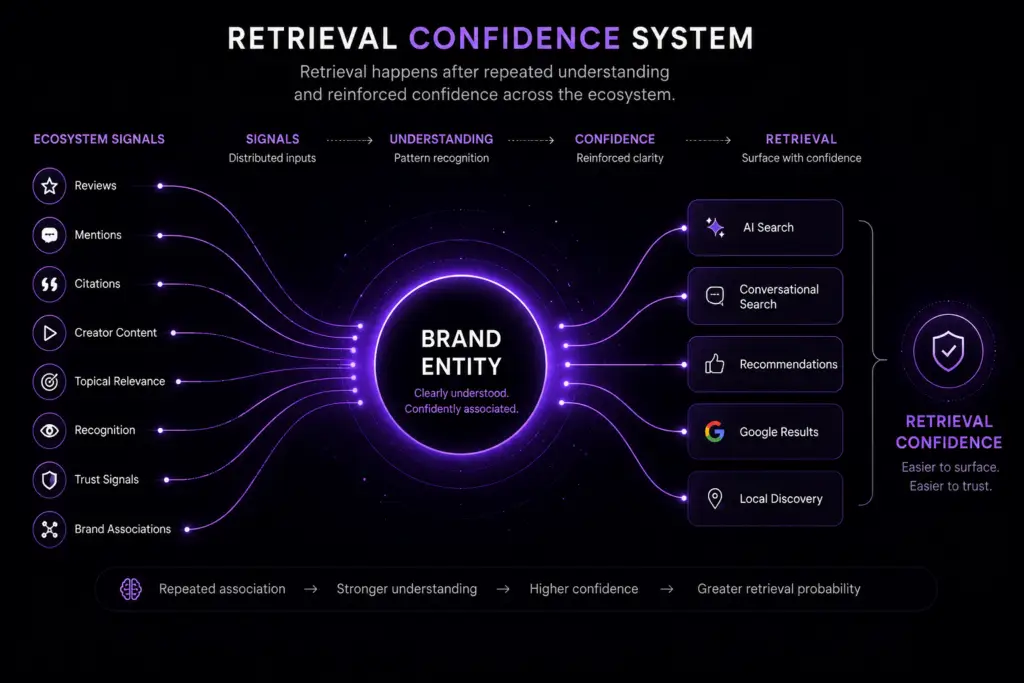
Brand retrieval rarely comes from one isolated signal.
It forms through repeated reinforcement.
The businesses that become easiest to retrieve are often the ones repeatedly connected to the same expertise, topics and positioning over time.
That reinforcement can come from:
- branded searches
- digital PR
- expert mentions
- reviews
- creator discussions
- topical content
- podcast appearances
- community conversations
- YouTube videos
- citations
- repeated recommendations
All of it helps systems strengthen contextual understanding.
But retrieval is not simply understanding.
Retrieval is what happens when systems act on that understanding.
When the system needs to generate an answer quickly, repeated reinforcement helps reduce ambiguity.
The business already feels categorised mentally.
That makes retrieval easier.
This is one reason generic content often struggles.
There may be content volume.
But weak association.
Weak positioning.
Weak contextual memory.
The system encounters the business.
But does not strongly connect it to a clear recommendation pathway.
Recognition reduces uncertainty.
Retrieval turns that reduced uncertainty into exposure.
Why Brand Retrieval Changes SEO Strategy
Traditional SEO focused heavily on:
- rankings
- keywords
- technical optimisation
- backlinks
- discoverability
Those things still matter.
But brand retrieval introduces another layer.
Businesses now increasingly need to think about:
- recommendation likelihood
- topical association
- entity recall
- conversational discoverability
- ecosystem reinforcement
- retrieval confidence
- contextual relevance
Because modern search visibility increasingly extends beyond websites.
The wider ecosystem matters more now.
A business mentioned repeatedly across trusted environments becomes easier for systems to retrieve later.
That is partly why some smaller brands remain almost invisible despite publishing large amounts of SEO content.
The surrounding ecosystem does not reinforce strong retrieval signals.
Meanwhile recognised brands often gain retrieval momentum naturally.
The systems repeatedly encounter them.
Repeated association strengthens recall pathways.
And over time the recommendation confidence compounds.
Google remembers patterns.
AI systems appear to do something very similar.
Brand Retrieval Sits At The End Of The Brand SEO Framework
Within the Brand SEO framework, Retrieval comes after:
Presence → Clarity → Recognition → Trust
That order matters.
Presence helps systems identify a business consistently.
Clarity strengthens understanding around what the business should be known for.
Recognition creates familiarity.
Trust reduces uncertainty.
Retrieval becomes the surfacing outcome.
The recommendation layer.
The recall layer.
The selection layer.
And honestly, this is where modern search starts becoming much bigger than rankings alone.
Because systems increasingly decide:
- who gets surfaced
- who gets included
- who gets recommended
- who gets recalled first
not simply:
- which pages exist
- which pages are indexed
- which websites contain information
That distinction feels increasingly important as conversational search continues growing.
The brands that get remembered get retrieved.
And the brands that get retrieved increasingly shape who gets discovered.
Final Thoughts
Brand retrieval is not really a standalone SEO tactic.
It is the outcome of systems repeatedly understanding where a business fits and feeling confident surfacing it when users need answers.
Modern search increasingly behaves like recommendation infrastructure.
And recommendation systems naturally narrow visibility toward businesses that feel:
- familiar
- reinforced
- contextually relevant
- clearly positioned
- easy to associate with expertise
- safe to recommend
That changes how exposure works online.
The challenge is no longer simply creating pages that can rank.
Increasingly, the challenge is becoming a business search systems confidently retrieve when users ask for solutions, expertise and recommendations.
And as AI search continues compressing discovery into conversational answers, retrieval will likely influence visibility far more than most businesses currently expect.
Recognition compounds.
But retrieval decides who gets surfaced.