

A lot of businesses think SEO problems start with rankings.
But increasingly, the issue starts earlier.
Google often struggles to understand what the business should actually be known for.
That usually happens because the positioning becomes messy.
The homepage says one thing. The service pages lean another direction. The business descriptions across social platforms all sound slightly different. Then the blog starts targeting completely unrelated topics because somebody heard publishing more content improves SEO.
Eventually the expertise signals start pulling in different directions.
And once that happens, search understanding becomes weaker.
That matters more now because Google increasingly relies on context, relationships and topic connections when interpreting businesses online.
Before search systems can confidently associate a business with a topic or service category, they first need to understand:
- what the business specialises in
- which topics it consistently talks about
- what expertise it demonstrates repeatedly
- which services connect naturally together
- how the business fits into a wider category
That is where brand clarity becomes important.
Not simply from a branding perspective.
From a search understanding perspective.
Because clear positioning helps search systems make sense of your expertise.
Within the wider Brand SEO framework, clarity comes after presence and before recognition.
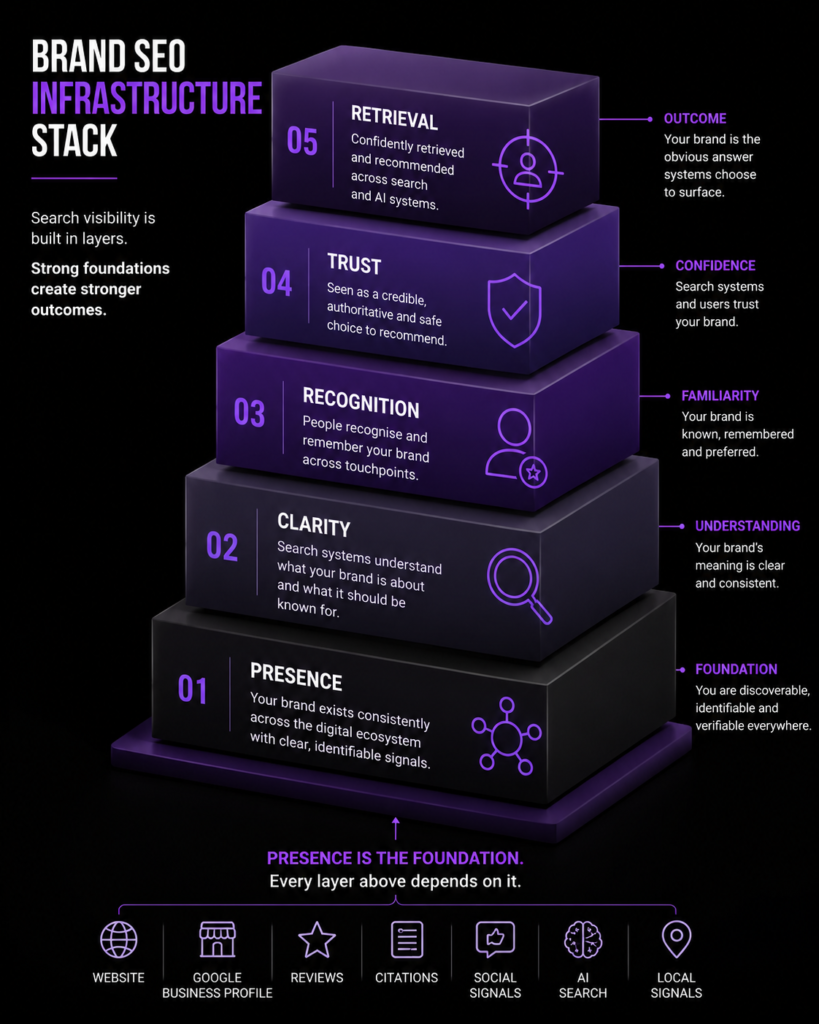
Because before a business can become remembered or trusted consistently, search systems first need to understand what the business actually appears to specialise in.
Presence helps the business become visible.
Brand clarity helps search systems understand what the business is actually about.
Summary
- Brand clarity helps Google make better sense of what your business actually does.
- Businesses that constantly shift positioning online usually become harder to categorise.
- Content tends to work better when the topics naturally connect together.
- Repeated context helps search systems understand expertise more clearly over time.
- Strong visibility often comes from clearer positioning rather than disconnected SEO activity.
- Businesses with focused messaging are usually easier for Google to interpret.
- Supporting content should strengthen the main expertise area rather than compete with it.
- AI search still depends on understanding what a business consistently appears to specialise in.
- Mixed positioning often weakens topical understanding.
- Modern SEO increasingly depends on clear interpretation, not just page-level optimisation.
Google Is Trying To Understand What Your Business Is About
One of the biggest shifts happening across search is that Google increasingly behaves less like a simple indexing system and more like a system trying to interpret meaning.
That changes visibility quite a bit.
Traditional SEO conversations used to revolve heavily around discoverability.
Can Google crawl the page? Can it index the content? Can it see the keywords?
Those things still matter.
But modern search increasingly depends on interpretation.
Google is constantly trying to work out:
- what a business actually does
- which services connect to it naturally
- which topics appear repeatedly
- what expertise the business demonstrates consistently
- how confidently it fits into a category
Even Google’s own documentation increasingly reinforces the importance of creating content that demonstrates clear expertise, helpfulness and relevance for users over time.
That understanding develops gradually.
Usually through repeated context.
Not isolated optimisation.
And definitely not disconnected messaging.
The clearer the topic relationships become, the easier the business becomes to categorise.
That matters because search systems generally prefer clearer understanding over ambiguity.
Most Businesses Accidentally Create Mixed Positioning Signals
This is probably where things start becoming messy.
A lot of businesses try to target too many things simultaneously.
A marketing agency might describe itself as:
- an SEO agency on the homepage
- a growth consultancy on LinkedIn
- a web design business in metadata
- a content agency inside service pages
- an AI automation consultancy inside blog content
Then publish articles about:
- e-commerce SEO
- hospitality marketing
- AI software news
- TikTok trends
- SaaS growth
- automation tools
all within the same month.
The issue is not content quantity.
The issue is that the surrounding expertise signals stop aligning clearly.
Search systems struggle when positioning becomes inconsistent.
Because Google is trying to answer a fairly simple question:
“What does this business consistently appear to specialise in?”
The harder that becomes to interpret, the weaker the topical understanding usually becomes.
That part gets overlooked constantly.
Especially in SEO conversations focused heavily on rankings rather than interpretation.
Brand Clarity Is Really About Focus
At its core, brand clarity is mostly about focus.
Not keyword stuffing. Not repeating the same phrase endlessly. Not removing personality from the business.
It is about helping search systems connect the right expertise signals together.
That usually happens through:
- connected topics
- aligned messaging
- repeated expertise areas
- logical service relationships
- consistent terminology
- supporting content themes
The stronger those relationships become, the easier the business becomes to understand.
For example:
A business consistently associated with:
- local SEO
- Google Business Profile optimisation
- local citations
- local landing pages
- map visibility
- local ranking improvements
creates a much clearer expertise profile than a business publishing random marketing content every week without any obvious thematic direction.
Consistent topic relationships make expertise easier to understand over time.
That feels increasingly important now.
Confused Positioning Usually Creates Weaker Search Understanding
This is one of the simplest ways to explain modern topical SEO.
Confused positioning usually creates weaker search understanding.
A lot of businesses unintentionally dilute their own expertise signals online.
Sometimes the business itself is not fully clear on what it wants to become known for.
That uncertainty eventually appears throughout the website.
Usually through:
- disconnected services
- inconsistent messaging
- broad content targeting
- scattered audience focus
- unclear service hierarchy
- overlapping topic areas
- fragmented site structure
Over time, the relationships become harder to interpret.
The expertise starts looking broader but weaker.
And broad positioning often creates softer topic association.
Who wants to recommend something they cannot fully understand?
That applies to people.
And increasingly, it applies to search systems too.
One Strong Article Rarely Creates Clear Expertise Positioning
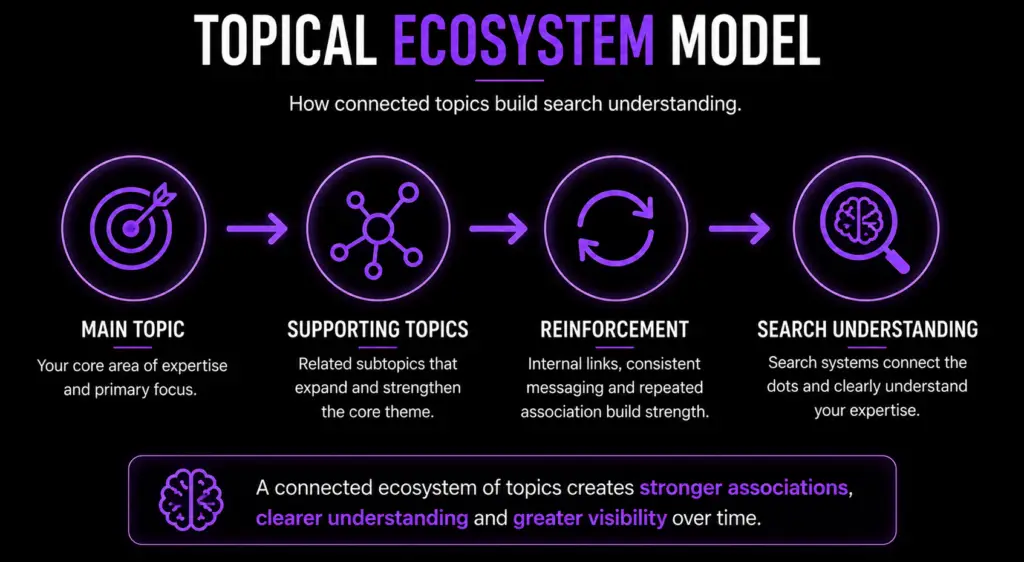
Search understanding usually develops through accumulation.
Repeated topics. Repeated context. Repeated expertise. Repeated service relationships.
That repetition helps search systems build stronger topic associations gradually.
Which is why connected content ecosystems matter far more now than isolated pages.
There is a big difference between:
A business publishing fifty unrelated articles.
And:
A business building content around tightly connected expertise areas.
One creates noise.
The other creates clearer understanding.
That distinction feels increasingly important across modern SEO.
Because search systems rely heavily on relationships.
Not just isolated keywords.
Clear Businesses Are Easier To Categorise
The businesses that often perform strongest long-term are not always the businesses publishing the most content.
They are often the businesses reinforcing the clearest expertise signals.
Again and again.
Their positioning stays relatively aligned. Their services connect logically. Their content themes reinforce each other naturally.
That consistency makes the business easier to categorise.
For example:
If a business consistently talks about:
- technical SEO
- indexing
- crawling
- rendering
- site architecture
- Core Web Vitals
Google gradually starts associating the business with technical SEO expertise.
That sounds obvious.
But businesses interrupt this process constantly by chasing disconnected topics purely because they have search volume.
The issue is rarely one random article.
It is accumulated inconsistency over time.
Brand Clarity Does Not Mean Staying Narrow Forever
This is where people sometimes misunderstand the idea.
Brand clarity does not mean a business can never expand.
It does not mean:
- only targeting one keyword
- only publishing one topic
- sounding repetitive constantly
- reducing the business down to one service
Expansion is fine.
Thematic connection is the important part.
A business specialising in local SEO can naturally expand into:
- Google Business Profile optimisation
- local citations
- review strategy
- map visibility
- local search behaviour
- local landing pages
Those topics reinforce each other naturally.
The ecosystem still makes sense.
Problems usually start when businesses move into unrelated topic areas with weak expertise relationships simply because the keyword volume looks attractive.
That weakens clarity.
And weaker brand clarity often weakens understanding.
Website Structure Influences Search Understanding Too
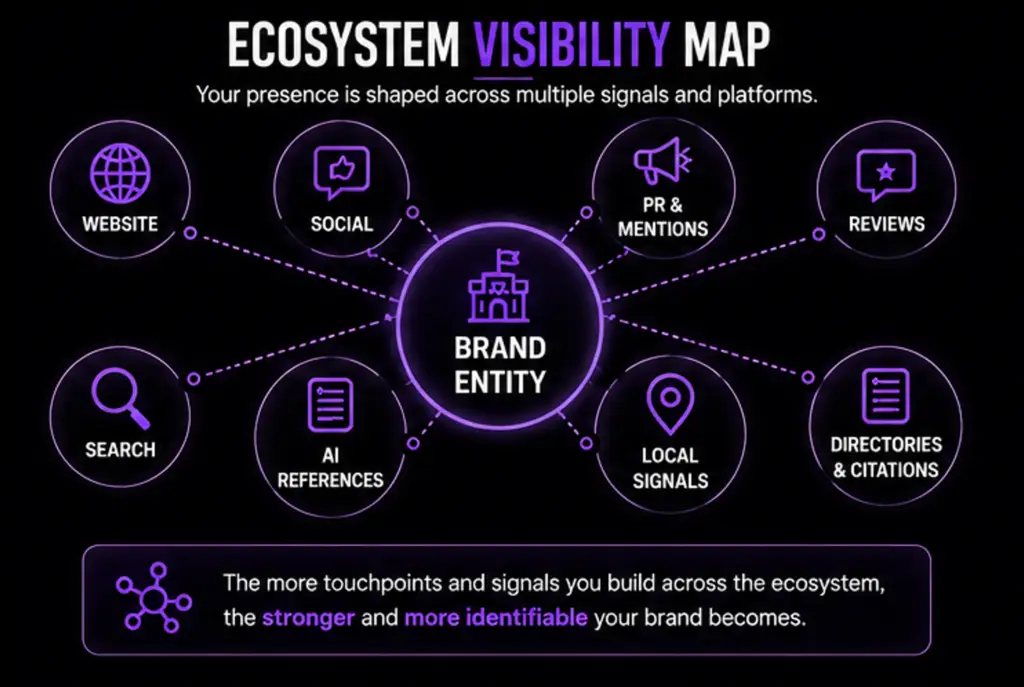
Brand clarity is not only a messaging issue.
It also appears through structure.
Search systems evaluate:
- internal linking
- content relationships
- service hierarchy
- page grouping
- supporting content
- category organisation
- terminology consistency
All of those help search systems interpret expertise relationships.
That is why strong websites usually feel logically connected.
The content supports the services. The services reinforce the positioning. The positioning aligns with the wider expertise.
Everything points in a similar direction.
That alignment matters much more now.
Because modern search increasingly behaves ecosystem-wide rather than page-by-page.
AI Search Still Needs Clear Topic Understanding
A lot of AI search conversations become overly dramatic.
But underneath most retrieval systems sits the same core requirement.
Clear understanding.
AI systems still need strong signals about:
- what a business specialises in
- which topics connect strongly to it
- what expertise appears consistently
- how the business fits into a category
That understanding still develops through repeated relationships and connected context.
If the positioning appears fragmented across:
- service pages
- supporting content
- profiles
- reviews
- external mentions
- website structure
then the understanding usually becomes weaker too.
Even AI search depends on strong topical understanding underneath the surface.
That is partly why clear expertise positioning keeps becoming more important across modern SEO.
Businesses that are easier to interpret are usually easier to associate with the right topics later.
Local SEO Makes Brand Clarity Problems Easier To Spot
This becomes especially obvious in local search.
Many local businesses try to target every possible service variation under the same brand.
A single website suddenly becomes associated with:
- kitchens
- roofing
- bathrooms
- driveways
- landscaping
- solar installation
- plastering
- home extensions
all at once.
The issue is not ambition.
The issue is that the expertise relationships become unclear.
Google struggles to determine what the business should strongly associate with.
Local brand clarity usually improves when businesses reinforce:
- connected services
- focused categories
- consistent terminology
- aligned local pages
- clearer review language
- stronger service relationships
The clearer the positioning becomes, the easier local understanding becomes.
That affects:
- local rankings
- map visibility
- service relevance
- category association
- local recommendations
Again, the problem is not always content quality.
Sometimes the positioning itself simply lacks focus.
Search Systems Learn Through Connected Relationships
One thing I keep noticing across modern SEO is how much understanding develops through connected relationships.
Search systems do not only evaluate isolated pages anymore.
They evaluate:
- supporting topics
- service relationships
- content structure
- semantic connections
- expertise reinforcement
- thematic consistency
That changes how businesses should think about content strategy.
Content is not only a traffic mechanism anymore.
It also helps shape understanding.
Every article either reinforces:
- expertise
- positioning
- topical focus
- category understanding
- service association
or weakens it.
That is why disconnected publishing often creates weaker long-term positioning.
The topic relationships stop making sense together.
Clear Brands Feel Easier To Understand
This sounds simple when phrased directly.
But it explains a huge amount about modern search visibility.
Clear businesses feel easier to interpret.
Easier to categorise. Easier to contextualise. Easier to associate with specific expertise.
That matters because modern search systems increasingly try to reduce uncertainty.
A business with:
- focused positioning
- connected services
- aligned content
- repeated expertise signals
- clear terminology
creates far less ambiguity than a business constantly shifting its positioning online.
The more aligned the themes become, the easier the expertise becomes to interpret.
That probably explains modern topical SEO better than most technical explanations.
Because once Google can consistently understand what your business appears to specialise in, stronger topic association becomes much easier to build.
Repeated Themes Help Build Stronger Topic Relationships
This is why repeated thematic reinforcement matters.
Not because repetition magically improves rankings.
But because repeated context strengthens understanding.
For example:
Main Topic: Brand SEO
Supporting Topics:
- branded search
- entity SEO
- local visibility
- topical authority
- semantic relationships
- recognition
- search trust
Those relationships reinforce each other naturally.
The expertise becomes easier to interpret.
The category becomes easier to understand.
That accumulation gradually strengthens search understanding over time.
Which is why modern SEO increasingly rewards:
- topical focus
- connected expertise
- semantic consistency
- aligned content ecosystems
- clearer positioning
Google remembers patterns.
And patterns become easier to interpret when the surrounding context stays connected.
What Strong Brand Clarity Usually Looks Like
Strong brand clarity usually feels:
- focused
- understandable
- connected
- commercially aligned
- topically consistent
The business repeatedly reinforces:
- what it does
- who it helps
- which problems it solves
- what expertise it demonstrates
- which services naturally connect together
That consistency appears across:
- homepage messaging
- service pages
- supporting content
- internal linking
- profiles
- metadata
- reviews
- external mentions
The signals support each other.
And over time, that helps search systems build clearer understanding.
Clear Brands Vs Fragmented Brands
Clear Brands
- connected topic ecosystems
- aligned messaging
- consistent positioning
- repeated expertise reinforcement
- focused service relationships
- stronger topical understanding
- clearer category association
Fragmented Brands
- disconnected targeting
- shifting positioning
- unrelated content themes
- unclear expertise signals
- broad unfocused services
- weak topic relationships
- diluted understanding
That distinction becomes increasingly important as search systems become more contextual.
Because modern SEO increasingly depends on interpretation.
Not simply optimisation.
Brand Clarity Reduces Interpretation Friction
The more I study modern search, the more it feels like visibility increasingly depends on reducing interpretation friction.
Clear businesses create fewer understanding problems.
Search systems can categorise them more easily. Understand their expertise more consistently. Associate them with topics more naturally.
That usually develops through repeated alignment over time.
The businesses that strengthen visibility long-term are often the businesses consistently reinforcing:
- connected expertise
- aligned services
- clear positioning
- focused topics
- understandable relationships
Again and again.
Modern SEO increasingly depends on topic understanding.
And topic understanding depends heavily on brand clarity.
Final Thoughts
Brand clarity matters because modern search systems increasingly rely on contextual understanding and topic relationships when interpreting businesses online.
Before Google can strongly associate a business with a category or expertise area, it first needs clear signals about:
- what the business specialises in
- which topics appear repeatedly
- what expertise connects naturally together
- how the services relate to each other
- what the business consistently appears to focus on
That understanding develops through:
- connected content
- aligned positioning
- repeated expertise signals
- consistent terminology
- logical topic relationships
Businesses with fragmented positioning often weaken their own search understanding without realising it.
The clearer the relationships become across your content, services and wider digital presence, the easier your business becomes to interpret.
And increasingly, stronger search visibility depends on being clearly understood.