

Most businesses still think visibility starts with rankings.
Higher rankings.
More keywords.
More traffic.
And obviously those things still matter.
But the longer you study modern search behaviour, the harder it becomes to ignore something much more human sitting underneath it all.
People choose businesses they recognise.
Not always consciously either.
Usually it happens quickly.
A familiar business feels safer.
More established.
Lower risk.
Easier to trust.
That behaviour influences far more search decisions than most businesses realise.
Because search behaviour is not purely rational.
It is heavily influenced by memory, familiarity and repeated exposure.
The businesses people remember tend to get searched more often.
They get clicked more confidently.
They get recommended more naturally.
And increasingly, those behavioural patterns shape visibility itself.
That is why brand recognition in search is becoming far more important.
Not simply as a branding exercise.
As a visibility advantage.
Summary
- Familiarity increasingly influences search behaviour across Google, AI search and recommendation systems
- People often click businesses they recognise before objectively comparing options
- Repeated exposure strengthens memory and future search behaviour
- Branded search often reflects accumulated familiarity rather than immediate intent
- Recognition reduces uncertainty and lowers decision friction
- Businesses people remember are more likely to be searched, recommended and retrieved later
- Modern SEO increasingly overlaps with psychology, memory and behavioural reinforcement
- Recognition compounds through repeated exposure across multiple platforms
- Familiar brands often create stronger long-term visibility stability
- The businesses that stay mentally available often stay commercially visible
Recognition Is Really About Memory
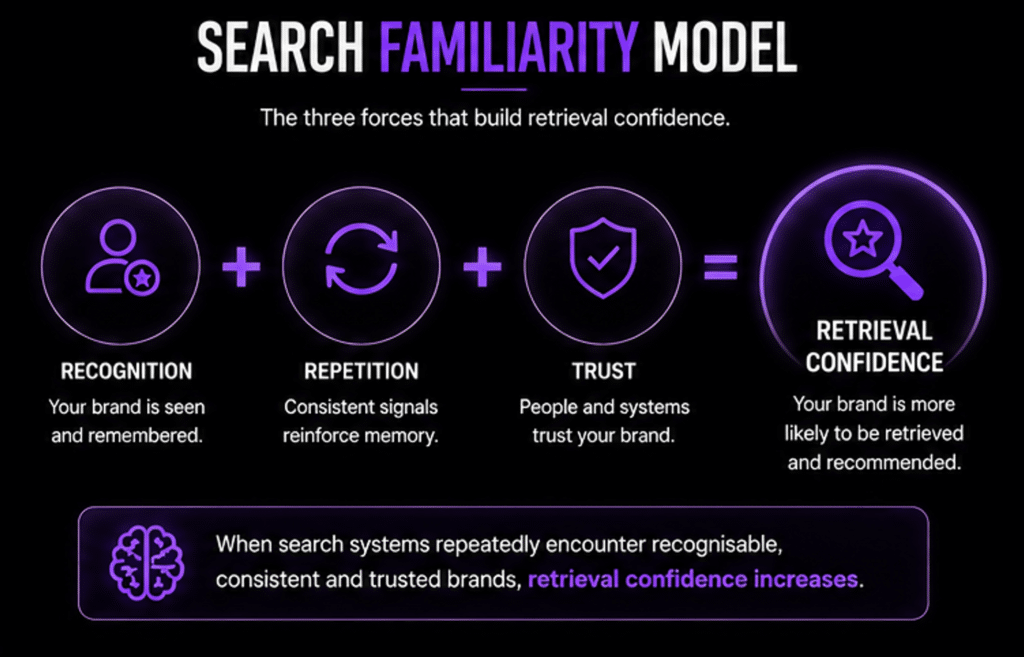
One of the biggest mistakes businesses make is treating recognition like a vanity metric.
Something soft.
Something difficult to measure.
Something separate from search performance.
But recognition is not really about awareness alone.
It is about memory.
Does somebody remember your business later?
That question matters far more than many businesses realise.
Because future searches often depend on future recall.
If somebody hears about your business today but cannot remember you next month, future visibility disappears with it.
No branded search.
No referral search.
No recommendation.
No direct visit.
The business simply falls out of consideration.
That is why recognition behaves differently from discoverability.
Discoverability helps somebody find you once.
Recognition increases the probability they remember you later.
Familiarity Changes Behaviour Before Evaluation Even Begins
Most SEO discussions still treat search behaviour as though users objectively compare every result carefully.
But that is rarely how humans behave.
People make fast decisions.
Particularly online.
And familiarity heavily influences those decisions.
If somebody sees a business name they recognise in search results, there is already a level of psychological comfort attached to it.
Even if they cannot fully explain where the familiarity came from.
Maybe they saw the business on LinkedIn.
Maybe they heard it mentioned on a podcast.
Maybe they encountered it repeatedly in search.
Maybe somebody recommended it months ago.
The source often matters less than the familiarity itself.
Because familiarity acts as a shortcut.
Humans naturally associate familiar things with lower risk.
That changes behaviour constantly across search.
People click recognised businesses faster.
They trust listings more easily.
They hesitate less.
They convert with less friction.
And importantly, they remember recognised brands more easily later.
That creates compounding visibility effects over time.
This is partly why businesses with average websites sometimes outperform businesses with technically stronger SEO.
Recognition changes behaviour before comparison even begins.
That part gets overlooked constantly.
Repeated Exposure Quietly Builds Visibility Momentum
Recognition rarely happens through a single interaction.
Usually it forms gradually.
Small repeated exposures.
Again and again.
That is how familiarity works psychologically.
People become more comfortable with things they encounter repeatedly.
Not necessarily because they consciously analyse them.
Often the opposite.
The repeated exposure simply makes the business feel known.
This is also why visibility increasingly extends beyond the website itself.
Recognition builds across:
- podcasts
- YouTube
- local communities
- reviews
- digital PR
- referrals
- creator content
- newsletters
- industry discussions
- repeat search exposure
And future recall increasingly influences future search behaviour.
Google Remembers Patterns
It is important not to oversimplify this.
Google does not publicly say it has a “recognition score”.
AI systems do not operate on a single familiarity metric.
But search engines absolutely observe patterns.
Repeated searches.
Repeated mentions.
Repeated clicks.
Repeated associations.
Repeated engagement.
Repeated topic connections.
Google increasingly understands entities, relationships and behavioural signals.
That means recognition leaves footprints.
If people consistently search for a business after hearing about it elsewhere, that matters.
If users repeatedly choose one result over another, that matters.
If a brand becomes strongly associated with a topic across the web, that matters.
If creators, publications, podcasts, reviews and communities repeatedly reference the same company in similar contexts, that matters.
Google remembers patterns.
And recognised brands naturally create stronger patterns.
This becomes even more important as search becomes increasingly entity-driven.
The more consistently search systems can associate a business with:
- a topic
- a category
- a location
- a problem
- an audience
- a reputation
…the easier retrieval becomes.
Branded Search Usually Starts Before The Search Itself
Branded search is one of the clearest signs that recognition already exists.
By the time somebody searches for a business by name, the recognition process has often been building for weeks or months.
That is important.
Because many businesses still misunderstand branded search.
They see it purely as a demand-generation metric.
But branded search is often memory becoming measurable.
It reflects accumulated exposure.
Accumulated familiarity.
Accumulated trust.
People rarely search for a business name they have never encountered before.
Usually the search happens after multiple previous touchpoints.
That could be:
- hearing the business mentioned repeatedly
- seeing content multiple times
- recommendations from other people
- encountering the brand in local environments
- repeated exposure across search and social platforms
The search itself is often the result of recognition already forming.
And branded searches behave differently because familiarity already exists.
That is why recognised businesses often generate stronger engagement behaviour.
The relationship started before the click happened.
Most Search Behaviour Is More Emotional Than Businesses Expect
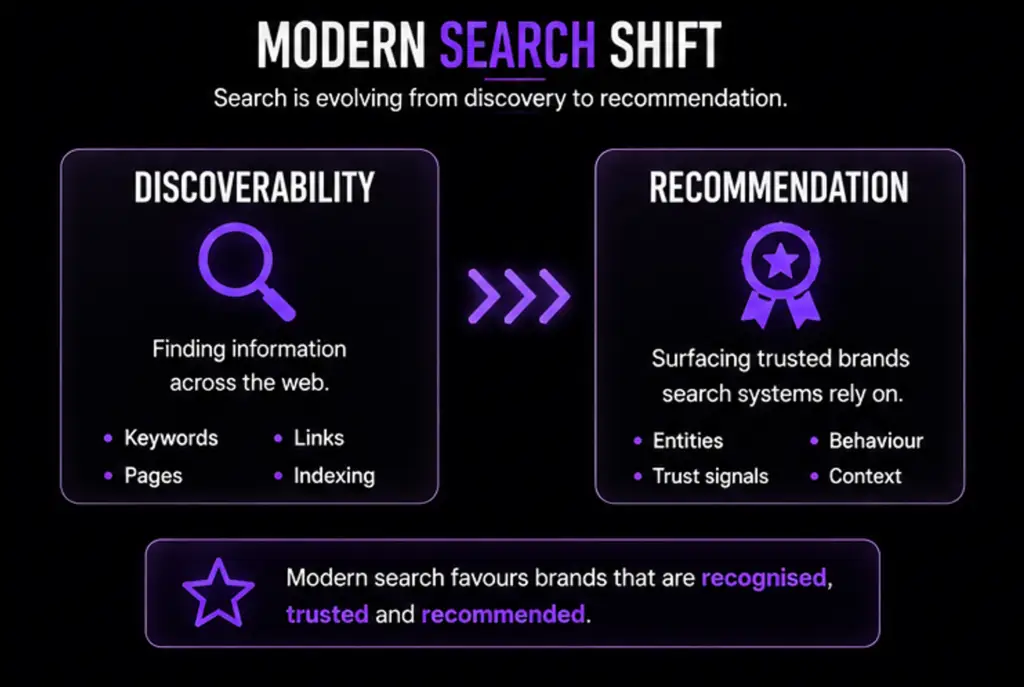
Traditional SEO conversations still lean heavily toward mechanics.
Rankings.
Optimisation.
Technical improvements.
But real search behaviour is often surprisingly emotional.
Humans do not evaluate every option rationally.
They look for reassurance.
Signals of safety.
Things that feel established.
And familiarity is one of the strongest reassurance signals humans naturally use.
Who wants to spend time researching ten unknown companies if one already feels recognisable?
That is usually where behaviour changes.
Especially in local search.
Especially in higher-trust purchases.
Especially when the user feels uncertain.
The Businesses People Remember Usually Get Recommended More
Recognition influences recommendation behaviour constantly.
Both online and offline.
When somebody asks for a recommendation, people usually mention businesses that come to mind quickly.
Not necessarily the objectively best business.
The remembered business.
That distinction matters.
Mental availability shapes recommendations.
And recommendations shape future searches.
Brand Recognition Matters Even More In Local Search
You can see this especially clearly in local SEO.
Local familiarity changes behaviour constantly.
When people repeatedly hear about a local business, search behaviour starts shifting long before rankings change.
The business feels known.
People trust the listing faster.
They click more confidently.
They search for the business directly.
They leave reviews more naturally.
They remember the name later when a problem appears.
That repeated local familiarity creates momentum.
It is one reason some local businesses consistently outperform competitors that look similar on paper.
Most local SEO conversations still focus heavily on:
- listings
- citations
- proximity
- optimisation checklists
And again, those things matter.
But local familiarity influences behaviour just as much.
In some industries, it may matter just as much as technical optimisation.
Because people trust businesses they recognise locally.
That behaviour has existed long before Google.
Search simply reflects it now.
Brand Recognition Creates Long-Term Visibility Stability
One thing that keeps appearing across strong businesses is how stable recognised visibility becomes over time.
Traffic based entirely on rankings can be fragile.
Positions fluctuate.
Competitors improve.
Algorithms shift.
But recognised businesses often maintain visibility more consistently because people actively seek them out.
That changes the relationship completely.
Brand recognition creates resilience.
People continue looking for businesses they remember.
Even if rankings move.
That is one reason strong brands often appear disproportionately visible online.
The visibility does not only live inside rankings anymore.
It lives inside memory.
Brand Recognition Is Built Through Consistent Exposure
Most businesses approach visibility too narrowly.
They publish occasional content.
Disappear for months.
Change messaging repeatedly.
Then wonder why brand recognition never forms.
But familiarity depends heavily on consistency.
Not perfect consistency.
Repeated consistency.
People remember businesses that reinforce similar ideas repeatedly over time.
That could include:
- recognisable positioning
- repeated topical expertise
- familiar language
- recurring observations
- visible founders
- repeated local presence
- recognisable content themes
- consistent messaging
Recognition is usually accumulated.
Not engineered overnight.
Memorable Businesses Usually Communicate More Clearly
One thing strong brands often do well is simplify their positioning.
Not oversimplify.
Clarify.
They become easier to associate with specific ideas.
Specific problems.
Specific expertise.
Specific categories.
That clarity strengthens memory.
Because humans remember simple repeated associations far more easily than fragmented messaging.
Businesses become forgettable when everything sounds vague.
Or interchangeable.
Or inconsistent.
That is partly why recognisable frameworks and repeated language work so well.
Not because they sound clever.
Because repetition strengthens recall.
People start mentally connecting the business with a particular idea.
And once that association forms, future searches become more likely.
Future recommendations become easier.
Future visibility becomes more stable.
Recognition is partly a memory structure problem.
The clearer the mental association becomes, the easier the business is to remember later.
AI Search Still Follows Human Familiarity Patterns
A lot of businesses are now trying to understand how visibility works inside AI search.
And while the systems themselves are obviously different from traditional search engines, one pattern keeps appearing.
Repeatedly recognised businesses tend to surface more often.
Not because AI systems think emotionally.
But because repeated human familiarity leaves stronger digital patterns behind.
That creates a broader pattern of recognition across the web.
So while AI retrieval mechanics matter, the underlying behavioural layer still matters first.
People repeatedly discussing, remembering and referencing a business creates stronger signals everywhere.
The systems are observing the behavioural outcomes of recognition.
That distinction is important.
Because the real advantage still starts with familiarity.
Brand Recognition Changes The Economics Of Marketing
There is also a commercial layer to this that businesses often underestimate.
Recognised businesses usually operate more efficiently.
They spend less energy overcoming uncertainty.
People arrive warmer.
Trust forms faster.
Clicks happen with less hesitation.
Conversions often require less persuasion.
That changes the economics of visibility entirely.
Brand recognition lowers resistance.
That influences almost every marketing channel.
SEO.
Paid search.
Social.
Local search.
Referrals.
Even hiring becomes easier for businesses people already recognise.
Familiarity shapes perception everywhere.
Which is why recognition should not sit separately from SEO strategy anymore.
It increasingly sits underneath it.
Brand Recognition Is Becoming Part Of SEO Itself
For years, SEO and branding were often treated separately.
One focused on rankings.
The other focused on awareness.
That separation is becoming much harder to maintain.
Because search behaviour increasingly reflects human behaviour.
And modern search systems increasingly observe those behavioural patterns.
That is why recognition is no longer sitting outside SEO.
It increasingly shapes visibility itself.
Not through a single algorithmic metric.
Through accumulated human behaviour.
The businesses people remember tend to stay visible.
The businesses people forget gradually disappear from consideration.
That feels like one of the most important shifts happening across modern search.
Because future visibility increasingly depends on future recall.
Brand Recognition Loop Framework
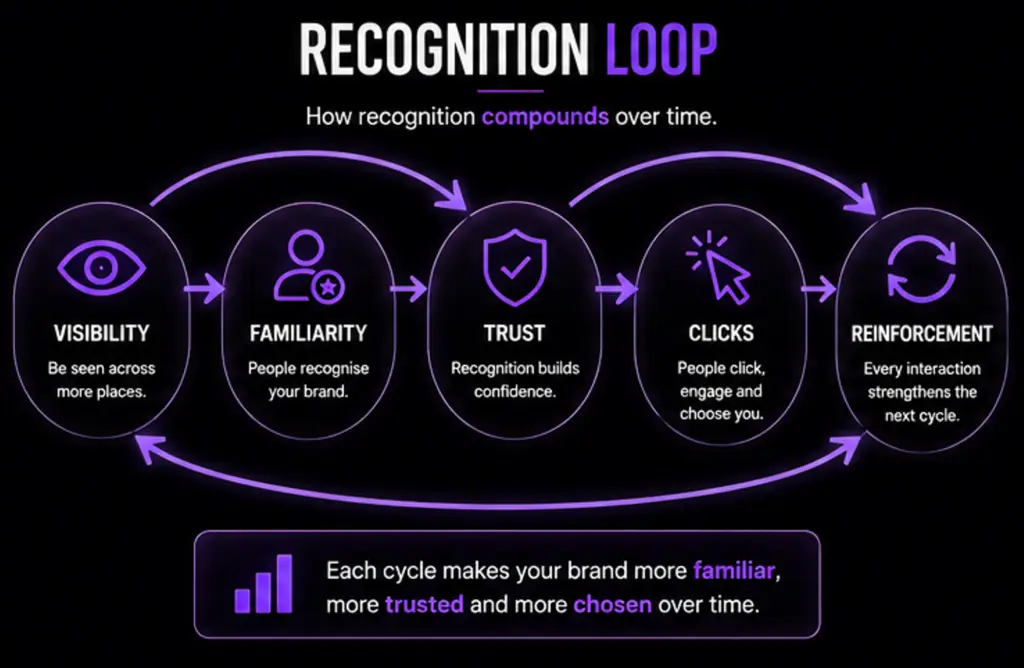
One useful way to visualise this is through a brand recognition loop:
Exposure → Familiarity → Memory → Trust → Search Behaviour → Reinforcement
Every stage strengthens the next.
More exposure increases familiarity.
Familiarity strengthens memory.
Memory improves future recall.
Recall influences future searches and clicks.
Then the cycle repeats.
That is why brand recognition compounds.
Not simply because businesses become visible.
Because they become remembered.
How This All Ties Together
Search visibility is becoming less about isolated optimisation and more about accumulated recognition.
People remember businesses they encounter consistently.
They search for them more often, trust them more quickly and recommend them more naturally.
Those behaviours create stronger patterns across Google, AI search and recommendation systems.
Recognition doesn’t replace SEO, but it increasingly strengthens it.
The businesses that stay mentally available are often the ones that stay commercially visible.