

Modern SEO is no longer only about rankings, keywords and website optimisation.
Search systems increasingly rely on brand presence, recognition, consistency and confidence to decide which businesses deserve visibility.
That shift is one of the core ideas behind Brand SEO.
Brand SEO is the process of making a business recognisable, trusted and retrievable across Google, AI search systems and local discovery.
The framework is built across five phases:
Presence → Clarity → Recognition → Trust → Retrieval
Each phase strengthens the next.
Brand presence is the foundational layer.
Before Google, AI search systems or recommendation engines can confidently rank, recommend or retrieve a business, they first need to consistently identify and understand it.
That is what brand presence is designed to solve.
Brand presence is not simply about existing online.
It is about creating identifiable digital presence across the wider search ecosystem.
Because search visibility now extends beyond websites.
Modern search systems increasingly build understanding through:
- websites
- Google Business Profiles
- reviews
- citations
- social profiles
- business mentions
- structured data
- author entities
- repeated topical association
The stronger and more consistent those signals become, the easier it becomes for search systems to confidently understand a business.
And modern search increasingly follows confidence.
Summary
- Brand presence is the foundation of modern search visibility because search systems need consistent signals before trust or retrieval can happen.
- Search visibility now extends beyond websites into reviews, citations, mentions, local profiles and wider ecosystem signals.
- Search systems increasingly rely on repeated association, consistency and recognisable identity to reduce uncertainty.
- Confused brands create weaker machine understanding because inconsistent signals reduce confidence and clarity.
- Presence strengthens every later phase of Brand SEO: Clarity, Recognition, Trust and Retrieval.
Search Visibility No Longer Lives In One Place
One of the biggest mistakes businesses still make is thinking their website is their entire brand presence within search.
That idea made more sense years ago.
Today, visibility is distributed.
Google increasingly builds understanding through:
- websites
- Google Business Profiles
- reviews
- social profiles
- citations
- author entities
- mentions
- structured data
- videos
- local references
- repeated topical associations
AI search systems behave similarly.
They don’t just analyse a single page.
They look for corroboration.
Repeated signals.
Consistent identity patterns.
The more consistently your business appears connected to the same categories, topics and associations, the easier it becomes to understand.
That’s why brand presence matters.
Because before search systems can trust a business, they first need to identify it confidently.
And this is where a lot of SEO conversations become too narrow.
Businesses often focus entirely on:
- rankings
- keywords
- content output
- technical fixes
while overlooking the wider ecosystem signals shaping machine understanding.
A company might have a strong website but weak digital presence consistency.
Or clear service pages but fragmented identity signals across platforms.
Or excellent content but very little corroboration outside their own website.
That creates uncertainty.
Search systems follow confidence.
The easier your business becomes to repeatedly recognise, the easier it becomes to classify, associate and retrieve.
What Brand Presence Actually Entails
Brand presence focuses on helping search systems consistently identify a business across the wider digital ecosystem.
That includes:
- entity consistency
- searchable business presence
- ecosystem visibility
- corroborating identity signals
- local consistency
- digital footprint reinforcement
- structured associations
- platform alignment
The purpose of brand presence is not simply exposure.
The purpose is recognisable existence.
Search systems increasingly rely on repeated patterns and corroboration to reduce uncertainty.
The more consistently a business appears connected to the same services, categories, topics and locations, the easier it becomes to classify and retrieve confidently.
This becomes especially important across:
- local search
- AI retrieval systems
- recommendation engines
- conversational search
- entity-based search systems
Brand presence creates the infrastructure layer supporting every later phase of Brand SEO.
Without Presence:
- Clarity becomes fragmented
- Recognition becomes weaker
- Trust becomes harder to reinforce
- Retrieval becomes less reliable
Brand Presence Is Really About Recognition Infrastructure
I think this is where modern SEO starts becoming far more interesting.
Your brand presence is not just about visibility.
It’s recognition infrastructure.
That distinction matters.
Because traditional SEO largely focused on discoverability.
Modern search increasingly relies on understanding.
Google is no longer just indexing pages.
It’s building associations.
Relationships.
Confidence.
The more repeated patterns search systems encounter, the lower uncertainty becomes.
That’s true across:
- local search
- AI search
- branded search
- recommendations
- entity understanding
- topical association
Recognition reduces uncertainty.
And search systems increasingly reward reduced uncertainty.
This is why recognisable brands often appear stronger online even when competitors have similar websites.
The ecosystem signals surrounding them are clearer.
More consistent.
More reinforced.
Google remembers patterns.
Google itself has discussed how understanding entities and relationships helps search systems interpret information more effectively, which is part of why consistent digital presence increasingly matters across the wider ecosystem. A useful example of this can be seen in Google’s own explanation of the Knowledge Graph and entity understanding.
That observation feels increasingly important.
Because once you start looking at search through the lens of repeated association, a lot of modern visibility behaviour suddenly makes more sense.
Why repeated mentions matter.
Why consistent positioning matters.
Why familiar brands get clicked more often.
Why local consistency matters.
Why AI systems tend to retrieve businesses that already appear strongly associated with particular topics.
Search systems are constantly trying to reduce uncertainty.
And familiarity helps them do that.
Confused Brands Confuse Google
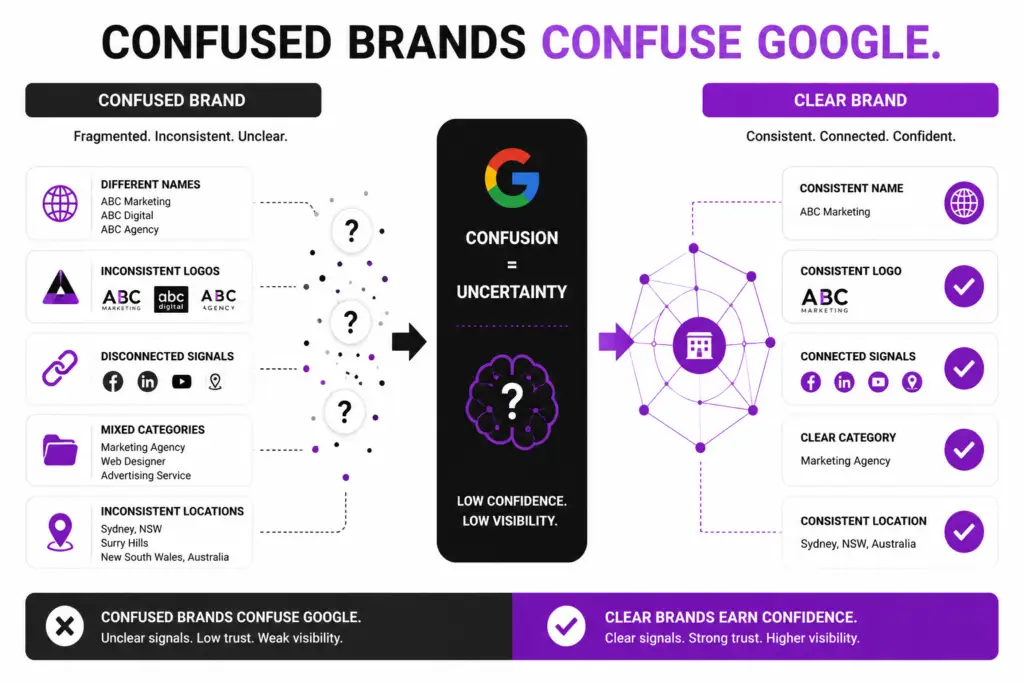
This is probably one of the simplest ways to explain brand presence.
Confused brands confuse Google.
Not because Google is unintelligent.
But because inconsistent signals create friction.
A business might describe itself differently everywhere.
Different service descriptions.
Different categories.
Different positioning.
Different messaging.
Disconnected profiles.
Unclear topical focus.
From a human perspective, that already creates confusion.
From a machine understanding perspective, it becomes even harder.
Because search systems increasingly rely on corroboration.
They look for repeated evidence.
Repeated identity.
Repeated association.
If one platform positions a business one way while another suggests something completely different, confidence weakens.
That doesn’t automatically mean rankings disappear overnight.
But it does create friction in understanding.
And modern search increasingly behaves like a system built around understanding.
This becomes especially important in local SEO.
A lot of businesses still treat local optimisation like a directory exercise.
But underneath that, local search is really about consistency and identifiable brand presence.
Can search systems confidently connect:
- the business
- the location
- the services
- the category
- the reputation
- the surrounding ecosystem signals
into one coherent entity?
That’s the real question.
And honestly, this feels increasingly relevant as AI search grows.
Because recommendation systems depend heavily on confidence.
If systems struggle to consistently understand what a business is, uncertainty increases.
And uncertainty weakens retrieval.
Your Website Is No Longer Your Entire Search Presence
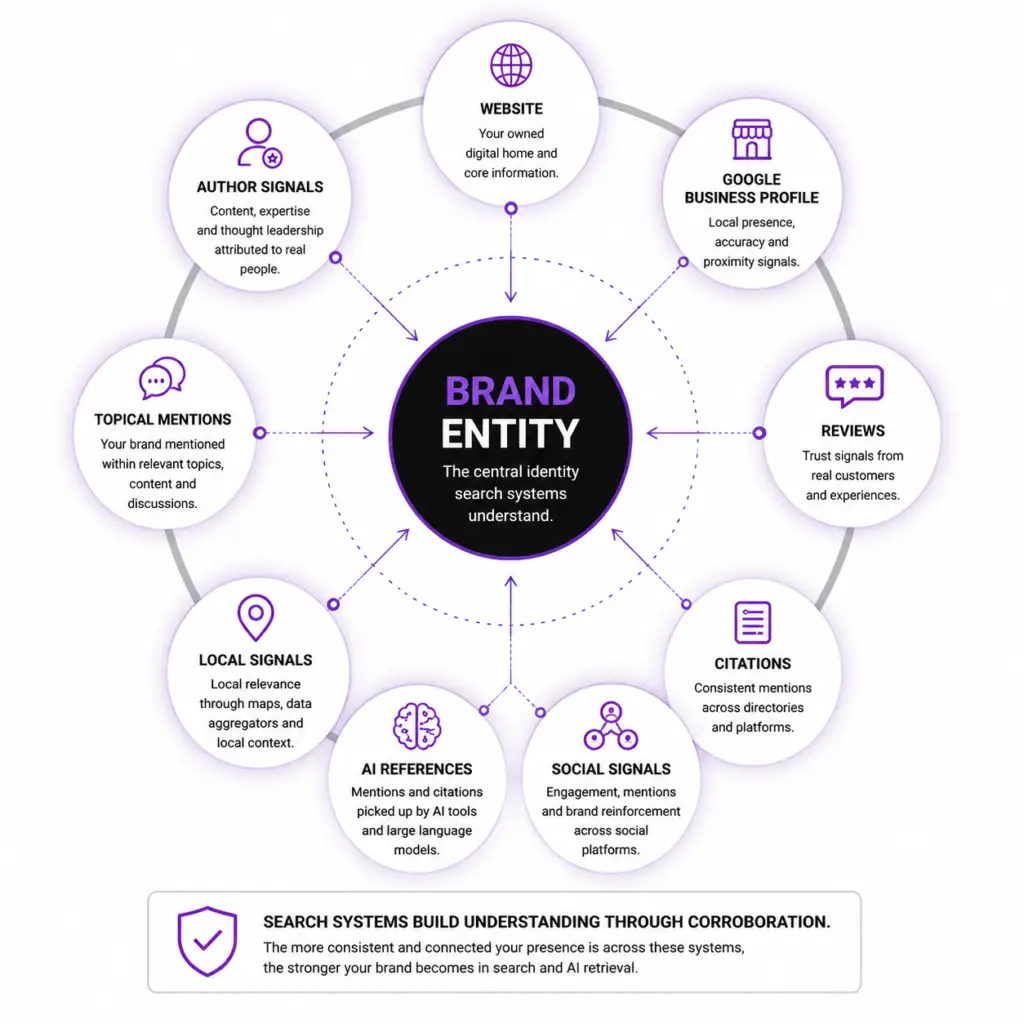
This is probably one of the most important shifts happening across modern SEO.
Your website still matters enormously.
But it’s no longer the entire visibility equation.
Search visibility now extends across a much wider ecosystem.
That includes:
- local platforms
- social profiles
- industry mentions
- review platforms
- podcasts
- author visibility
- video content
- AI references
- business citations
- topical co-occurrence
The wider ecosystem increasingly reinforces search understanding.
That’s why some businesses feel “known” online.
Even before you click their website.
You’ve seen them mentioned.
You’ve seen them appear repeatedly.
You’ve encountered consistent associations around what they do.
That repeated exposure strengthens familiarity.
And familiarity reduces uncertainty.
This is also why modern SEO increasingly overlaps with branding.
Not branding in the traditional visual identity sense.
But branding in the sense of:
- recognition
- familiarity
- repeated association
- clear positioning
- identifiable expertise
Search systems increasingly rely on those patterns.
AI search especially seems to behave more like recommendation infrastructure than traditional search.
And recommendation systems naturally favour recognisable, corroborated entities.
The brands that get remembered get retrieved.
That feels increasingly true.
Traditional SEO Solved Discoverability
Traditional SEO solved a very important problem.
Discoverability.
Can pages be found?
Can they rank?
Can traffic be generated?
Those things still matter.
But modern search increasingly seems to operate one layer deeper.
Now the challenge is often:
Can search systems confidently understand who you are, what you do and what you should be associated with?
That’s a very different problem.
And it explains why some businesses struggle even after “doing SEO”.
They improve pages.
They optimise titles.
They publish content.
But their wider digital identity remains fragmented.
Weak recognition creates weak reinforcement.
This is where Brand SEO starts becoming strategically useful.
Because it reframes visibility through:
- recognition
- clarity
- trust
- retrieval
- familiarity
- entity understanding
rather than rankings alone.
That doesn’t mean technical SEO becomes irrelevant.
Far from it.
Technical SEO still supports discoverability and machine access.
But increasingly, search visibility also depends on confidence.
And confidence depends heavily on repeated understanding.
Search systems follow confidence.
The more consistently your business appears understood across the ecosystem, the easier it becomes to retrieve confidently.
Presence Is The Foundation Layer
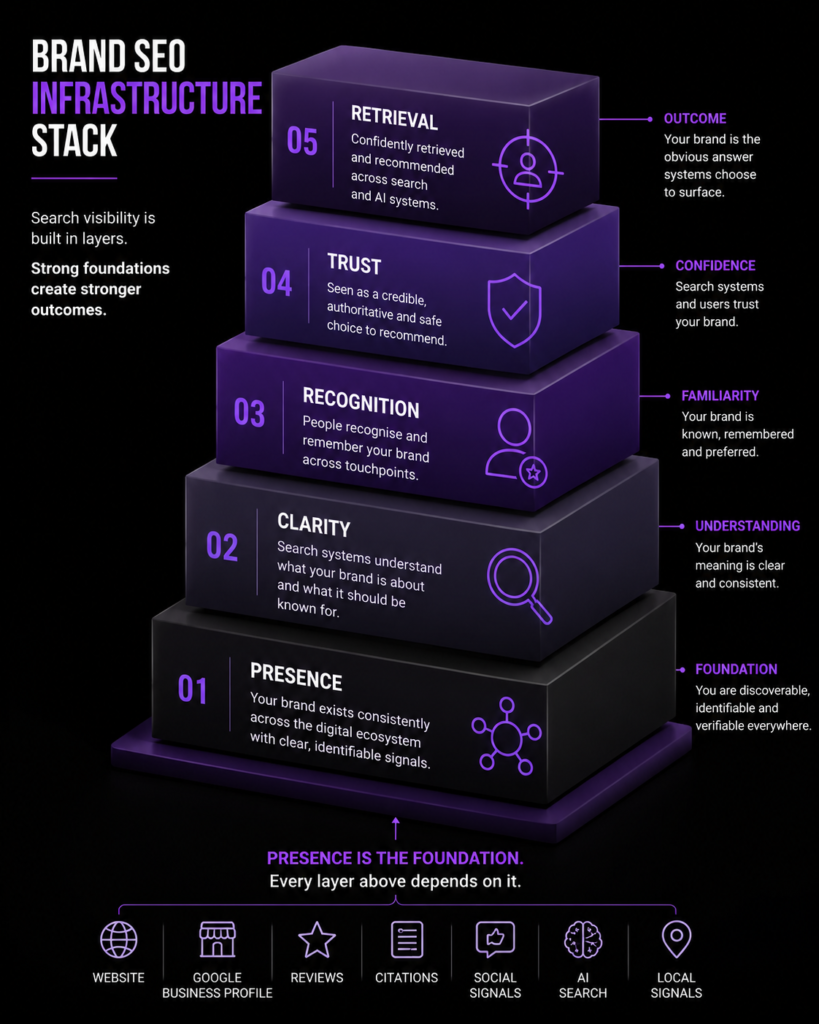
This is why Presence sits at the beginning of the Brand SEO framework.
Because every later phase depends on it.
Presence → Clarity → Recognition → Trust → Retrieval
If search systems struggle to consistently identify a business, everything later becomes weaker.
Clarity becomes inconsistent.
Recognition becomes fragmented.
Trust becomes harder to reinforce.
Retrieval becomes less likely.
Presence creates the infrastructure that allows every later layer to compound.
That’s what makes this phase so important.
And honestly, I think this is one of the biggest shifts happening in modern search.
Visibility increasingly behaves less like isolated ranking mechanics and more like an ecosystem of:
- confidence
- familiarity
- corroboration
- repeated association
- recognisable identity
The businesses that become easiest to consistently understand often become easier to confidently recommend.
That applies across:
- AI search
- local discovery
- recommendation systems
- conversational retrieval
Modern search is increasingly entity-driven.
And entities become stronger through repeated, recognisable presence.
Final Thoughts
Presence is the foundation of Brand SEO because search systems need consistent, identifiable signals before trust, recommendations or retrieval can happen reliably.
Modern search visibility increasingly depends on how clearly a business can be recognised and understood across the wider digital ecosystem.
That includes:
- websites
- local profiles
- citations
- reviews
- mentions
- structured data
- repeated topical associations
The stronger and more consistent those signals become, the easier it becomes for search systems to reduce uncertainty and build confidence around a business.
Search systems follow confidence.
That is why brand presence matters.
Without strong brand presence:
- Clarity becomes fragmented
- Recognition becomes weaker
- Trust becomes harder to reinforce
- Retrieval becomes less reliable
Modern SEO is increasingly entity-driven.
And entities become stronger through repeated, recognisable presence across the wider search environment.
Search visibility no longer lives entirely inside rankings.
It increasingly lives inside recognition, consistency and confidence.