
Search for SEO advice and you will usually see the same cycle repeated. Keyword research. Content production. Backlinks.
None of that is wrong. It still matters.
The problem is that it often ignores the reason people choose one business over another in the first place.
That gap feels much bigger now because search itself is changing. Results are no longer just lists of blue links. AI summaries, featured snippets, review platforms, Reddit discussions, and aggregated recommendations all shape what people see before they ever reach your website.
If your business is not clearly understood across the web, it becomes easier to overlook, even when your pages rank well.
A brand SEO strategy tackles that problem directly. It focuses on positioning, clarity, consistency, and real expertise. The goal is not simply to appear in search results. It is to become recognised and trusted wherever your business shows up.
Summary
What a Brand-Led SEO Strategy Actually Means
A brand-led SEO strategy starts with positioning before optimisation. Instead of asking what people search for first, it asks who you help and what you want to be known for.
SEO then becomes a way to communicate that clearly across your website and beyond it.
That is very different from the more common approach where content is built almost entirely around keyword opportunities. That method can still drive traffic, but it often creates pages that feel interchangeable with everybody else in the search results.
When branding leads the strategy, your content carries a more consistent point of view. It reflects how you think, how you work, and the type of client you are genuinely best suited to help.
That matters more now because search engines are no longer just indexing pages. They are trying to understand context, reputation, expertise, and relationships between topics.
A business with a clear position tends to create clearer signals.
And honestly, most businesses skip this part completely.
Why Traditional SEO Starts To Break Down
Traditional SEO often focuses on scale. More keywords. More pages. More reach.
On paper, that sounds sensible.
In practice, it can dilute your message very quickly.
When a website tries to cover everything, it usually ends up sounding broad and cautious. The content becomes safe. Generic. Difficult to remember.
That creates a problem because users are comparing businesses constantly now. AI search systems are doing the same thing.
They are not simply ranking pages anymore. They summarise, compare, recommend, and interpret information from multiple sources at once.
If your business appears inconsistently across the web, or your positioning feels vague, it becomes harder for those systems to confidently surface your brand.
A brand-led SEO strategy shifts the focus away from pure volume and towards relevance.
Not all traffic carries the same value.
A smaller number of highly relevant visitors will usually outperform large amounts of unfocused traffic. Especially when those visitors already understand what your business stands for before they land on your site.
That part gets overlooked constantly.
Positioning Comes Before Keywords
Before keyword research starts, positioning needs to be clear.
Otherwise SEO becomes reactive.
You end up chasing search terms rather than building a coherent presence.
Positioning is really about defining who you help and where your strongest expertise sits. It is not about listing every possible service you could offer.
For example, saying you provide SEO services for all businesses sounds flexible, but it creates weak signals. It becomes difficult for both users and search engines to understand where your real experience sits.
Now compare that with a business focused on helping local trades generate enquiries through search.
That creates a much clearer foundation.
The topics become more focused. The language becomes more specific. The examples feel more relevant.
Everything starts reinforcing the same message.
This also affects how your business is recognised across platforms.
When your positioning stays consistent, search engines and AI systems find it easier to associate your brand with particular topics and areas of expertise.
That consistency matters far more now than it did a few years ago.
Non-Branded vs Branded Search, How People Actually Find You
Platforms like Search Logistics have shared clear breakdowns of this behaviour, showing how discovery and decision are rarely part of the same search.
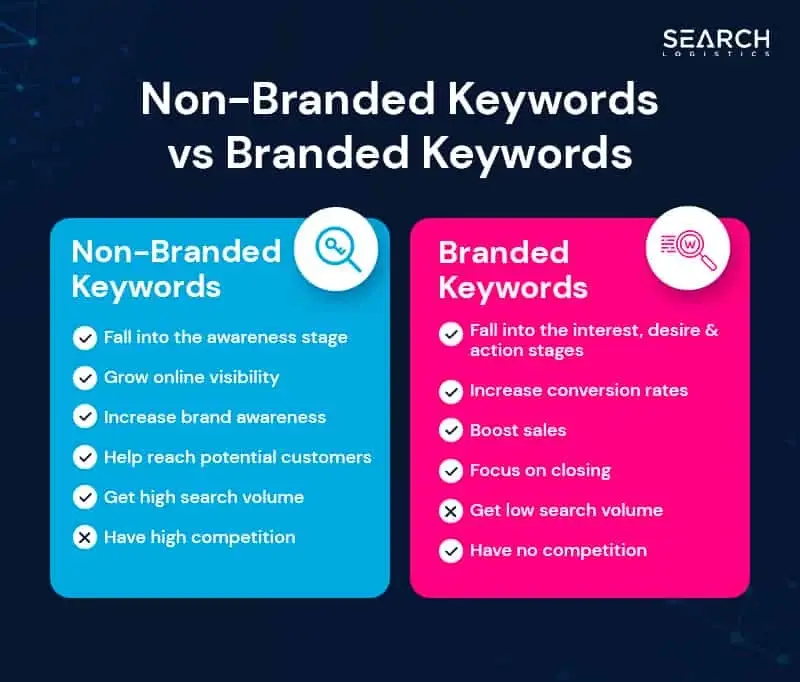
Most SEO strategies become heavily focused on non-branded keywords.
That makes sense because non-branded search is usually where discovery starts.
Someone searches for a problem. They compare options. They explore possible solutions.
At that stage, your goal is visibility.
Branded search happens later.
This is when somebody already knows your business name and actively searches for you directly. Trust is higher at this point, and conversions tend to become much easier.
The important thing is understanding how people move between those stages.
That shift from non-branded discovery to branded search rarely happens by accident.
It usually comes from repeated exposure, consistent positioning, useful content, reviews, recommendations, and familiarity built over time.
This is where a brand-led SEO strategy starts becoming much more powerful.
Instead of only chasing clicks, you are building recognition.
There is a big difference between somebody stumbling across your website once and somebody actively searching for your business by name.
Content Built From Real Experience Carries More Weight
One of the biggest problems with modern SEO content is how detached it feels from actual work.
A lot of articles repeat the same advice in slightly different wording. You can usually tell within a few paragraphs.
The content sounds polished, but empty.
A brand-led approach goes in the opposite direction.
It builds content from genuine experience and real scenarios.
That changes the detail completely.
You can explain why certain decisions were made. What problems came up. What failed. What improved over time.
Those practical details are difficult to fake.
They also make the content more trustworthy because readers can sense when something comes from experience rather than surface-level research.
TOP TIP
“This is where intent becomes important.When your content comes from real client work, you naturally move closer to topics tied to genuine buying intent.”
People searching those topics are often looking for solutions, not just information.
That keeps your content aligned with your actual services instead of drifting into broad traffic-focused publishing.
It also matters more in AI-driven search.
AI systems increasingly pull information from forums, discussions, reviews, and multiple content sources at once. Content grounded in real experience tends to align better with those signals because it reflects practical understanding rather than generic commentary.
Why Brand Entity Matters More In Modern SEO
Search engines increasingly try to understand businesses as entities.
In simple terms, they want to understand your business as a recognisable thing with clear attributes.
Your name, services, expertise, reputation, reviews, and mentions across the web all contribute to that understanding.
A brand-led SEO strategy strengthens those signals by keeping them consistent.
Your website is only one part of the picture.
The rest comes from how your business appears elsewhere.
That includes review platforms, Reddit discussions, testimonials, local citations, podcasts, interviews, social profiles, and industry mentions.
All of those help build a clearer picture of who you are and what your business is associated with.
And people do check these things.
Most users naturally look beyond a company website before making decisions now. They search reviews. They compare opinions. They look for outside validation.
Some of the most commonly used UK review platforms include:
– Trustpilot
– Feefo
– Reviews.io
– Yell
– Checkatrade
– Rated People
– Google Reviews
– Tripadvisor
– Glassdoor
– Which? Trusted Traders
None of these platforms exist in isolation anymore. Together, they help shape how your brand is understood.
Real-World Signals Matter More Than They Used To
In the past, SEO could rely heavily on on-page optimisation and backlinks.
That alone is no longer enough.
Real-world signals now play a much bigger role in how businesses are interpreted online.
When people discuss your company on forums, leave reviews, recommend you to others, or mention your work publicly, it creates a broader picture of credibility.
That picture matters because AI systems increasingly rely on aggregated signals.
And users do too.
Most businesses highlight their strongest testimonials on their own websites. There is nothing wrong with that, but people naturally treat it with a bit more caution because they know those examples were selected intentionally.
External reviews feel different.
They feel less controlled.
That is why platforms like Reddit often influence decisions heavily now. People trust conversations that sound honest, even when they are imperfect.
TOP TIP
“External signals are often influenced by your content without people realising it.”
When your content has a clear perspective and practical value, it becomes easier for people to reference, remember, and discuss your business.
That leads to more mentions, more recognition, and stronger topic association over time.
It also helps search engines connect your brand with particular areas of expertise.
Consistent language and positioning create clearer patterns.
That supports visibility both in traditional search and in AI-generated responses.
The Brand Visibility Pyramid
The Brand Visibility Pyramid is not just about awareness.
It reflects how effort and return change as recognition grows.
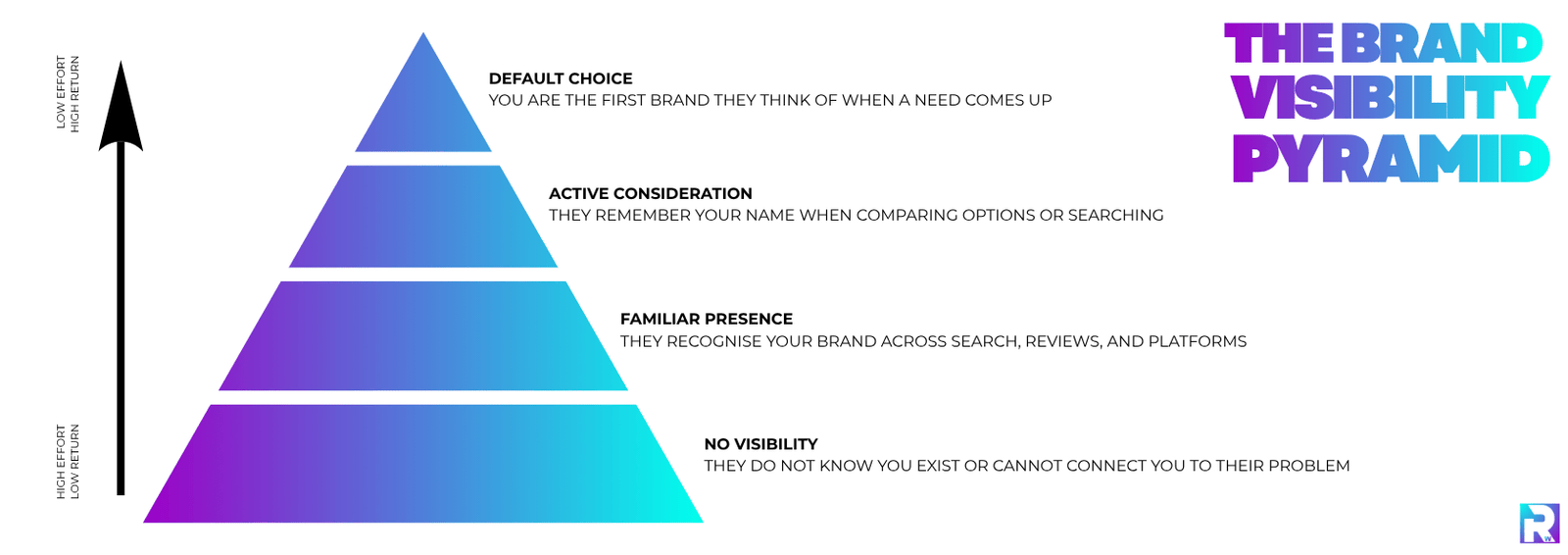
At the lower levels, most businesses spend their time trying to be seen.
They publish constantly, push for rankings, and rely heavily on active outreach.
Results can feel inconsistent because every lead requires fresh effort.
As recognition grows, the dynamic changes.
People begin arriving with context already in place. They have seen your business mentioned before. They recognise your name from reviews, recommendations, content, or discussions elsewhere online.
That familiarity reduces friction.
At the highest level, visibility starts working in your favour.
Search becomes less about aggressively chasing rankings and more about reinforcing an existing presence.
Visitors are no longer discovering you for the first time.
They are confirming a decision they have already started making.
That usually leads to:
- Higher conversion rates
- Shorter decision cycles
- More direct enquiries
In practical terms, SEO starts feeling very different at this stage.
Instead of relying entirely on constant content output, your broader presence continues supporting visibility over time.
Reviews, mentions, past articles, discussions, and brand familiarity all keep contributing.
This matters even more with AI search.
Systems are naturally more confident recommending businesses that appear consistently across multiple trusted sources.
The shift is subtle, but important.
At the bottom of the pyramid, you work to be noticed.
At the top, people expect to see you.
Depth Usually Outperforms Volume
Publishing more content can feel productive.
That does not automatically mean it is effective.
A stronger approach is often to focus on fewer topics and cover them properly.
Depth creates stronger signals.
It demonstrates expertise, improves trust, and makes your content more genuinely useful.
It also increases the chances of people referencing, sharing, or returning to your work later.
A shallow content strategy usually creates the opposite effect. Lots of pages. Very little substance.
And honestly, AI-generated SEO content has made this problem worse.
There is far more content online now, but much of it says almost exactly the same thing.
TOP TIP
“When you focus on depth, your content naturally becomes more connected.”
Articles begin reinforcing one another rather than competing internally.
That creates a clearer structure for both readers and search engines.
It also strengthens your brand entity over time because your business becomes consistently associated with particular topics and expertise.
The result is usually stronger credibility, not just more indexed pages.
SEO Works Better When It Reflects Your Actual Services
SEO creates much better results when it aligns closely with what your business genuinely offers.
That sounds obvious, but many websites drift away from this.
They publish content designed purely for traffic growth, even when those topics sit far away from their real services.
Eventually the gap becomes noticeable.
The traffic arrives, but conversions stay weak because the audience is not closely aligned with the business itself.
When your positioning, services, content, and external signals all reinforce the same direction, things become much clearer.
Visitors understand what you do.
Search engines understand your relevance.
AI systems find it easier to associate your brand with specific solutions.
That alignment reduces friction and makes decision-making easier for potential clients.
Measuring The Right Things
It is easy to become obsessed with rankings and traffic.
Those metrics still matter.
They just do not tell the full story anymore.
A brand-led SEO strategy looks at broader signals.
Engagement shows how useful your content actually is.
Enquiry quality shows how relevant your audience is becoming.
Branded search growth shows recognition building over time.
You can also look at:
– Review volume
– External mentions
– Referral traffic from discussions or communities
– Repeat visitors
– Direct searches for your business name
These signals often reveal far more about long-term visibility than rankings alone.
Because ultimately, the goal is not simply to attract attention.
It is to become remembered.
Brand SEO FAQs
What is a brand-led SEO strategy?
A brand-led SEO strategy starts with positioning and expertise before keyword targeting. Instead of chasing broad traffic opportunities, it focuses on topics closely connected to your services, audience, and real experience.
How does AI search affect SEO?
AI search pulls information from multiple sources at once. That means consistent branding, reviews, mentions, and clear positioning all influence how visible your business becomes in generated answers.
What is a brand entity in SEO?
A brand entity is how search engines recognise your business across your website, reviews, mentions, and wider reputation signals. The stronger and more consistent those signals are, the clearer your business becomes to search systems.
Do reviews affect SEO?
Reviews influence trust directly, but they also contribute to broader visibility signals. Consistent external feedback helps search engines and AI systems build confidence around your business reputation.
Is this useful for local businesses?
Yes. Local businesses often benefit heavily because reviews, local mentions, community reputation, and real-world experience play a major role in visibility and conversion.
How This All Fits Together
A brand-led SEO strategy creates alignment between your positioning, content, reputation, and visibility.
That alignment matters much more now because search is becoming increasingly contextual.
Visibility depends less on isolated rankings and more on how clearly your business is understood across multiple sources.
By focusing on positioning, real expertise, consistent messaging, and stronger external signals, you build something more durable than rankings alone.
You build recognition.
And recognition usually leads to better enquiries, stronger trust, and more reliable growth over time.
If you want to build a brand-led SEO strategy that reflects your expertise properly and improves how your business is understood across search, get in touch. A more focused approach usually creates far stronger long-term visibility than simply publishing more content for the sake of it.