

Most businesses still think brand trust mainly affects conversions.
Reviews help people feel comfortable. Testimonials help businesses look credible. A strong reputation helps customers choose faster.
That part is obvious.
The part many businesses miss is that trust now affects visibility itself.
Modern search systems are constantly trying to reduce risk.
Google wants to surface businesses that feel reliable. AI tools are far more likely to pull from sources that already look established and credible. Local platforms usually lean toward businesses with stronger reputations and more visible customer validation.
That changes how brand trust works inside SEO.
Trust is no longer sitting separately from visibility.
It increasingly shapes:
- recommendation confidence
- local visibility
- click behaviour
- branded search
- engagement patterns
- AI retrieval
- repeat exposure
- discoverability across platforms
Within the Brand SEO framework, Trust sits after:
Presence → Clarity → Recognition
That progression matters.
Presence helps search systems identify a business.
Clarity helps systems understand what the business should be known for.
Recognition creates familiarity.
Brand trust affects how comfortable platforms are surfacing a business again and again.
That distinction feels increasingly important.
Because modern search increasingly behaves less like a simple ranking system and more like recommendation infrastructure.
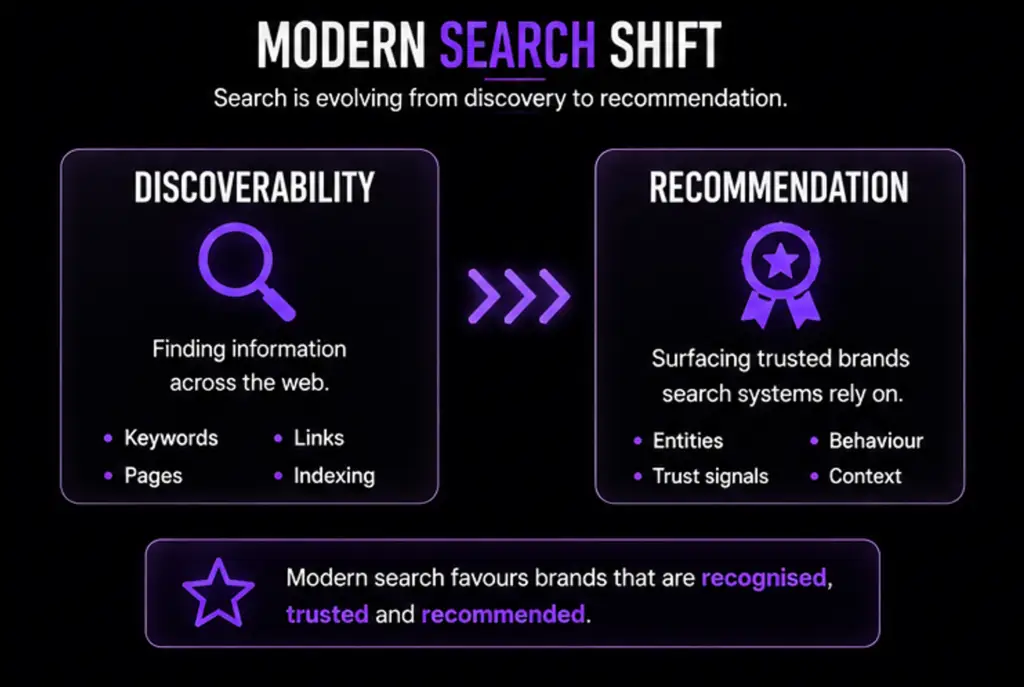
And recommendation systems naturally prefer lower-risk choices.
Summary
- Brand trust increasingly influences visibility, not just conversions
- Search systems favour businesses that appear reliable, validated and safe to recommend
- Reviews, reputation, expertise signals and third-party mentions all reinforce recommendation confidence
- Trust reduces uncertainty for both users and search systems
- Businesses with stronger trust signals often become easier to surface across Google, AI search and local discovery
Search Systems Try To Reduce Recommendation Risk
This is probably the most important idea underneath modern search trust.
Search systems are constantly trying to reduce uncertainty.
Not emotionally.
Structurally.
Google does not simply want relevant results.
It wants results that feel dependable.
That becomes especially important when search systems are effectively making recommendations.
If somebody searches for:
- a local accountant
- a financial adviser
- a dentist
- a legal service
- a software platform
…Google is not only evaluating relevance.
It is also trying to understand:
“Is this business likely to satisfy the user?”
That changes the role brand trust plays inside visibility.
Businesses that appear:
- credible
- reputable
- experienced
- consistently reviewed
- positively discussed
- validated by others
…often feel safer to recommend.
Familiarity and trust heavily influence how people make decisions online.
Research from the Edelman Trust Barometer has repeatedly shown that credibility and brand trust significantly shape behaviour long before conversions happen, which increasingly overlaps with how modern search systems evaluate confidence and recommendation quality.
That is why brand trust signals increasingly overlap with visibility itself.
Not because Google has human emotions.
Because recommendation systems naturally try to avoid poor outcomes.
If a business sends mixed signals online, platforms become far less comfortable pushing it heavily.
That feels increasingly visible across:
- local SEO
- AI search
- Maps
- review platforms
- conversational search
- recommendation-driven discovery
Search systems follow confidence.
And brand trust helps create that confidence.
Recognition And Brand Trust Are Not The Same Thing
This is where a lot of SEO conversations become blurred.
Recognition and brand trust overlap heavily.
But they are not identical.
A business can be recognised without being trusted.
And a business can have credibility within a smaller audience without being widely recognised.
Recognition answers:
“Have people and systems encountered this business repeatedly?”
Trust answers:
“Do people and systems believe this business is reliable?”
That distinction matters strategically.
Recognition creates familiarity.
Brand trust is really external proof.
It shows the business is believable beyond its own marketing.
One helps people remember you.
The other helps people feel comfortable choosing you.
Google seems to look at both now.
This is one reason many highly visible businesses do not simply have:
- strong websites
- strong rankings
- strong optimisation
They also tend to have:
- stronger reputations
- more reviews
- more third-party mentions
- clearer expertise signals
- more ecosystem validation
- repeated recommendation patterns
Brand trust is not just about being known.
It is about being validated.
That feels like a very important shift in modern SEO.
Brand Trust Signals Are Everywhere Now
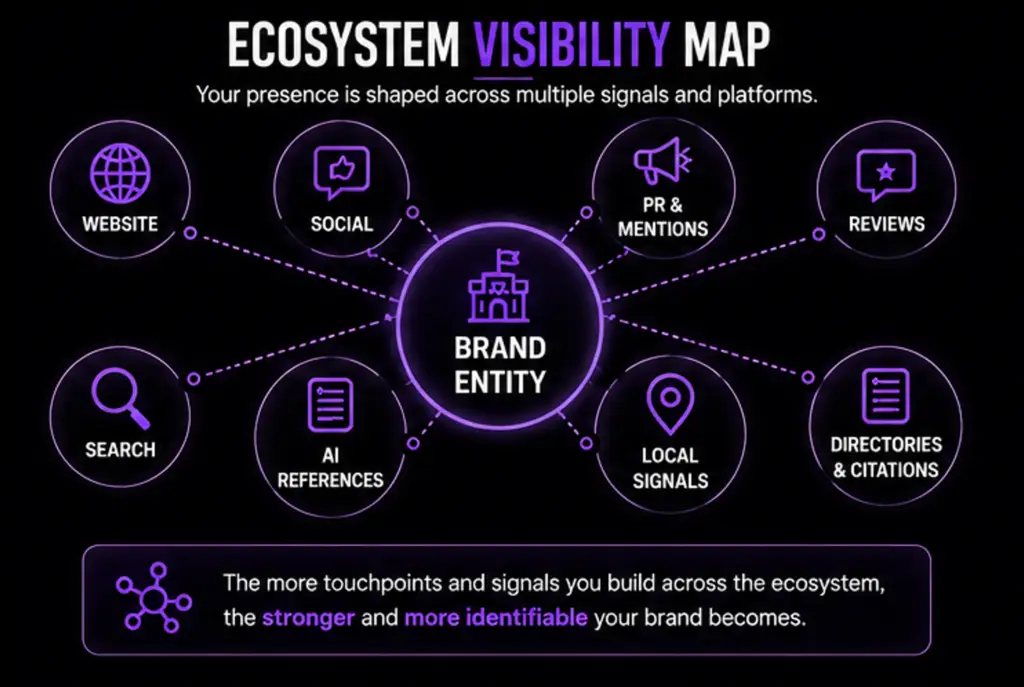
One of the biggest mistakes businesses make is assuming trust lives only on their own website.
It does not.
Trust signals now sit everywhere online.
Google looks for repeated confirmation.
In other words, search systems look for repeated validation across multiple environments.
That includes things like:
- Google reviews
- Trustpilot reviews
- industry directories
- backlinks
- media mentions
- expert citations
- podcast appearances
- creator recommendations
- case studies
- customer sentiment
- local reputation
- branded searches
- author credibility
- social proof
- repeated topic association
On the surface these often feel like separate marketing conversations.
But underneath, they all help answer the same question:
“Does this business appear trustworthy?”
That is the deeper pattern.
A business claiming expertise about itself is easy.
A wider ecosystem reinforcing that expertise is much harder to fake.
And that is where trust becomes significantly more powerful.
The more consistently a business appears:
- recommended
- reviewed
- referenced
- discussed positively
- validated independently
- associated with expertise
…the easier it becomes for search systems to reduce uncertainty around that business.
That is why brand trust increasingly extends beyond websites alone.
The wider ecosystem matters.
Why Reviews Matter Beyond Conversion Rates
Most businesses still think reviews mainly influence customer decisions.
They absolutely do.
But reviews increasingly influence search visibility as well.
Especially within local search.
A business with:
- strong review volume
- recent reviews
- detailed reviews
- repeated positive sentiment
- consistent engagement
…creates stronger trust reinforcement.
Not just for customers.
For search systems too.
That becomes particularly important because reviews contain:
- behavioural signals
- service associations
- topical relevance
- location reinforcement
- repeated credibility indicators
They also create something very important:
corroborated experience.
The business is no longer describing itself.
Customers are validating the experience independently.
That reduces uncertainty.
And uncertainty reduction increasingly sits underneath modern search visibility.
This is partly why businesses with stronger reputations often feel more dominant online.
Not purely because of rankings.
Because stronger trust signals create stronger recommendation confidence.
Google Increasingly Looks For Corroboration
One of the clearest patterns across modern search is corroboration.
Google increasingly appears to build confidence through repeated agreement across the ecosystem.
That means isolated optimisation is often weaker than reinforced validation.
For example:
If a business claims:
- expertise
- authority
- reputation
- service quality
…Google increasingly looks for supporting signals elsewhere.
That could include:
- review platforms
- local citations
- industry sites
- media references
- creator mentions
- backlinks
- expert discussions
- branded search behaviour
- entity associations
This is one reason digital PR and reputation increasingly overlap with SEO.
Search systems seem to trust corroborated information more than isolated self-promotion.
Honestly, this is where many businesses struggle.
They focus heavily on optimising pages while ignoring ecosystem reputation.
But modern visibility increasingly depends on how the wider web reinforces your credibility.
That feels especially true inside AI search.
AI systems increasingly retrieve:
- trusted entities
- repeated expertise
- corroborated information
- recognised sources
- validated associations
The brands that get remembered get retrieved.
But increasingly, the brands that get validated get retrieved more confidently.
Expertise Has Become More Visible
Another major shift is how visible expertise has become across search.
Years ago, many businesses could compete online with relatively thin authority.
That feels much harder now.
Modern search increasingly rewards demonstrated expertise.
Not just claimed expertise.
There is a big difference.
Demonstrated expertise looks like:
- useful educational content
- visible specialists
- expert commentary
- industry discussion
- public-facing knowledge
- consistent topical depth
- creator visibility
- recognised authorship
- repeated contribution
This is partly why personal brands increasingly influence business visibility.
People trust people.
Search systems increasingly observe those trust patterns.
A recognised expert discussing a topic repeatedly creates:
- stronger topic association
- stronger credibility reinforcement
- stronger trust signals
- stronger retrieval probability
That does not mean every business needs a founder-led content strategy.
But it does mean invisible expertise is becoming less effective.
Search systems increasingly favour businesses that visibly demonstrate knowledge and credibility over time.
Brand Trust Influences Click Behaviour Too
This part gets overlooked constantly.
Trust does not only influence rankings.
It influences behaviour.
And behaviour feeds back into search visibility.
People naturally click businesses that feel safer.
That safety often comes from things like:
- familiar reviews
- recognisable branding
- visible expertise
- professional presentation
- recommendation patterns
- social proof
- positive reputation
If users repeatedly choose one business over another, search systems observe those patterns.
Repeated engagement becomes another form of reinforcement.
This is one reason weak trust signals can quietly damage visibility over time.
Even if the SEO fundamentals appear solid.
Businesses sometimes focus entirely on:
- rankings
- traffic
- optimisation
…while ignoring the credibility layer affecting user behaviour underneath.
But visibility and trust increasingly reinforce each other.
Trust improves engagement.
Engagement reinforces confidence.
Confidence strengthens visibility.
Recognition compounds.
AI Search Makes Trust Even More Important
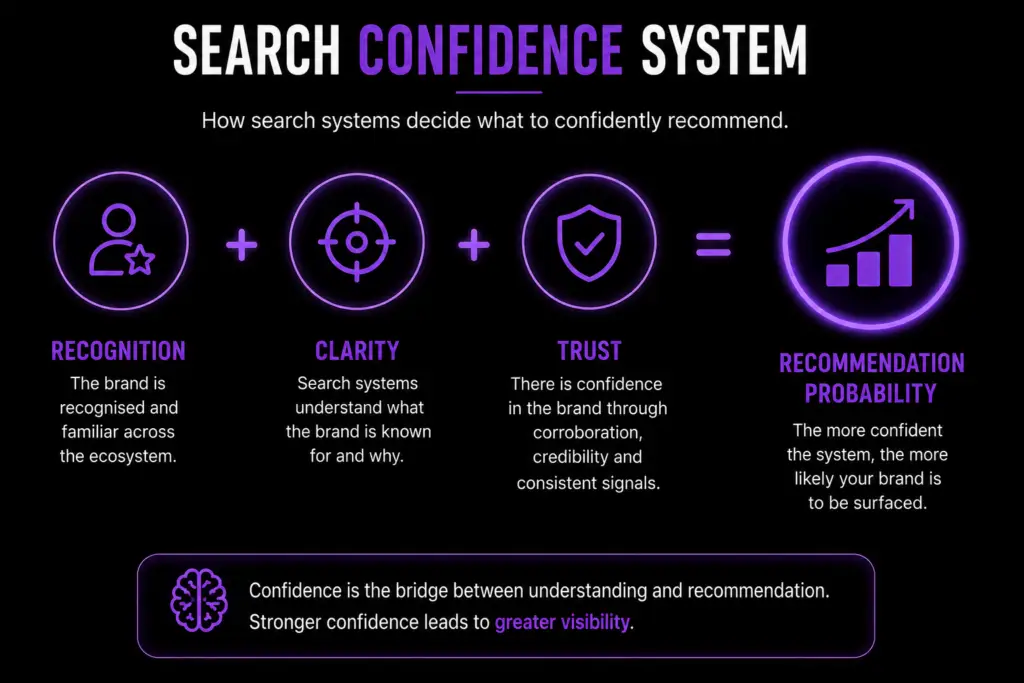
This shift becomes even more obvious inside AI search.
AI systems increasingly behave like retrieval and recommendation engines.
They are trying to surface answers that appear:
- credible
- useful
- corroborated
- safe
- widely reinforced
That naturally increases the importance of trust.
Because retrieval systems depend heavily on confidence.
The more consistently a business appears associated with:
- expertise
- positive reputation
- repeated mentions
- third-party validation
- trusted information
…the easier it becomes for AI systems to confidently reference that business.
This is one reason modern SEO increasingly overlaps with:
- reputation
- authority
- visibility beyond websites
- ecosystem presence
- creator influence
- public expertise
The future of SEO is retrieval.
And retrieval increasingly depends on trust.
Final Thoughts
Modern search systems increasingly try to reduce recommendation risk.
Brand trust matters because trust lowers uncertainty.
Businesses that appear:
- credible
- validated
- reputable
- consistently reinforced
- associated with expertise
…often become easier for search systems to confidently surface.
That visibility now extends beyond traditional rankings alone.
It increasingly influences:
- Google visibility
- AI retrieval
- local discovery
- conversational search
- recommendation systems
- branded search behaviour
Trust should no longer be viewed as a separate branding concept sitting outside SEO.
It increasingly shapes visibility itself.
That is why modern SEO now overlaps so heavily with:
- reputation
- social proof
- authority
- corroboration
- expertise
- recommendation confidence
- repeated validation
Search systems follow confidence.
And trust is one of the strongest ways businesses build that confidence over time.