Getting your website cited in an AI answer sounds like a win.
Your content has been found, understood and used as a source. From an SEO point of view, that’s clearly valuable.
But there’s a problem.
Your website can be cited while your brand gets forgotten.
Summary
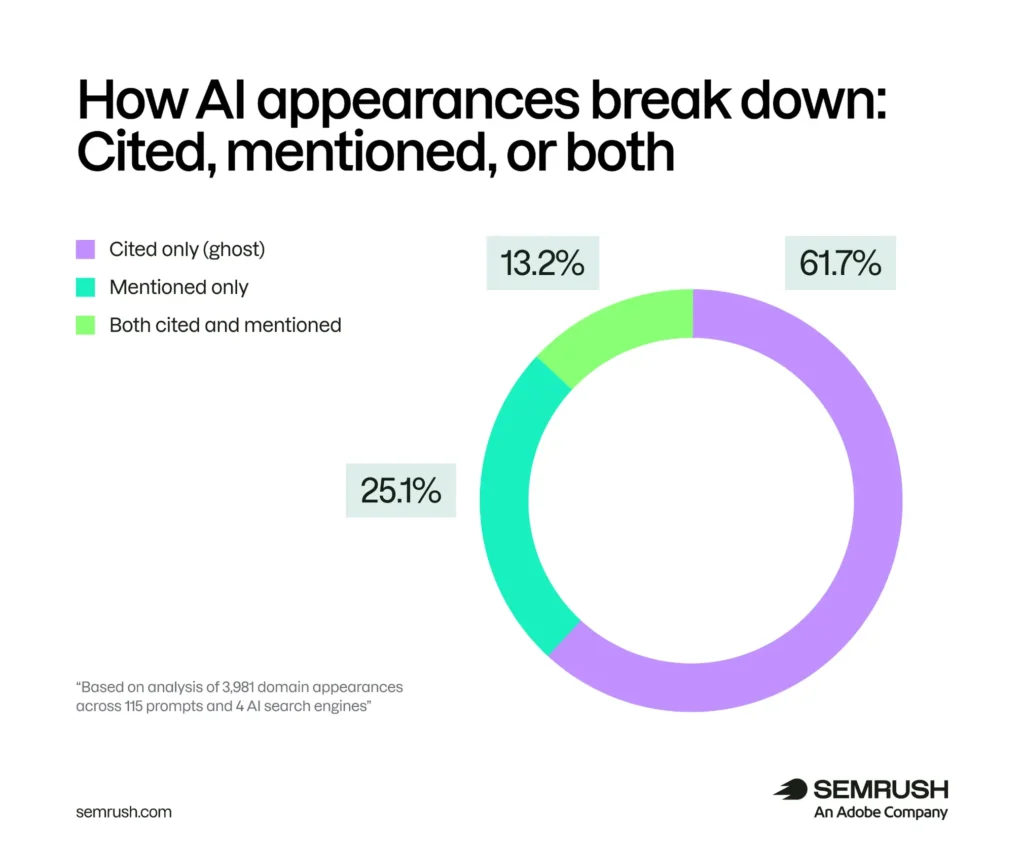
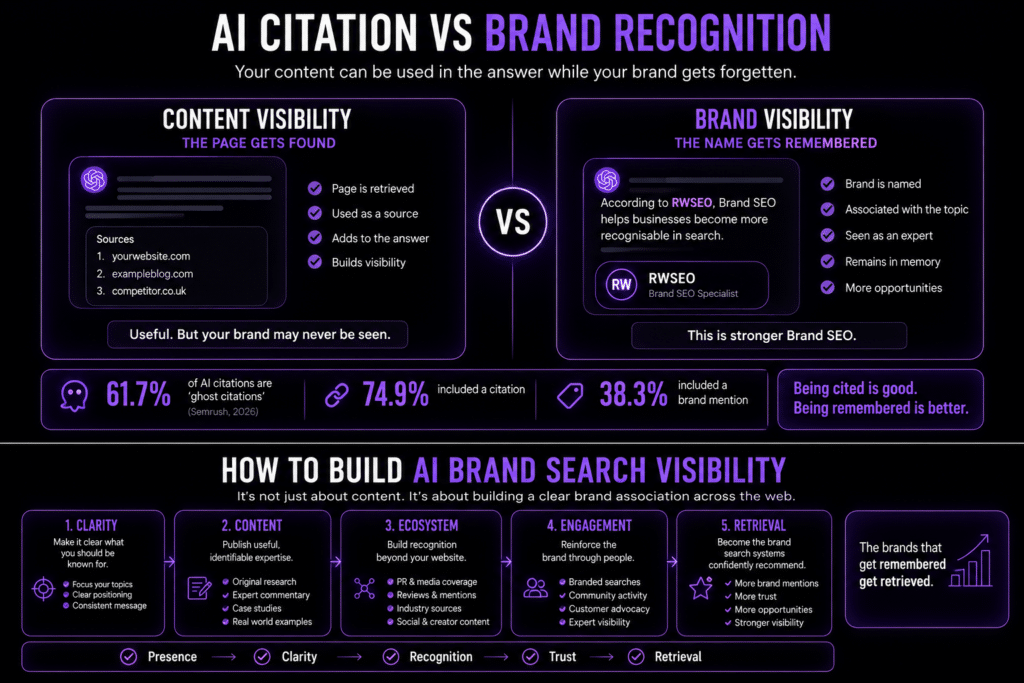
Recent research from Semrush found that 61.7% of citations in its study were what it calls ghost citations. The AI used a page as a source, but the brand itself wasn’t mentioned in the answer. Across the study, 74.9% of brand appearances included a citation, while only 38.3% included an actual brand mention.
That’s an important distinction for AI Brand Search Visibility.
Because getting your content into the answer and getting your brand into the answer aren’t necessarily the same thing.
And if we’re talking about Brand SEO, we should be measuring both.
What is a ghost citation?
A ghost citation happens when an AI search system uses your website as a source but doesn’t name your brand in the answer.
Imagine you’ve published a detailed guide based on your experience.
Someone asks ChatGPT or another AI search system a question related to it. Your page gets retrieved and contributes to the response.
Your website appears somewhere amongst the citations.
But the answer doesn’t mention your business.
The information made it through.
The brand didn’t.
Semrush’s study, carried out with Kevin Indig, looked at 3,981 domain appearances across 115 prompts, 14 countries and four AI search experiences: ChatGPT, Gemini, Google AI Overviews and Google AI Mode. Ghost citations accounted for 61.7% of the appearances they analysed.
That doesn’t make the citation worthless. Far from it.
But it does mean we need to separate content visibility from brand visibility.
Being cited isn’t the same as being recognised
SEO has traditionally been quite page-focused.
Where does the page rank?
How many impressions does it receive?
How much organic traffic does it generate?
Which queries bring people to it?
AI search introduces another layer because the user doesn’t always need to visit the page. The system can retrieve information from several sources and use that information to construct its own response.
So your content can be part of the answer without your brand becoming part of the user’s memory.
That’s where this becomes a Brand SEO issue.
There is a meaningful difference between a search system understanding:
“This page contains useful information about this topic.”
and:
“This brand is strongly associated with this topic.”
The first is useful content.
The second is recognition.
Ideally, we want both.
AI Brand Search Visibility needs a wider definition
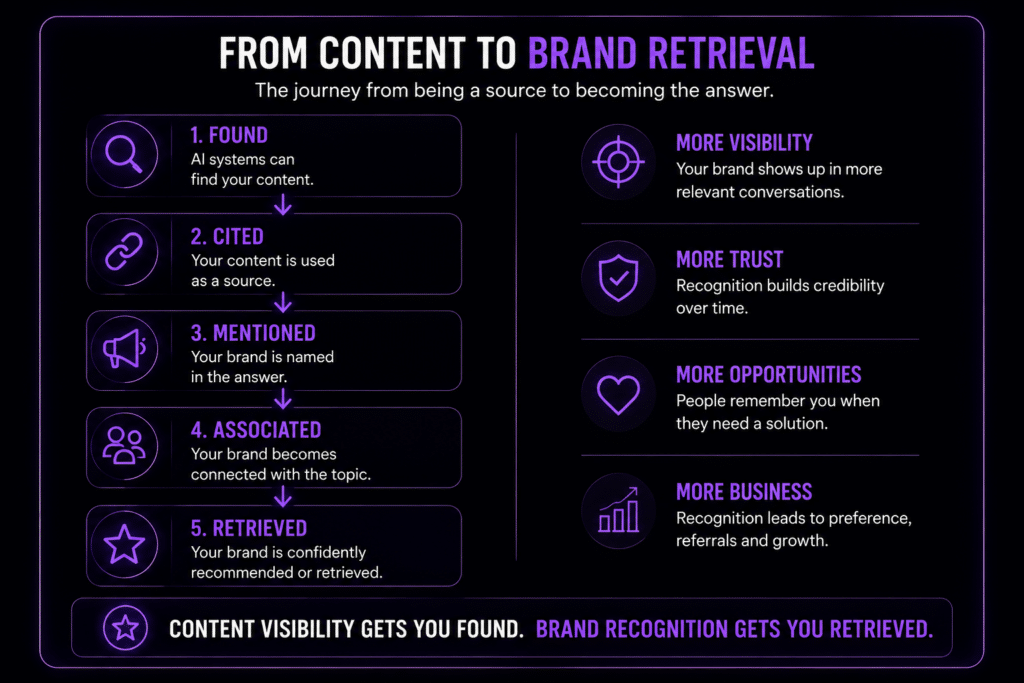
If we measure AI visibility purely by citations, we could get a misleading picture.
Imagine your website is being cited regularly. Your AI visibility report looks fantastic.
Then you start checking the actual answers and discover your brand is barely mentioned.
Are you visible?
Technically, yes.
Is your brand visible?
Not nearly as much as the citation numbers suggest.
A better way to think about AI Brand Search Visibility is as a progression:
Found → Cited → Mentioned → Associated → Retrieved
First, can AI systems find your content?
Then, do they use it as a source?
Do they actually name your brand?
Do they associate your brand with the subject?
And when someone asks for a business, product, expert or recommendation in your category, does your brand get retrieved?
Those are different levels of visibility.
A lot of AI SEO discussion currently stops around the second stage.
“How do we get cited?”
It’s a useful question. It just isn’t the only one.
For Brand SEO, the later stages become much more interesting.
Different AI systems treat brands differently
Another useful finding from the Semrush research is that AI platforms don’t behave in exactly the same way.
In the study, Gemini mentioned brands in 83.7% of appearances but generated a citation in only 21.4%.
ChatGPT showed almost the opposite behaviour, with an 87% citation rate and a 20.7% brand mention rate. Semrush also found very little overlap between the brands ChatGPT cited and the brands Gemini named for the same prompts.
So saying:
“We’re visible in AI search.”
doesn’t tell us much on its own.
Visible where?
Are you being cited?
Are you being named?
Are you appearing for informational questions?
Are you appearing when people ask for recommendations?
Those are much better questions.
The study also found that informational queries generated an 89.3% citation rate but only an 18% brand mention rate. Comparative queries produced brand mentions 2.4 times more often than informational queries.
That makes sense.
If someone asks an AI system to explain a concept, it can pull information from several places without needing to make those sources central to the response.
Ask for the best providers, products or options and suddenly brands have to enter the conversation.
The type of visibility changes with the question.
This is where Brand SEO comes in
Brand SEO isn’t simply about putting your company name into more content.
It’s about building a clear relationship between your brand and what you want to be known for.
That relationship needs to exist beyond one page.
For example, imagine you’re an accountancy firm specialising in hospitality businesses.
You could publish hundreds of general articles about tax, bookkeeping and company accounts. Those pages might rank well and some might get cited by AI systems.
But that doesn’t necessarily mean your firm becomes associated with hospitality accounting.
For that to happen, the relationship needs reinforcing.
Your website should make the specialism clear.
Your experts should talk about it.
Your case studies should demonstrate it.
Your original research might explore financial trends in hospitality.
Industry publications might reference you on the subject.
Customers might describe you in similar terms.
Videos, interviews, social content and third-party coverage can reinforce the same relationship.
Now there is a pattern.
Brand + hospitality accounting.
That’s much closer to what we’re trying to build.
Not another isolated page competing for another isolated keyword, but a recognisable relationship between an entity and a subject.
Start measuring mentions, not just citations
This is probably the most practical change businesses can make.
Keep measuring citations.
Just don’t stop there.
Take the prompts and topics that matter commercially and look at what actually happens when your brand or website appears.
Track things such as:
- where your website is cited
- where your brand is actually named
- which topics trigger brand mentions
- which questions trigger citations without mentions
- which competitors are named
- how your brand is described
- where you’re actively recommended
- which AI systems are producing those results
That gives you a much better picture than a single AI visibility score.
You may discover that your website is regularly used for broad informational questions but your brand rarely appears in commercial conversations.
Or you might find that AI systems associate your business strongly with one service while another important part of the business is almost invisible.
That’s useful information because you’re starting to see the gap between what you publish and what your brand is known for.
Look at the topics that cause your name to appear
This is the question I’d pay particular attention to:
What does someone have to ask before the AI mentions your brand?
Try different types of prompts around your market.
Broad informational questions.
Problems customers commonly have.
Comparisons.
Recommendations.
Service questions.
Buying questions.
Then look for patterns.
If you’re constantly cited around a subject but never named, you’ve found a recognition gap.
If competitors are repeatedly named while you’re only appearing as a source, look at the wider signals surrounding those competitors.
What are they known for?
Where are they discussed?
What third-party sites mention them?
Do they have research or resources that people regularly reference?
Are customers discussing them?
Does their positioning remain consistent across the web?
You don’t need to copy what they’re doing. You’re trying to understand why their brand appears to have a stronger association with the topic.
Build content people can associate with you
This is also where generic SEO content starts becoming a problem.
A lot of websites publish content that could belong to almost anybody.
Same advice.
Same statistics.
Same headings.
Same examples.
Take the logo away and you’d struggle to tell which company wrote it.
That content can still be useful. It might rank. It might earn links. It might even get cited by AI.
But what is there for somebody to remember?
Original research can help here.
So can first-hand experience, expert commentary, case studies, proprietary data, genuine opinions and useful frameworks.
Semrush’s ghost citation study is a good example itself. We aren’t just talking about the general idea that citations and mentions differ. We can associate the 61.7% ghost citation figure with Semrush’s research.
The information has a recognisable source.
Businesses don’t all need huge research budgets to do this either.
A local business could analyse common customer questions.
An agency could review patterns across client campaigns.
An accountant could publish anonymised trends.
A trades business could document common problems it sees in older properties.
A software company could analyse how customers use a particular feature.
Useful original information gives other people something to reference and gives the brand something to become known for.
Your website can’t build recognition on its own
There’s another part of this that businesses sometimes miss.
You can tell Google and AI systems what you’re good at all day long.
It’s still you saying it.
Recognition becomes more convincing when other sources reinforce the same thing.
Reviews.
News coverage.
Industry websites.
Podcasts.
Interviews.
Professional profiles.
Relevant directories.
Community discussions.
Creator content.
Partnerships.
None of these should be chased simply because somebody said “brand mentions are a ranking factor”.
That’s far too simplistic.
The point is that your brand exists across an information ecosystem.
If your own website says you’re a specialist in something, your customers say something completely different and the rest of the web barely connects you with the subject at all, the association isn’t particularly strong.
If those signals repeatedly point in roughly the same direction, the picture becomes clearer.
Recognition compounds.
One mention won’t create that.
Repeated, relevant association can.
Don’t try to fix ghost citations by stuffing in your brand name
There’s an obvious shortcut here.
If AI systems aren’t mentioning the brand enough, put the company name everywhere.
That’s not the answer.
Clear attribution is useful. Original research should identify who produced it. Expert commentary should identify the expert. Products and services should be clearly connected with the company behind them.
But repeating your brand name twenty times in an article doesn’t create genuine recognition.
The bigger job is making the association credible.
What is this business known for?
Does its content demonstrate that?
Do other sources reinforce it?
Do customers recognise it for the same thing?
Does the business consistently talk about the subject?
Can search systems find enough evidence to understand the relationship?
That’s a Brand SEO problem, not a keyword-density problem.
From presence to retrieval
The wider Brand SEO framework I use is:
Presence → Clarity → Recognition → Trust → Retrieval
Ghost citations sit neatly inside that progression.
Your content can have presence. AI systems can find it.
It can have enough clarity to be understood and used as a source.
But the brand itself may still lack recognition.
And that’s the interesting bit.
Because the longer-term objective isn’t simply getting more URLs into AI citations.
It’s building enough recognition and trust around the business that its name becomes relevant when somebody asks a question connected with its expertise.
That’s retrieval.
The brand itself becomes part of the answer.
Being the source is valuable. Being remembered is better.
Ghost citations don’t mean AI citations have no value.
They show us that there are different kinds of AI search visibility.
Your content can be found.
It can be cited.
Your brand can be mentioned.
Your brand can become associated with a subject.
And eventually, it can become something search systems retrieve when people ask relevant questions.
That’s why I’d avoid measuring AI Brand Search Visibility with one number.
Look at citations, but look at mentions too.
Look at the topics connected with those mentions.
Look at the language being used around your business.
Look at which competitors get named when you don’t.
Then work on strengthening the relationship between your brand and the subjects you genuinely want to be known for.
Because your website being used as a source is good.
But if nobody remembers who provided the answer, part of the value has been lost.
The brands that get remembered are far more likely to get retrieved.