
Brand SEO isn’t just about helping search engines find your business. It’s about helping people and machines understand it. The B.R.A.N.D. Framework is a practical way to document the knowledge, experience and identity that makes your business recognisable, trusted and easier to retrieve across modern search.
Summary
Artificial intelligence is changing how businesses create content, but the quality of AI output still depends on one thing: how well it understands your business.
That’s where the B.R.A.N.D. Framework comes in.
Rather than relying on better prompts, the framework helps you document the five foundations of your business:
- Beliefs – what your business stands for and the opinions that shape your advice.
- Reputation – the evidence that builds trust, from reviews and case studies to awards and partnerships.
- Audience – who you help, the challenges they face and the language they naturally use.
- Narrative – your tone of voice, messaging and the way your brand communicates.
- Data – the factual knowledge that supports accurate, consistent content.
In this guide, you’ll learn why documenting these five areas helps AI produce better content, improves consistency across your marketing and supports a stronger Brand SEO strategy. We’ll also look at why modern search is becoming less about optimising pages and more about helping search systems understand the businesses behind them.
By the end, you’ll have a practical framework for creating a documented understanding of your business that benefits your team, your customers and the AI tools you use every day.
AI doesn’t have a content problem. It has a context problem.
If you’ve spent any time using AI to create content, you’ve probably experienced both extremes.
Sometimes it produces something genuinely useful. It sounds natural, stays on topic and saves you a considerable amount of time.
The next prompt, though, feels completely different.
The tone changes.
The messaging becomes generic.
It starts using phrases you’d never say.
You find yourself rewriting most of it anyway.
The obvious reaction is to blame the prompt.
Maybe it wasn’t detailed enough.
Maybe another AI model would have performed better.
Maybe there’s a prompt template you haven’t discovered yet.
I’m starting to think that’s the wrong question.
The real issue isn’t prompting.
It’s context.
AI doesn’t know your business.
It doesn’t know why customers choose you instead of a competitor.
It doesn’t know what your company believes, how your team communicates or what your customers regularly ask before making a purchase.
It doesn’t know the stories you’ve told for years, the lessons you’ve learned, or the opinions that shape the advice you give every day.
Unless you tell it.
Without that context, AI does exactly what it has been trained to do.
It predicts.
It fills in the gaps using patterns it has seen elsewhere.
That’s why so much AI-generated content feels technically correct but strangely forgettable.
It isn’t missing information.
It’s missing understanding.
Your business knows more than AI ever will
Here’s something I don’t think gets discussed often enough.
Every business already has an incredible amount of knowledge.
The problem is that most of it isn’t written down.
Some of it lives inside your website.
Some of it sits in proposals you’ve sent to clients over the years.
Some of it is hidden inside customer emails.
Your sales team knows things your marketing team doesn’t.
Your support team hears the same objections every week.
Your founder can explain the business in a way nobody else can.
Your longest-serving employee knows why certain decisions were made years ago.
Collectively, that’s your business knowledge.
Unfortunately, it’s usually scattered across dozens of places.
Humans are remarkably good at connecting those pieces together.
AI isn’t.
If the information isn’t available, it can’t use it.
That’s usually where businesses go wrong.
They expect AI to understand a company they’ve never properly documented themselves.
The prompt isn’t the asset
For the last couple of years, prompt engineering has dominated the conversation around AI.
There are thousands of articles explaining how to write better prompts.
There are libraries full of templates.
There are videos promising the “perfect prompt”.
Some of them are genuinely useful.
But I think we’ve become a little distracted.
A prompt is temporary.
Business understanding is permanent.
A prompt helps with one conversation.
A documented understanding of your business improves every conversation.
That’s a completely different asset.
It helps AI produce more consistent content.
It helps new employees understand the business more quickly.
It gives marketing, sales and customer support a shared reference point.
It reduces mixed messages.
It saves time.
Most importantly, it creates consistency.
And consistency is becoming one of the most valuable assets a business can have.
Search is becoming a confidence engine
This is where the conversation becomes much bigger than AI.
Traditional SEO largely focused on helping search engines discover pages.
Modern search feels increasingly focused on understanding businesses.
Think about how many signals search engines can now analyse.
Your website.
Reviews.
Business profiles.
Videos.
Social media.
Mentions on other websites.
Articles.
Podcasts.
Authors.
Customer feedback.
Questions people ask.
Images.
Local citations.
None of these exist in isolation.
Together, they build a picture of your business.
The question search systems are trying to answer isn’t simply:
“Should this page rank?”
It’s increasingly becoming:
“What should this business be recognised for?”
That feels like an important shift.
The clearer your business is about its expertise, values and positioning, the easier it becomes for search systems to associate your brand with particular topics.
Recognition compounds.
The brands that get remembered become easier to retrieve.
That’s one of the reasons Brand SEO has become such an important part of modern search.
It’s no longer just about optimisation.
It’s about understanding.
Better understanding creates better recommendations
This idea isn’t unique to Google.
It’s becoming increasingly relevant across AI search as well.
Recently, SEO consultant Joe Hall observed that AI search isn’t replacing SEO. Instead, it’s increasing the importance of clarity, usefulness and genuine expertise.
I think that’s exactly right.
AI doesn’t reduce the value of expertise.
It increases the value of documenting it.
If your knowledge remains scattered across people’s memories, disconnected documents and years of experience, AI has very little to work with.
The same applies to search systems trying to understand what your business should be recommended for.
The businesses that consistently present clear, corroborated information create less uncertainty.
Search systems follow confidence.
Confidence grows when information is consistent.
That led me to one simple question
If AI performs better when it understands a business…
And search systems build confidence by recognising consistent information…
Why aren’t businesses documenting themselves in a structured way?
Most have brand guidelines.
Some have tone-of-voice documents.
Others have product catalogues or knowledge bases.
Almost nobody has a single document that explains the business as a whole.
Not just what it sells.
But what it believes.
Who it serves.
How it communicates.
Why people trust it.
And the knowledge it has built over years of experience.
That feels like a missing piece.
So I started thinking about what that document should actually contain.
Not from an AI perspective.
Not even from an SEO perspective.
From a business perspective.
If you had to explain your entire company to someone joining tomorrow, what information would they genuinely need to understand?
The answer wasn’t another prompt.
It was a framework.
Introducing The B.R.A.N.D. Framework
Every business has a brand.
Every business has knowledge.
Every business has expertise.
The challenge is that those things rarely exist in one place.
They’re spread across websites, presentations, proposals, conversations, customer calls and people’s memories.
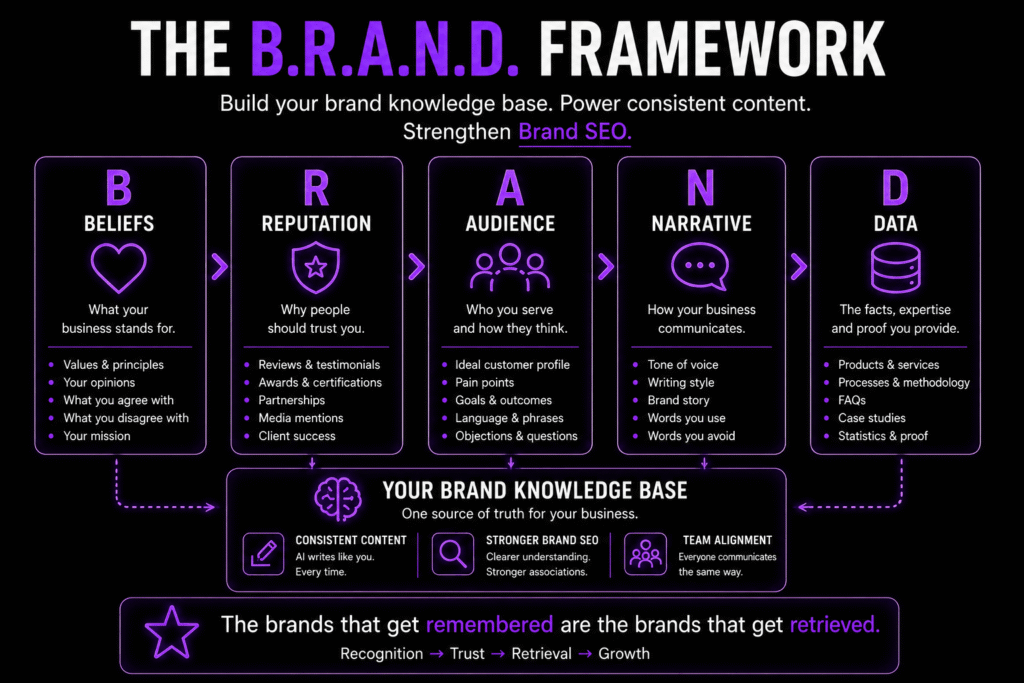
The B.R.A.N.D. Framework brings them together into a structured understanding of your business.
It’s not an AI prompt.
It isn’t a style guide.
And it isn’t another marketing exercise.
It’s a practical framework for documenting the five things every business already has, but very few organise effectively.
- B — Beliefs
- R — Reputation
- A — Audience
- N — Narrative
- D — Data
Together, these five elements create a clearer understanding of your business.
That understanding helps your team communicate consistently.
It gives AI meaningful context instead of assumptions.
And it makes it easier for search systems to understand what your business should be recognised for.
Because that’s really what modern Brand SEO is about.
Not creating more content.
Creating more clarity.
Breaking Down the B.R.A.N.D. Framework
At first glance, the B.R.A.N.D. Framework looks simple.
Five letters.
Five sections.
In reality, each one captures a different part of your business.
Collectively, they create something much bigger than a marketing document.
They create understanding.
If somebody new joined your business tomorrow, these five sections should help them understand not only what your company does, but how it thinks, communicates and earns trust.
That’s exactly the same understanding AI needs before it can consistently represent your business.
Let’s look at each part.
B is for Beliefs
Every business has beliefs.
Some simply haven’t taken the time to document them.
Your beliefs are your opinions, principles and point of view. They’re the ideas that influence every decision you make and the lens through which you see your industry.
They’re also one of the biggest reasons some brands feel distinctive while others blend into the background.
Without beliefs, AI naturally becomes neutral.
It doesn’t know what your business agrees with.
It doesn’t know what advice you challenge.
It doesn’t know where you stand on common industry debates.
Instead, it produces content that sounds like everyone else because it has no reason to sound different.
That’s usually where generic content begins.
Documenting your beliefs gives AI something far more valuable than information.
It gives it perspective.
Think about the questions your business already answers every day.
- What do we believe customers should know before buying?
- What common advice do we disagree with?
- What mistakes do we regularly see?
- What principles guide the way we work?
- What would we never recommend?
Those answers become the personality behind your content.
Over time, people begin to associate those ideas with your business.
Recognition doesn’t happen because you repeat keywords.
It happens because you consistently repeat ideas.
That’s one of the foundations of Brand SEO.
Include things like:
- Company values
- Industry opinions
- Common myths you challenge
- Core principles
- Mission and vision
- Ethical positions
- Advice you refuse to give
Ask yourself:
If somebody removed our logo from an article, would readers still recognise our point of view?
R is for Reputation
Beliefs tell people what you think.
Reputation proves why they should believe you.
This is the evidence layer.
Almost every business claims to be experienced.
Almost every business claims to care about customers.
Claims are easy.
Proof is much harder.
Your reputation is everything that supports the promises your business makes.
That includes customer reviews, testimonials, awards, certifications, partnerships, successful projects and independent recognition.
From an AI perspective, reputation gives context credibility.
Instead of simply saying your business is trusted, AI can reference the reasons people trust you.
The same applies to search systems.
Google doesn’t rely on one signal when evaluating a business.
It looks for corroboration.
Reviews support claims.
Mentions support expertise.
Awards reinforce authority.
Partnerships provide additional confidence.
Search systems follow confidence.
Confidence grows when multiple sources tell the same story.
Include things like:
- Google Reviews
- Testimonials
- Case studies
- Awards
- Certifications
- Partnerships
- Press coverage
- Client success stories
- Industry memberships
Ask yourself:
Are we asking people to trust us, or are we giving them reasons to?
A is for Audience
This might be the most overlooked section of the framework.
Businesses spend an enormous amount of time describing themselves.
Very few spend enough time documenting the people they’re trying to help.
Understanding your audience goes far beyond demographics.
It’s about empathy.
What frustrates them?
What motivates them?
What language do they naturally use?
What questions do they ask before making a decision?
What objections stop them buying?
When AI understands your audience, something interesting happens.
It stops writing about your business.
It starts writing for your customers.
That’s a subtle difference.
But it’s often the difference between content that feels promotional and content that genuinely helps someone solve a problem.
The more accurately you describe your audience, the more naturally your content reflects their concerns.
That’s one of the reasons audience understanding is such an important part of both marketing and Brand SEO.
Search systems are increasingly rewarding content that satisfies genuine user needs.
That starts by understanding the people behind the search.
Include things like:
- Customer personas
- Goals
- Pain points
- Frequently asked questions
- Buying objections
- Industry terminology
- Emotional triggers
- Search intent
- Common misconceptions
Ask yourself:
Have we documented what our customers care about, or only what we want to sell?
N is for Narrative
Narrative is how your business communicates.
It’s your voice.
Your personality.
Your rhythm.
It’s what makes your content feel familiar.
Without a documented narrative, every piece of AI-generated content starts from scratch.
One article sounds formal.
The next sounds conversational.
An email suddenly becomes overly enthusiastic.
A LinkedIn post uses phrases you’d never say.
That’s not an AI problem.
It’s a consistency problem.
Your narrative should explain how your business communicates across every channel.
Not just the words you use.
The words you deliberately avoid.
The way you structure ideas.
The examples you regularly return to.
The observations you repeat because they reinforce your message.
For example, throughout my own content I often return to ideas like:
Recognition compounds.
Search systems follow confidence.
The brands that get remembered get retrieved.
Those aren’t accidental.
They’re repeated because memorable ideas build familiarity.
Familiarity builds recognition.
Recognition reduces uncertainty.
Your business should have its own recognisable language too.
Include things like:
- Tone of voice
- Writing style
- Preferred vocabulary
- Words to avoid
- Messaging pillars
- Brand story
- Brand personality
- Examples of previous content
Ask yourself:
Would every member of our team explain the business in the same way?
D is for Data
The final section is the factual foundation of your business.
If beliefs provide perspective and narrative provides personality, data provides certainty.
This is the information AI shouldn’t have to guess.
Products.
Services.
Processes.
Methodologies.
Pricing.
Policies.
FAQs.
Research.
Statistics.
Technical documentation.
Case studies.
Everything that represents the factual knowledge your business has developed over time belongs here.
The more complete this section becomes, the more accurate every future conversation becomes.
Instead of repeatedly explaining the same services or correcting small inaccuracies, you’re giving AI a reliable reference point.
Your team benefits from the same consistency.
Customers receive clearer answers.
Content becomes more accurate.
Search systems see fewer contradictions across your digital presence.
That’s exactly what documented business knowledge should achieve.
Include things like:
- Products and services
- Processes
- Methodologies
- FAQs
- Pricing guidance
- Technical information
- Case studies
- Research
- Statistics
- Internal documentation
Ask yourself:
Does AI have access to facts, or is it filling the gaps with assumptions?
The real strength of the B.R.A.N.D. Framework
Each section is valuable on its own.
Together, they become far more powerful.
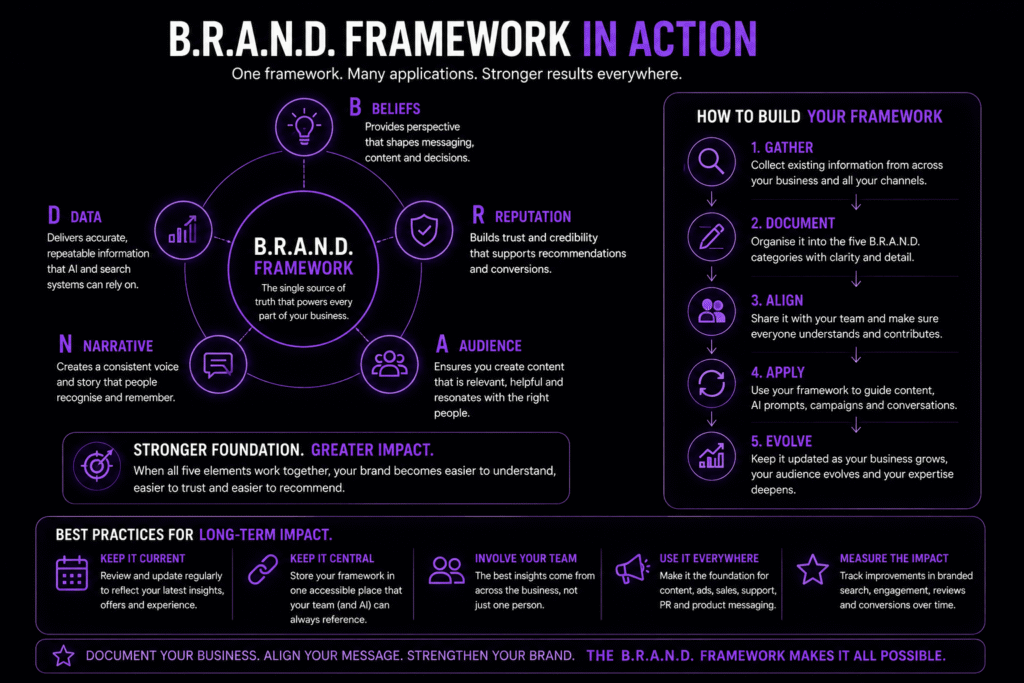
Your beliefs create perspective.
Your reputation builds trust.
Your audience provides empathy.
Your narrative creates consistency.
Your data delivers certainty.
Individually, they’re useful.
Combined, they create something every modern business needs.
A documented understanding of itself.
And once you have that, something interesting starts to happen.
AI becomes more consistent.
Your marketing becomes more consistent.
Your sales conversations become more consistent.
Even onboarding new team members becomes easier because everyone starts from the same understanding.
That consistency doesn’t just improve communication.
It strengthens recognition.
And recognition is one of the strongest signals a brand can build over time.
Why the B.R.A.N.D. Framework Matters Beyond AI
At this point, you might be thinking:
“This sounds useful for AI, but couldn’t I just keep using my existing prompts?”
You could.
The problem is that prompts solve today’s task.
The B.R.A.N.D. Framework solves tomorrow’s consistency.
That’s a much bigger difference than it first appears.
The more I study modern search, the more I think we’re asking the wrong question.
For years we’ve asked:
“How do I optimise this page?”
Increasingly, I think we should be asking:
“How do I make my business easier to understand?”
That’s a completely different way of thinking about SEO.
It’s also why I believe documenting your business has become one of the most valuable things you can do.
Businesses now have two audiences
For most of the internet’s history, businesses only had one audience.
People.
Today, every business has two.
The first is still human.
Prospective customers.
Existing clients.
Partners.
Employees.
The second audience is machine-based.
Search engines.
AI assistants.
Recommendation systems.
Knowledge graphs.
Language models.
These systems don’t buy your products.
They don’t become customers.
But they increasingly influence the recommendations people receive.
That changes everything.
Humans are good at reading between the lines.
Machines aren’t.
If your business presents inconsistent information across different channels, people might overlook it.
Search systems are much less forgiving.
They’re trying to reduce uncertainty.
They’re trying to determine what your business should be recognised for.
The clearer that picture becomes, the easier it is for them to build confidence.
Search systems don’t read pages. They build understanding.
This feels like one of the biggest shifts happening in search.
Google doesn’t simply analyse one page anymore.
It compares information across your entire digital footprint.
Your website.
Your Google Business Profile.
Your reviews.
Industry directories.
Videos.
Podcasts.
LinkedIn posts.
Articles.
Authors.
Mentions.
Images.
Even the questions people ask about your business.
Each one becomes another piece of evidence.
Individually, these signals don’t say much.
Together, they help search systems answer one important question.
“What is this business genuinely known for?”
That’s why consistency matters so much.
If every source describes your business differently, confidence becomes harder to build.
If every source reinforces the same ideas, understanding becomes much clearer.
Google remembers patterns.
So do AI systems.
Recognition is built through repetition
One of the biggest misconceptions about branding is that recognition comes from logos or colours.
They certainly help.
But recognition usually comes from repetition.
The same ideas.
The same language.
The same expertise.
The same perspective.
Repeated consistently over time.
Think about the businesses you recognise immediately.
You probably associate them with a particular message.
A way of thinking.
A promise.
An area of expertise.
That isn’t accidental.
It’s the result of consistent communication.
The B.R.A.N.D. Framework helps create that consistency because every piece of content starts from the same understanding.
Your website says the same thing as your social media.
Your sales conversations reinforce the same beliefs.
Your AI-generated content reflects the same tone.
Your case studies support the same positioning.
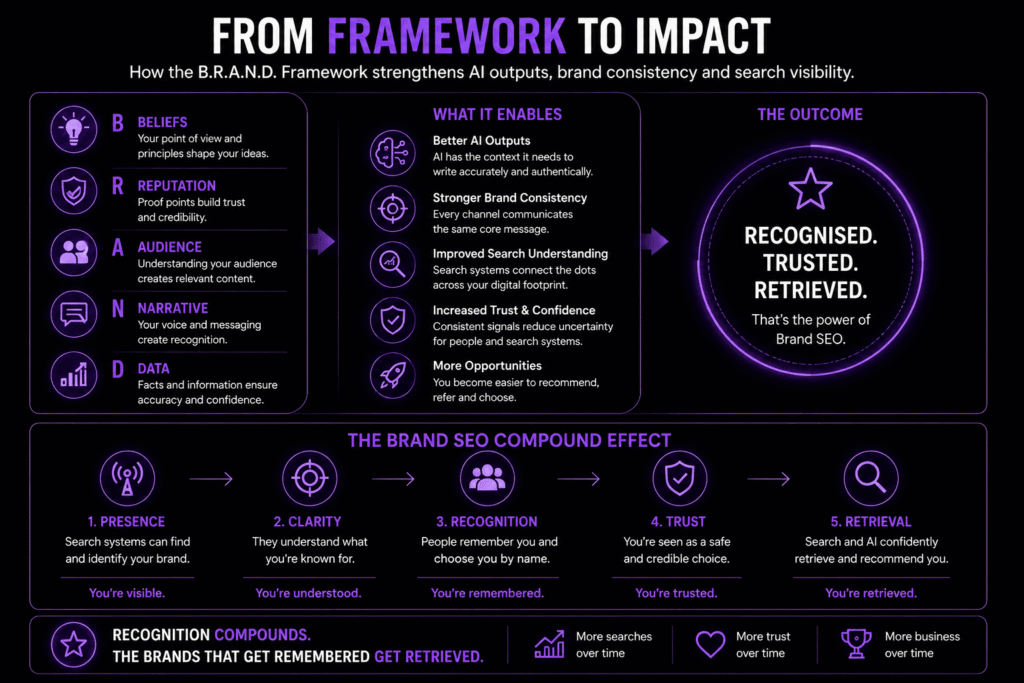
Recognition compounds.
Every consistent interaction strengthens the next one.
AI is becoming another touchpoint
Many businesses still think of AI as a writing tool.
I think that’s underselling what’s happening.
AI is increasingly becoming another way people discover businesses.
People ask questions.
AI recommends answers.
Sometimes it recommends companies.
Sometimes it summarises information from multiple sources.
Sometimes it introduces brands people have never searched for before.
That means AI isn’t just creating content.
It’s becoming another layer between businesses and potential customers.
If AI doesn’t understand your business, it’s much harder for it to represent your expertise accurately.
The B.R.A.N.D. Framework isn’t about teaching AI to sound clever.
It’s about making your business easier to understand.
That’s a subtle distinction.
But it’s an important one.
Better documentation creates better retrieval
I’ve written before that search is becoming recommendation infrastructure.
I think that’s becoming clearer every month.
Traditional SEO focused heavily on discoverability.
Modern search is increasingly influenced by retrieval.
Can search systems confidently retrieve your business when someone asks a relevant question?
That confidence doesn’t come from one perfectly optimised page.
It comes from repeated evidence.
Consistent messaging.
Clear expertise.
Strong reputation.
Recognisable language.
Corroborating information.
That’s exactly what the B.R.A.N.D. Framework encourages businesses to document.
Not because Google needs another document.
But because your business benefits from becoming consistently understandable everywhere it appears.
The future of SEO is retrieval.
Retrieval begins with understanding.
Documentation reduces uncertainty
It’s less about creating signals.
It’s more about reducing uncertainty.
Every unanswered question creates doubt.
Every inconsistency weakens confidence.
Every contradiction makes it harder for search systems to understand your business.
Documentation solves many of those problems before they happen.
Your team refers to the same messaging.
AI references the same business knowledge.
Content reflects the same positioning.
Reviews reinforce the same expertise.
Search systems encounter fewer conflicting signals.
Understanding becomes stronger.
Confidence grows naturally.
Search systems follow confidence.
This isn’t about replacing creativity
Whenever frameworks are discussed, there’s always a concern that they’ll make content feel repetitive.
The opposite is usually true.
The B.R.A.N.D. Framework doesn’t tell you what to write.
It gives you confidence that everything you write reflects the same business.
Creativity still matters.
Stories still matter.
Experience still matters.
AI still needs human judgement.
The framework simply provides a consistent foundation.
Think of it like an architect’s blueprint.
No two buildings look identical.
But they’re all built from a clear plan.
The same applies here.
Your blogs.
Your emails.
Your videos.
Your social posts.
Your presentations.
They should all feel different enough to suit the format.
But they should all feel like they came from the same business.
The businesses that document themselves will have an advantage
I don’t think the competitive advantage over the next few years will simply be who publishes the most content.
AI has made content easier than ever to produce.
Volume is no longer difficult.
Clarity is.
The businesses that stand out won’t necessarily have the largest marketing budgets.
They’ll be the ones that have taken the time to document what makes them different.
What they believe.
Why they’re trusted.
Who they help.
How they communicate.
What they know.
That’s exactly what the B.R.A.N.D. Framework captures.
And that’s why I see it as more than an AI exercise.
It’s a practical way of creating the consistency that modern businesses need, regardless of how people discover them.
Building Your Own B.R.A.N.D. Framework
The good news is you probably already have most of the information.
The challenge isn’t creating it.
It’s finding it.
Every business has beliefs.
Every business has a reputation.
Every business has an audience.
Every business has a narrative.
Every business has data.
The problem is that those pieces usually exist in isolation.
Your values might be buried on your About page.
Customer testimonials sit inside your CRM.
Your sales team has documented objections that marketing has never seen.
Support teams answer the same questions every day, but those answers never make it into your content.
The B.R.A.N.D. Framework isn’t about inventing something new.
It’s about bringing everything together into one place.
Think of it as creating the operating manual for your business.
Once it exists, it becomes something everyone can use.
Your marketing team.
Your copywriters.
Your salespeople.
Your AI tools.
Even new employees.
Everyone starts from the same understanding.
Start with clarity, not perfection
One mistake I see businesses make repeatedly is trying to create the perfect document.
Don’t.
The first version won’t be perfect.
It shouldn’t be.
Your business changes.
Your products improve.
Your audience changes.
Your experience grows.
Your reputation grows.
Your framework should grow with it.
Treat it as a living document rather than a finished project.
Add new case studies.
Update your FAQs.
Expand your beliefs as your thinking develops.
Refine your messaging as your positioning becomes clearer.
The businesses that get the most value from this aren’t the ones with the biggest document.
They’re the ones that keep it current.
Make it part of your workflow
The B.R.A.N.D. Framework shouldn’t sit in a folder gathering dust.
It should become part of how your business operates.
Before creating content, review it.
Before onboarding a new employee, share it.
Before launching a new service, update it.
Before asking AI to write anything, use it as the foundation.
The framework shouldn’t replace creativity.
It should provide context.
That’s a very different role.
Instead of explaining your business every time you open ChatGPT or another AI assistant, you’re giving it a consistent understanding to work from.
The result isn’t just better writing.
It’s more consistent thinking.
Your business becomes easier to understand
One of the things I’ve noticed while studying Brand SEO is that many businesses make themselves unnecessarily difficult to understand.
Different messages appear on different platforms.
Service descriptions change from page to page.
The website says one thing.
LinkedIn says another.
Sales presentations introduce completely different language.
None of it is intentionally misleading.
It’s simply inconsistent.
Over time, those inconsistencies create uncertainty.
The B.R.A.N.D. Framework reduces that uncertainty.
Not because it tells everyone exactly what to say.
But because everyone starts from the same understanding.
Consistency doesn’t mean saying exactly the same thing every time.
It means communicating the same ideas in ways that feel natural across different channels.
That’s an important distinction.
The future belongs to businesses that are easy to understand
Every major change in search has rewarded businesses that communicate clearly.
The arrival of AI hasn’t changed that.
If anything, it’s reinforced it.
The more I study AI search, Google’s Knowledge Graph, entity understanding and retrieval systems, the more I come back to the same conclusion.
Search systems aren’t trying to understand pages.
They’re trying to understand businesses.
They’re looking for patterns.
They’re looking for consistency.
They’re looking for confidence.
They’re trying to answer a deceptively simple question.
“What should this business be known for?”
That’s why I believe the future of Brand SEO is becoming less about optimisation and more about understanding.
The businesses that communicate clearly will become easier to recognise.
The businesses that become easier to recognise become easier to trust.
And the businesses that become easier to trust become easier to retrieve.
Recognition compounds.
Search systems follow confidence.
The brands that get remembered get retrieved.
Final Thoughts
Most businesses don’t have an AI problem.
They have a documentation problem.
Their knowledge is scattered.
Their expertise is fragmented.
Their messaging changes depending on who is writing.
Their experience lives inside people’s heads instead of being shared across the business.
AI simply exposes those gaps.
It doesn’t create them.
The B.R.A.N.D. Framework isn’t another marketing tactic.
It isn’t another AI prompt.
And it certainly isn’t a replacement for human expertise.
It’s a practical way of documenting what already makes your business valuable.
What you believe.
Why people trust you.
Who you help.
How you communicate.
What you know.
Once those five areas are organised, something interesting happens.
Your marketing becomes more consistent.
Your team becomes more aligned.
Your AI produces better results because it has better context.
And your business becomes easier for both people and search systems to understand.
I don’t think that’s just good for AI.
I think it’s becoming essential for modern Brand SEO.
Because the businesses that succeed over the next few years won’t simply publish more content.
They’ll communicate with more clarity.
And clarity is difficult to imitate.
Where to Go Next
If you’re serious about improving your visibility across Google and AI search, don’t stop at documenting your business.
The next step is understanding how that information influences recognition, trust and retrieval.
That’s exactly what Brand SEO is designed to help you achieve.
If you haven’t already, read our guide to Brand SEO to learn how documented business knowledge, consistent brand signals and entity understanding work together to make your business easier to find, easier to trust and easier to recommend.