
Think about the brands you instinctively trust.
Chances are, you recognised them long before you needed them.
You’d heard people mention them. Seen them appear in different places. Maybe you’d noticed them in passing without paying much attention at all. Then, when the need finally arrived, they already felt familiar.
That familiarity matters.
It influences the decisions people make every day.
I’m starting to think it’s influencing the choices search systems make too.
For years, brand awareness sat firmly within marketing. SEO had its own priorities. Rankings, keywords and backlinks dominated the conversation.
That distinction feels harder to defend now.
Search behaviour has changed. People move between Google, reviews, social platforms, YouTube and AI tools before making decisions. They don’t follow neat journeys anymore.
Through all of that change, one thing keeps standing out.
Familiar brands often feel like safer choices.
Brand awareness has traditionally been viewed as a marketing metric
Before going any further, it’s worth answering a simple question.
What is brand awareness?
Brand awareness refers to how easily people recognise and remember a business. It reflects familiarity, recall and the associations people make with a brand over time.
Traditionally, businesses focused on brand awareness because recognised brands attract attention. Advertising becomes more effective. Purchasing decisions become easier.
There’s nothing controversial about that.
The interesting part is what happens when you look at brand awareness through the lens of modern search.
Brand awareness for SEO isn’t about replacing technical optimisation or abandoning keyword research.
It’s about recognising that visibility increasingly relies on familiarity and trust.
People search for brands they remember.
They click names they recognise.
They recommend businesses they’ve heard of.
That doesn’t mean only large companies benefit.
It means awareness may play a bigger role in visibility than many businesses realise.
Recognition changes behaviour
Think about how quickly certain brands come to mind.
Nike. Just Do It.
Tesco. Every Little Helps.
McDonald’s. I’m Lovin’ It.
The slogans themselves aren’t really the point.
Recognition is.
Those brands occupy space in people’s minds long before a purchasing decision appears.
Smaller businesses can achieve something similar within their own markets.
People begin associating a business with reliability. Expertise. Convenience. Good service. The local specialist who always gets recommended.
Over time, those associations strengthen.
That’s traditionally been viewed as a branding success.
It may also be a search advantage.
People generally feel more comfortable with what they already know.
Search systems appear to lean in a similar direction.
Purple cows get remembered
Seth Godin introduced the concept of the Purple Cow more than twenty years ago.
The idea was simple.
If you drove past hundreds of ordinary cows, you probably wouldn’t remember any of them.
A purple cow would stand out.
Remarkable things get noticed.
Many businesses still blend into their category.
Their messaging sounds similar. Their websites look familiar. Their content often covers the same ground in the same way.
Standing out doesn’t mean being outrageous.
It means being memorable in ways that reinforce what you want to be known for.
Because people rarely search for businesses they don’t remember.
They recommend businesses they’ve heard of.
They trust businesses that feel familiar.
Recognition compounds.
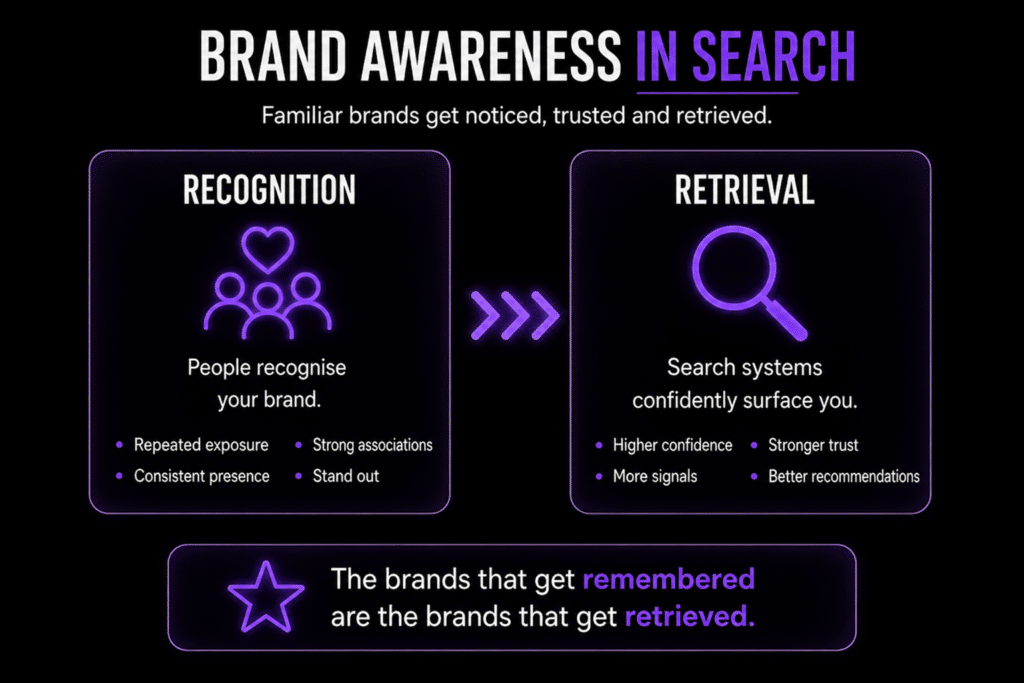
Search is evolving from discoverability towards recommendation. Familiar brands increasingly have an advantage.
Search systems increasingly follow confidence
Traditional SEO has largely focused on discoverability.
Optimise the page.
Target the keyword.
Build authority.
Improve rankings.
Those foundations still matter.
To be clear, this isn’t an argument against technical SEO.
It’s simply recognising that another layer appears to be emerging above it.
Google wants to surface results that feel helpful and dependable.
Local platforms often lean towards businesses with stronger reputations.
AI tools need confidence before retrieving and presenting information.
Search systems are constantly trying to reduce uncertainty.
That changes how brand awareness fits within SEO.
Brand awareness no longer sits separately from visibility.
It can influence:
- branded search behaviour
- click confidence
- recommendation likelihood
- local visibility
- review engagement
- cross-platform discoverability
- AI retrieval
Traffic without recognition can be fragile.
Visibility becomes much stronger when people already know who you are.
AI search changes the visibility equation
People don’t just search Google anymore.
They ask questions in ChatGPT.
They use Claude to explore ideas.
Google’s AI Overviews are changing how information appears within search itself.
Gemini is increasingly integrated across Google’s ecosystem.
These experiences work differently from traditional search.
They’re pulling information together from multiple sources and trying to provide useful answers.
Naturally, that creates a preference for businesses and sources that already appear credible.
I don’t think this means rankings suddenly stop mattering.
But it does suggest that search is becoming more complex.
The question increasingly becomes:
If someone asked an AI system about businesses in your category, would your brand enter the conversation?
That’s a very different question from:
How do I rank for this keyword?
Visibility extends beyond your website
For years, many businesses treated their website as the centre of their digital presence.
Today, customers move across multiple touchpoints before making decisions.
They read reviews.
Watch YouTube videos.
Browse LinkedIn.
Explore community discussions.
Compare options across different platforms.
Search systems increasingly surface information from these environments too.
Presence without reinforcement is weak.
Repeated exposure strengthens familiarity.
Familiarity builds recognition.
Recognition contributes to trust.
Search visibility now extends beyond rankings.
What this means for local businesses
I don’t think many local businesses wake up and decide they need to build brand awareness for SEO.
Usually, they’re trying to become the obvious choice when someone nearby needs what they offer.
Yet that’s essentially what’s happening.
Every review, recommendation and repeated interaction strengthens familiarity over time.
Google Business Profiles.
Reviews.
Community involvement.
Local partnerships.
Consistent branding.
All of these contribute to awareness.
National recognition isn’t the goal.
Recognition within the audience that matters most is.
The same principles apply.
Just on a different scale.
This is where Brand SEO fits
As search evolves, businesses need more than rankings alone.
They need to become recognisable, trusted and retrievable.
That’s where Brand SEO becomes useful.
Rather than viewing SEO purely through a technical lens, Brand SEO focuses on strengthening the signals modern search increasingly appears to value.
Presence.
Clarity.
Recognition.
That progression matters.
Presence helps search systems identify a business.
Clarity helps systems understand what that business should be known for.
Recognition creates familiarity.
Trust influences confidence.
Retrieval determines whether a business enters the conversation when it matters.
Visible.
Understood.
Remembered.
Trusted.
Retrieved.
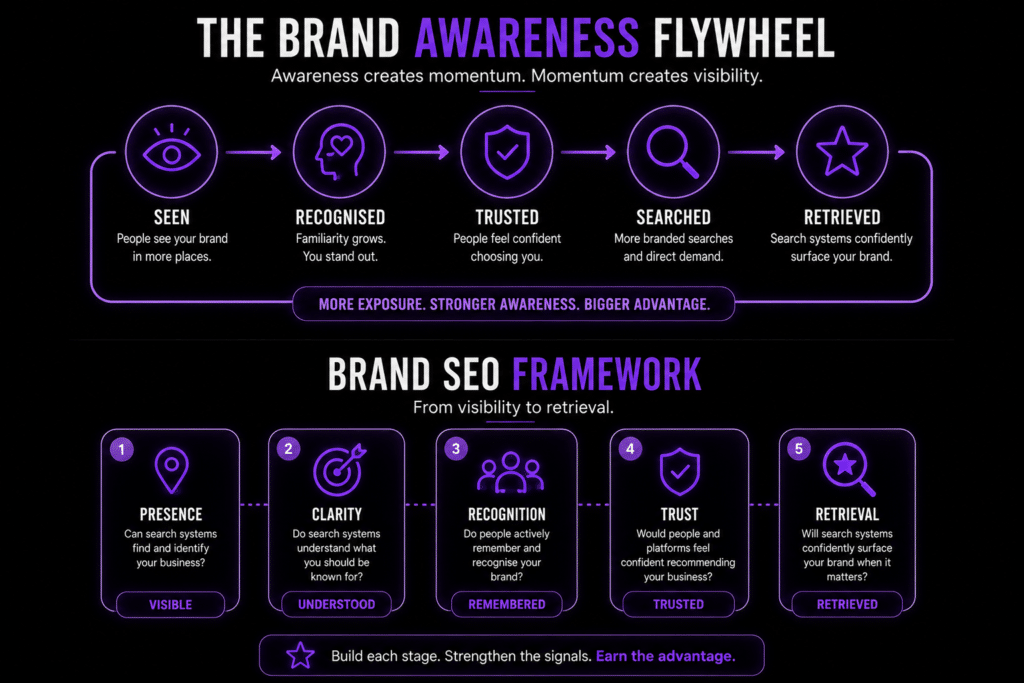
Awareness creates familiarity. Familiarity strengthens trust. Trust improves retrieval.
Try this yourself
If you’re curious about how search systems currently perceive your brand, try searching for your business name in Google and pay close attention to what appears in AI Overviews.
What information is being surfaced?
Which sources are being referenced?
Are the descriptions accurate?
Do reviews, third-party mentions or other websites reinforce what you want your business to be known for?
Or is Google struggling to build a clear picture?
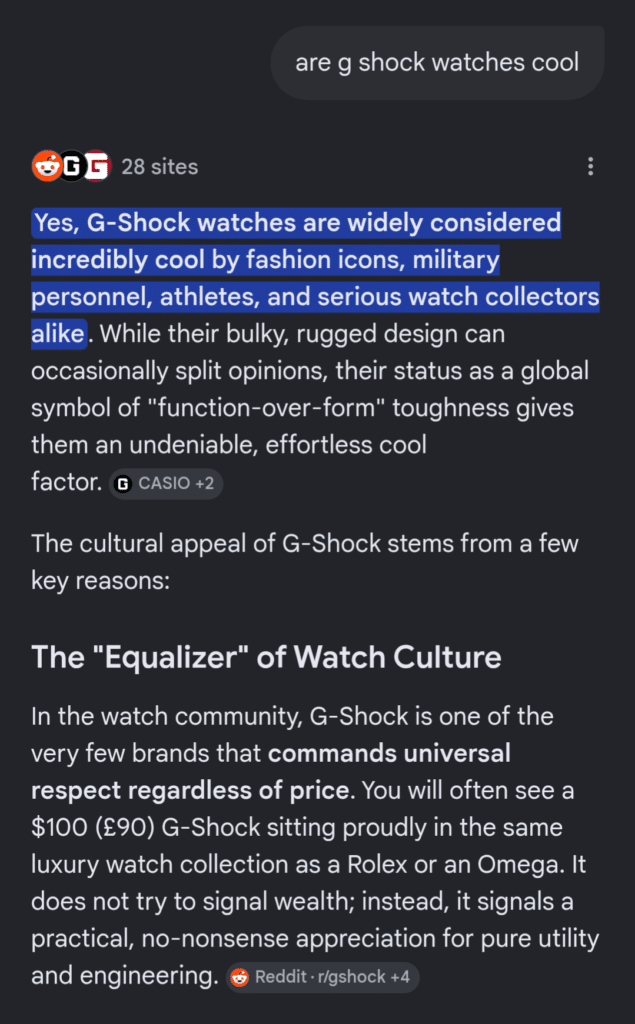
It’s a simple exercise, but it can be surprisingly revealing.
The more I experiment with AI-driven search experiences, the more I think they offer a glimpse into how search systems understand brands. Not just websites.
That doesn’t mean every AI-generated response is correct. Far from it. But it does highlight something important.
Your brand exists beyond your website.
The reviews you collect, the platforms you appear on, the expertise you share and the consistency of your messaging all contribute to the picture search systems build over time.
If the future of search increasingly relies on recommendation and retrieval, understanding how your brand is currently represented feels like a worthwhile place to start.
The future of search belongs to trusted brands
For years, businesses have largely framed SEO as a visibility problem.
How do we rank?
How do we attract traffic?
How do we appear above competitors?
Those questions still matter.
But they may no longer be the only questions worth asking.
Would people recognise your business?
Would they trust it?
Would search systems confidently retrieve it?
Businesses that feel familiar often have an advantage.
People are more likely to click them. Recommend them. Return to them.
Search systems appear to follow similar patterns.
Brand awareness has traditionally been viewed as a marketing objective.
I’m starting to think it’s becoming a search advantage too.
The future of search seems likely to favour businesses that people recognise and trust.
And the brands that get remembered increasingly become the brands that get retrieved.
More Reading
If you’d like to explore how Brand SEO can help your business become more recognisable, trusted and retrievable across Google, AI search and local discovery, start with the Brand SEO framework and build from there.