
If SEO is about helping people find your website, keywords are the words and phrases that guide them there. They show how people search, what they are trying to understand, and what kind of answer they expect to find.
That is why SEO keyword research should never be treated as a box-ticking exercise. It is not about forcing the same phrase into a page as many times as possible. It is about choosing the right topic, understanding the reason behind the search, and creating a page that gives the reader a clear and useful answer.
When keywords are used properly, they help both search engines and people understand what a page is about.
Summary
Keywords help connect the pages on your website with the searches your audience is already making.
The main points to remember are:
- Keywords are the words and phrases people type into Google
- The best keywords are relevant to your services, realistic to compete for, and searched often enough to be useful
- Search intent matters because different searches need different types of pages
- Each page should focus on one main topic rather than trying to cover too much
- Keywords should appear naturally in the page title, introduction, headings, and body copy
- Related terms and internal links help give the page more context
- Customer language is often the best place to start when building a keyword list
- Rankings are useful to monitor, but enquiries, actions, and visitor quality matter more
What Are Keywords?
Example from Google Keyword Planner Tool.
Keywords are the words and phrases people type into Google.
That’s it.
They can be broad. They can be specific. Sometimes they are questions. Sometimes they are direct service searches.
A search like “SEO tips” means something very different from “SEO consultant for dentists in Manchester”. One is exploratory. The other is much closer to action.
That difference matters.
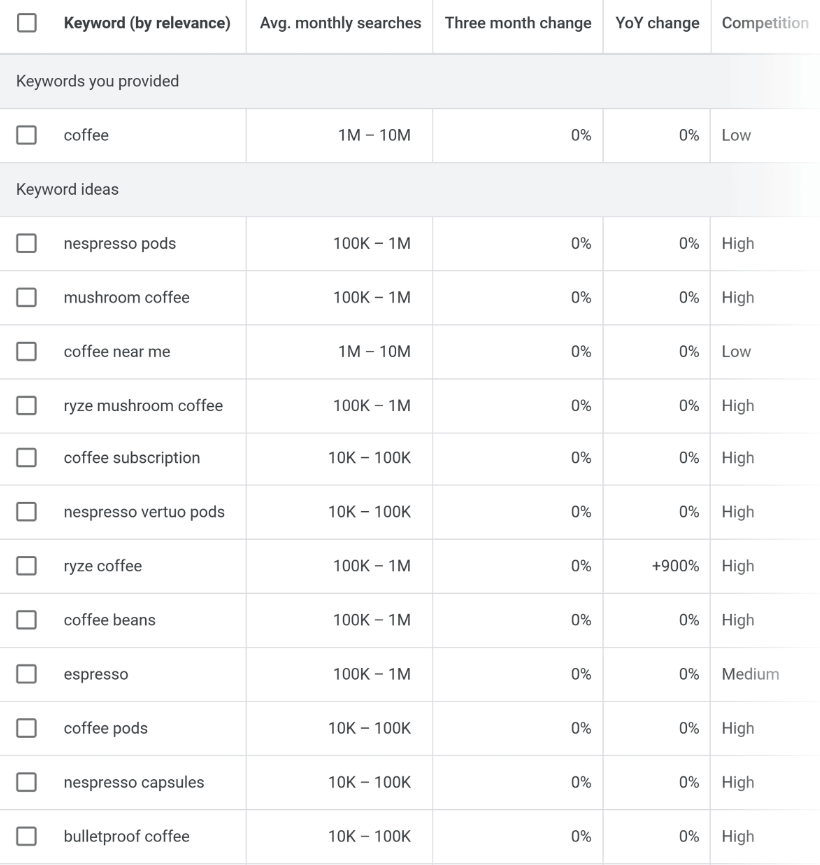
Example from Google Keyword Planner Tool.
Search engines use keywords to understand what a page is about and where it might fit within search results. But modern SEO is less about exact wording now.
Google understands context far better than it used to.
So stuffing the same keyword into every paragraph does not help. If anything, it usually makes the content worse.
Good keyword use is really about clarity.
Does the page clearly explain the topic?
Does it match what the searcher was hoping to find?
Does the language feel natural?
That’s usually where things either work well or start becoming messy.
Top Tip
“One keyword per page is usually enough.”
Trying to target too many keywords on one page can make the content unclear. The page starts pulling in different directions, and neither the reader nor the search engine gets a strong signal about what it is really about.
A focused page is easier to understand and easier to optimise. If you have several different topics to cover, it is usually better to create separate pages and link them together where it makes sense.
What Makes A Keyword Worth Targeting?
Not every keyword is worth targeting.
Some get huge search volume but attract completely irrelevant traffic. Others bring fewer visitors but far better enquiries.
That’s why keyword research needs a bit more thought than simply chasing the biggest numbers.
Three things usually matter most.
Search Volume
Search volume tells you how many searches a keyword receives each month.
High numbers can look attractive.
But broad keywords are often far more competitive. They also tend to bring less focused traffic.
A smaller keyword with clearer intent can easily outperform a larger one.
For example, “marketing” is extremely broad.
“Marketing consultant for independent retailers” tells you far more about the person searching.
That kind of specificity is usually more useful.
Relevance
Relevance matters more than volume.
A keyword needs to align properly with your services and your audience.
Otherwise the traffic means very little.
This is where businesses often go wrong.
They focus on traffic first instead of relevance first.
But rankings are not the goal on their own. Useful traffic is.
Competition
Some keywords are heavily dominated by major websites.
Competing for those terms can take a long time.
That’s why long-tail keywords are often the better option, especially for smaller businesses.
Long-tail searches are more specific.
Usually less competitive too.
And the person searching them often already knows exactly what they need.
Those searches may bring less traffic overall.
But the quality is often far better.
Where To Find SEO Keywords
A good keyword list often starts with the language your customers already use.
Think about the questions people ask before they buy from you. Look at enquiry forms, emails, phone calls, reviews, sales conversations, and common objections. These can all reveal the words people naturally use to describe their problem.
That matters because customers do not always search in the same language a business uses internally.
A company may describe a service in a technical way, while customers use simpler, more practical wording. Search content works better when it reflects the customer’s language.
Once you have a list of ideas, keyword tools can help you check them.
Google Keyword Planner can give you search volume and competition data. Tools such as SEMrush, Ahrefs, Ubersuggest, and WordStream can also help you find related terms, competitor keywords, and common questions.
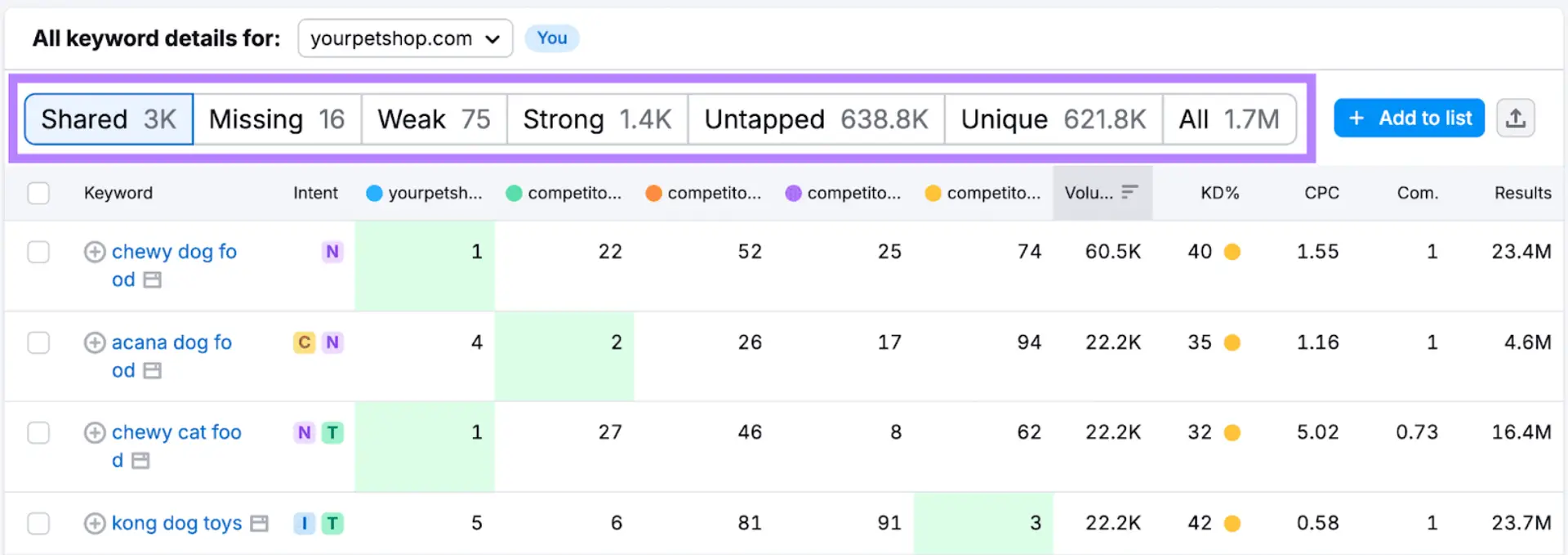
SEMRUSH Competitor Ranking Tool. Source: SEMRUSH
These tools are useful, but they should support your judgement rather than replace it.
Competitor research is also helpful. Look at the pages that rank for the topics you care about. Notice the keywords they appear to target, the sections they include, and the questions they answer.
Then look for gaps.
A gap might be a question they have not answered properly, a topic they have only covered lightly, or a search intent they have misunderstood. Those gaps can become useful content opportunities.
Matching Keywords With Intent
Keywords only make sense when you understand the intent behind them.
People search with a goal in mind.
Sometimes they want information.
Sometimes they want to compare options.
Sometimes they are ready to buy or contact somebody immediately.
The page needs to reflect that.
A search like “how to improve local SEO” needs educational content.
A search like “local SEO consultant near me” needs a service page.
Same topic.
Completely different intent.
This is why it helps to search the keyword yourself before building content around it.
Look at what is already ranking.
Are the results:
- blog posts
- service pages
- comparison articles
- product pages
- directories
Google usually gives a strong indication of what type of page belongs there.
Once you choose a keyword for a page, keep the topic focused.
Use the keyword naturally in the title, introduction, and supporting headings where it fits.
Then support it with related language.
If the page is targeting “dog groomer Liverpool”, you might naturally mention:
- puppy grooming
- dog washing
- mobile dog grooming
- pet grooming services
That supporting context helps search engines understand the wider topic without making the page feel repetitive.
Top Tip
“Before committing to a keyword, search it yourself.”
Look at what’s already ranking. Are the results blog posts, product pages, or local services?
This helps you understand what kind of content Google thinks suits that term, so you can create something similar or better.”
Understanding Different Keyword Intent
Not all keywords serve the same purpose.
Some searches are made by people who want to learn. Others are made by people comparing options. Some are made by people ready to book, buy, or call.
Understanding that difference helps you create content that feels useful at the right moment.
Most searches fall into four broad types of intent.
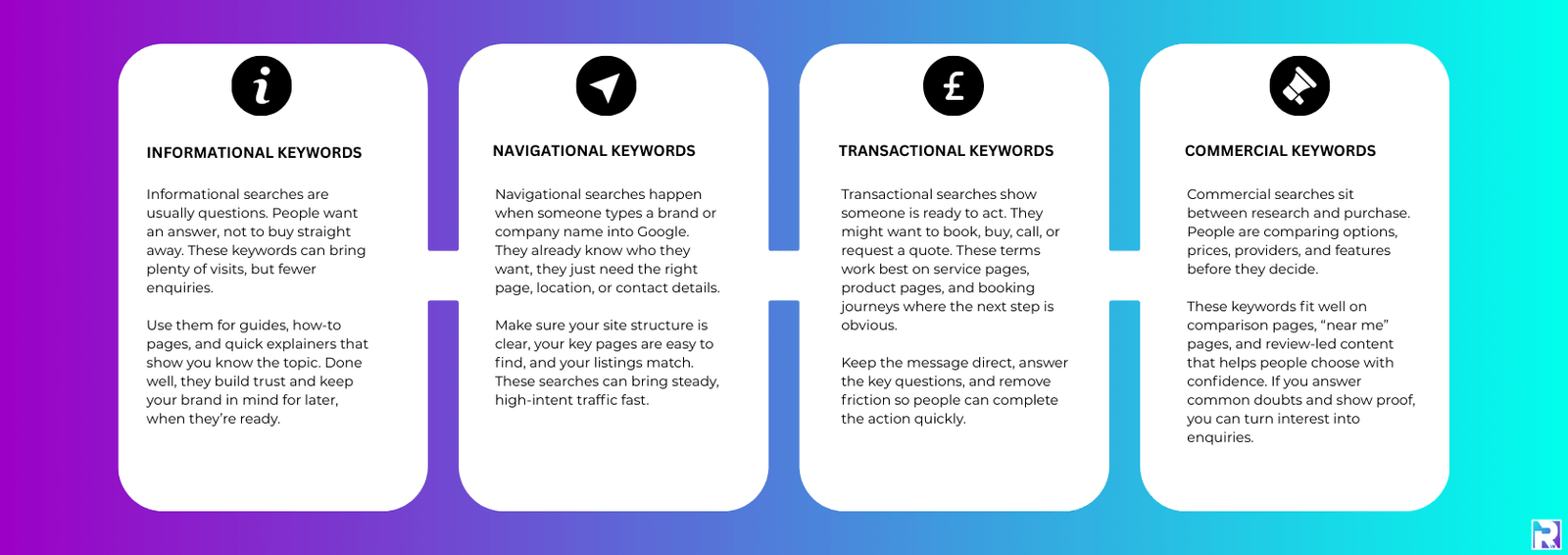
Informational
Informational searches happen when someone wants to understand something.
They may be looking for a definition, a step-by-step explanation, or practical advice. A search like “how to clean roof tiles” suggests the person wants guidance rather than a sales message.
Content for informational searches should be clear, helpful, and easy to follow. It should answer the question properly and guide the reader towards the next useful step.
Navigational
Navigational searches happen when someone already knows where they want to go.
They might search for a brand, a website, or a specific page. For example, someone searching “GOV UK driving licence” is probably trying to reach the official government page.
Content that supports navigational intent should be simple, direct, and easy to access.
Commercial
Commercial searches happen when someone is considering their options.
They may know what they need, but they have not made a final decision yet. Searches such as “best laptops under £500” or “best accountant for small business” show that the person is comparing choices.
This kind of content should help the reader make a decision. It should explain differences clearly, answer likely questions, and avoid sounding too pushy.
Transactional
Transactional searches show that someone is ready to act.
They may want to book, buy, call, download, or request a quote. A search like “book dentist near me” suggests the person needs a clear next step.
Pages targeting transactional keywords should make that next step easy. Contact details, booking options, prices, and calls to action should be clear and easy to find.
Content that matches intent tends to perform better because it gives the reader what they came for.
How To Use Keywords Naturally
Keywords still matter.
But forcing them into every sentence does not.
That style of SEO writing feels dated now.
Readers notice it immediately.
So do search engines.
The better approach is usually simpler.
Write clearly.
Explain the topic properly.
Use natural language throughout.
When the content genuinely covers the subject well, related terms tend to appear naturally anyway.
Your main keyword should still appear in important places:
- the page title
- the H1
- the opening paragraph
- relevant headings
- the meta description
But it does not need repeating constantly.
If a sentence sounds awkward because of a keyword, rewrite the sentence.
Natural readability matters more.
Internal links help here too.
If a blog post connects closely to one of your services, link between them naturally.
That helps readers continue through the site.
It also helps search engines understand how your pages connect together.
Putting Keywords Across Your Site
A clear keyword plan helps your website stay organised.
Once you have a list of target keywords, decide which page each keyword belongs to. Your homepage usually suits a broader phrase connected to your main service or business type. Service pages should target more specific terms. Blog posts can then answer questions and support those service pages.
This gives your site a clearer structure.
It also helps avoid keyword overlap.
Keyword overlap happens when several pages target the same or very similar terms. This can confuse search engines because it is not clear which page should rank. It can also weaken your results because the value is spread across multiple pages instead of focused on one strong page.
In most cases, one well-developed page is better than several thin or overlapping pages.
Internal linking helps bring the structure together. Important pages should be easy to find through menus, related content, and contextual links within the copy.
A good site structure should feel natural to the reader. They should be able to move from one useful page to the next without having to think too hard about where to go.
How This All Ties Together
Keyword rankings can be helpful to track, but they are not the whole measure of SEO success.
Search results change depending on location, device, search history, and other factors. A ranking position can move around, and it does not always show the full value of the traffic you receive.
What matters more is the quality of the visitors coming to your site.
Are they the right people? Are they finding useful information? Are they taking the next step, such as making an enquiry, booking a call, or visiting a service page?
Those actions usually tell you more than rankings alone.
Strong keyword use is really about clarity. The page should have a clear topic, match the searcher’s intent, and give a useful answer. When your keywords reflect real searches and your writing feels natural, SEO becomes much easier to understand and much more useful for the business.
Good keyword choices support better structure, clearer content, and more relevant traffic. That is where the real value sits.