

When people search for a local service, they rarely type the neat version you use on your price list. They type what’s on their mind, often with a place name, a problem, or a time pressure attached. That’s why keyword research for small business websites matters. It turns vague ideas into a clear plan for pages that match real searches, and it keeps your SEO keyword research focused on the phrases that tend to bring calls, bookings, and quote requests.
Summary
This guide shows how to do keyword research for small business websites in a practical way, starting with your real services and the words customers actually use. From there, it explains how to expand your list with modifiers, locations, and simple sources like autocomplete, related searches, and Search Console, so you are not guessing what people type.
It also covers how to judge intent, group long-tail phrases into sensible themes, and map those themes to the right page type, like a core service page, a supporting guide, or a location page. The goal is a short, workable list you can act on, focused on searches that lead to calls, bookings, and quote requests. It also shows how to avoid creating piles of thin location pages that do not help users and often end up competing with each other.
What keyword research is
Keyword research is the process of finding the phrases people use when they look for a product, service, or answer. It covers short terms like “boiler service” and longer searches like “boiler service cost in Nottingham”. It also covers question-style searches, like “how often should a boiler be serviced”, which often belong in blog posts or FAQs.
There are two parts to it. The first is discovery, building a list of terms you could target. The second is judgement, deciding which terms are worth your time and where they should live on your website.
A useful way to think about keyword research is that it helps you learn your customer’s language. Many businesses describe what they do in one way, while customers describe the same thing in a different way. Keyword research closes that gap.
Why keyword research matters for small business SEO
For a small business, time is usually the tightest resource. Local keyword research helps you spend that time in the right places.
It also makes your website easier to structure. When you know the main phrases people use, it becomes clearer which services deserve their own pages, which topics belong in supporting content, and which searches are not worth chasing at all.
Keyword research can also improve lead quality. A broad term might bring plenty of visitors but few enquiries. A more specific term, often a long-tail keyword, can bring fewer visitors but a higher share of people who are ready to act.
Finally, it supports local visibility. Local searches often include town names, neighbourhoods, and “near me” intent. Local keyword research helps you reflect that in your service pages and location content, so your site matches what people are actually typing.
Start with your services, not tools
Before you open any keyword research tools, start with what you sell. Write down your core services in plain language. Keep it honest and specific.
If you’re a roofer, you might list “roof repairs”, “flat roof replacement”, “leak detection”, and “gutter cleaning”. If you run a salon, you might list “balayage”, “highlights”, “men’s haircut”, and “hair extensions”. If you’re a solicitor, you might list “conveyancing”, “family law”, and “wills”.
Once you have your list, expand each service into problem language. People often search for the problem first, then the service. “Roof leak near chimney” is a different search from “roof repair”, but they can lead to the same job.
A simple check that helps is reading your last 20 enquiries and pulling out the phrases customers used. Those words often become your best starting keywords, because they come straight from real buyers.
Top Tip
“If you only have time for one thing this week, write ten services and ten problems your customers mention. That list is the seed of your SEO keyword research.”
Build real searches using modifiers and locations
Most searches are not just “service”. They come with extra words that show intent.
Common modifiers include:
- urgency, like “emergency”, “same day”, “24 hour”
- price, like “cost”, “price”, “quote”
- quality signals, like “best”, “trusted”, “reviews”
- suitability, like “for flats”, “for landlords”, “for small businesses”
- brand or model, common in trades, like “Worcester boiler repair”
Then you have local modifiers. These include city names, towns, neighbourhoods, and sometimes landmarks. In the UK, people often search using nearby areas rather than the bigger city name, especially in places like London, Birmingham, and Manchester.
A practical local keyword pattern looks like this:
Service + city
Service + smaller area
Service + urgency + city
Service + cost + city
You do not need hundreds of locations. Start with the places that are most valuable to you. If 60 percent of your work is in three towns, build your early plan around those.
Expand your list with keyword research tools
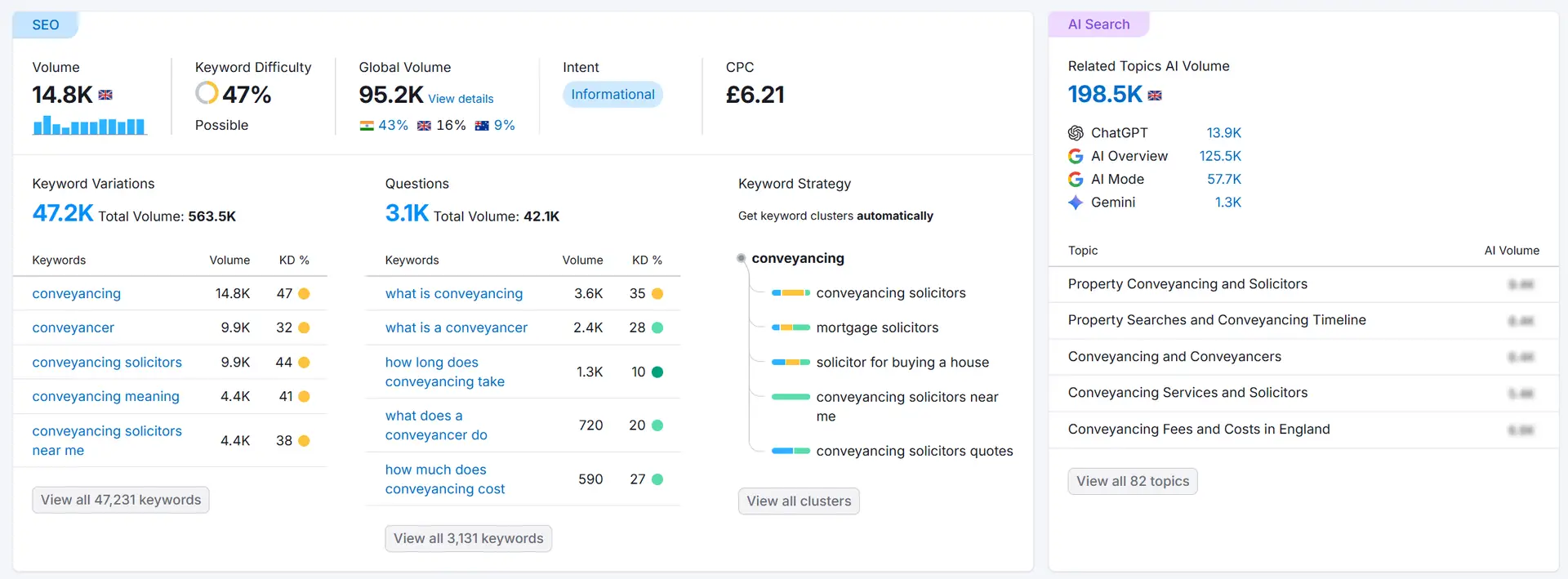
Now tools can help. At this stage you want to go wide, then narrow down later.
Keyword research tools are useful for three things. First, they show phrasing you would not guess. Second, they help you spot long-tail keywords that fit your services. Third, they give you a rough sense of demand, which helps with prioritising.
Treat metrics with care. Search volume and difficulty scores are estimates. They are helpful for comparison, but they are not a promise. For small businesses, relevance and intent usually matter more than chasing the biggest numbers.
When you use a tool, export the suggestions into a spreadsheet. A simple sheet structure keeps this manageable:
- Keyword
- Service theme (which service it belongs to)
- Location (if relevant)
- Intent (hire / compare / learn)
- Page type (service page / location page / blog / FAQ)
- Priority (now / later)
If you cannot assign a keyword to a page type, it is usually not ready to target.
Free keyword research tools you can use today
You do not need paid tools to get started with SEO keyword research. Google already gives you several free ways to see how people search, and for many small businesses, these are enough to build a solid plan.
Start with Google itself. Autocomplete suggestions show you common phrases as you type, often revealing location and intent. The “People also ask” box highlights the questions searchers commonly have, which are ideal for FAQs and blog posts.
Google Search Console is one of the most underused keyword research tools. It shows the exact queries your site already appears for, even if you are not ranking highly yet. These are often your quickest wins. A page with impressions but low clicks usually needs clearer wording, a better title, or a stronger opening.
Google Keyword Planner can also be useful, even if you never run ads. It provides rough search volume ranges and related phrases, which help you compare options and spot patterns.
If you want another free option, tools like Ubersuggest offer limited searches per day and can help surface long-tail variations. Use them to expand ideas, not to chase the biggest numbers.
The goal with free tools is direction, not perfection. You are looking for phrasing, intent, and opportunities you can act on, not exact volumes.
Check search intent before you pick winners
Search intent is the reason behind the search. It’s the difference between someone learning and someone ready to hire.
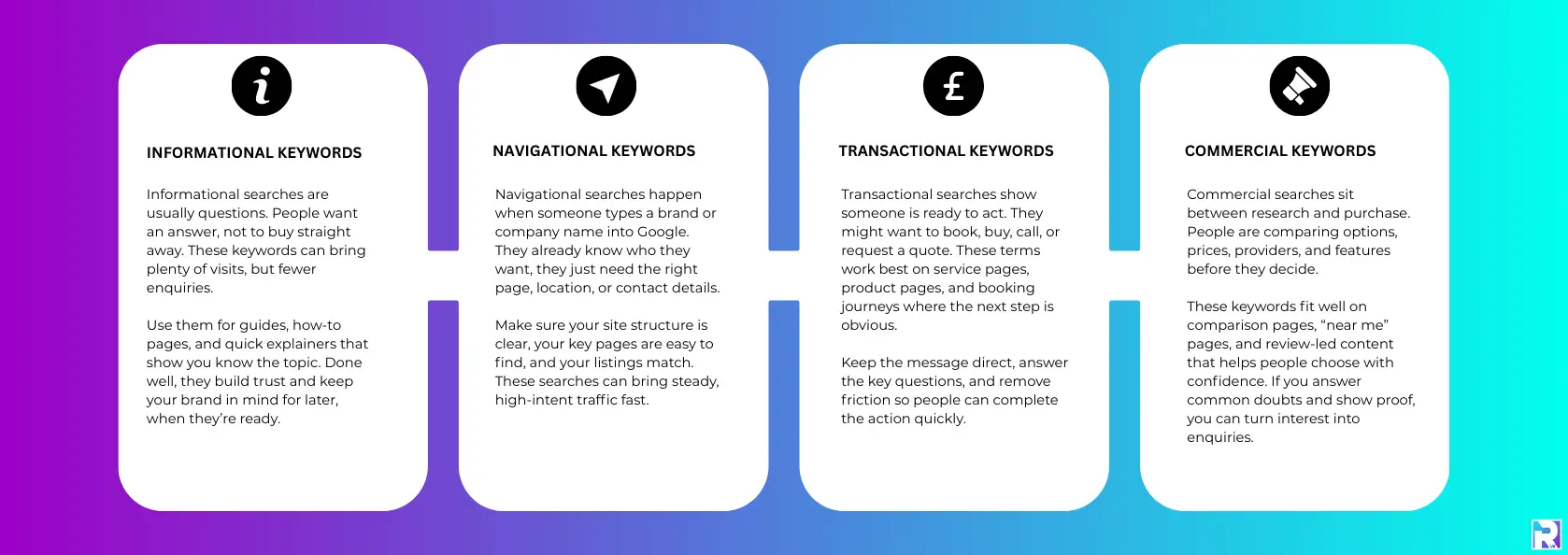
A quick way to judge intent is to search your keyword and look at the first page. If you see service pages and local business sites, it’s often a “hire someone” query. If you see guides, definitions, and long articles, it’s usually an “I’m learning” query.
This matters because it affects what you should create. Trying to rank a service page for an informational query often fails, even if the page is well written. The search results are already telling you what format Google thinks searchers want.
Intent also helps you keep your site tidy. Instead of stuffing one page with every keyword, you can split the work. Service pages cover buying intent. Blog posts and FAQs cover question intent. Comparison pages cover decision intent, if you have a reason to publish them.
Treat long-tail keywords as mini-topics, not tiny add-ons
Long-tail keywords often look too specific to bother with. In practice, they can be the best route to early wins.
Instead of scattering them across your site, group them. For example, “boiler making noise”, “boiler losing pressure”, and “boiler not heating water” can sit under a “Boiler repair” hub, or be grouped into a strong troubleshooting guide that links back to your repair page.
This keeps your site structured. It also makes the content more useful, because you’re answering related questions in one place.
A quick rule that works in real life: if the first page is full of service pages, build or improve a service page. If it is full of guides and definitions, publish a guide or FAQ that links back to the service page.
Competitor keyword analysis, without copying
Competitor keyword analysis helps you find two things. It shows what’s already working, and it shows what’s missing.
Start with a manual review. Search for your main service and your main area. Open a few of the businesses that appear often. Look at the way they name services, the headings they use, and the extra topics they include on their pages, such as pricing, timelines, or common questions.
Then use a tool-based view, if you have one. Competitor tools can show what keywords a site ranks for, which pages bring them traffic, and where there are gaps. The point is not to mimic. The point is to see patterns and decide what your site should cover better.
If you want to speed this up, pull competitor page titles and headings into one place so you can spot repeated patterns quickly. You are looking for what they explain well (pricing, timelines, reassurance, FAQs), and what they avoid. Use that to make one better page, not ten extra pages.
If you want a quick way to pull competitor page data into something you can review, use my SEO Data Extractor tool here: SEO Data Extractor. It’s useful for collecting page titles, headings, and other on-page details across a list of competitors, so you can spot the phrases and page structures that keep appearing in your niche. Check out SEMRUSH’S Competitor Analysis article for more information
Top Tip
“Competitor research is most useful when it leads to clearer pages, not more pages. If you can cover the same topic in a more helpful way, you often do not need to publish ten extra articles.”
Build a local keyword set that matches your real service area
Local keyword research is not just “service + city”. People search in more varied ways than that.
Some will use neighbourhoods. Some will use nearby towns. Some will search with “near me” wording. Some will add a need, like “open now”, “weekend”, or “same day”.
There’s also a practical point that gets missed. Your content needs to reflect where you actually work. If you create location pages for places you do not serve, you may get a few clicks, but you often end up with poor enquiries, higher bounce rates, and awkward calls.
A grounded way to do local SEO keywords is to start with where you already do work. Then expand outwards if it makes business sense. It also helps to use local cues in your copy, like borough names, surrounding areas, and travel times, as long as it stays truthful.
Prioritise your keywords and map them to pages
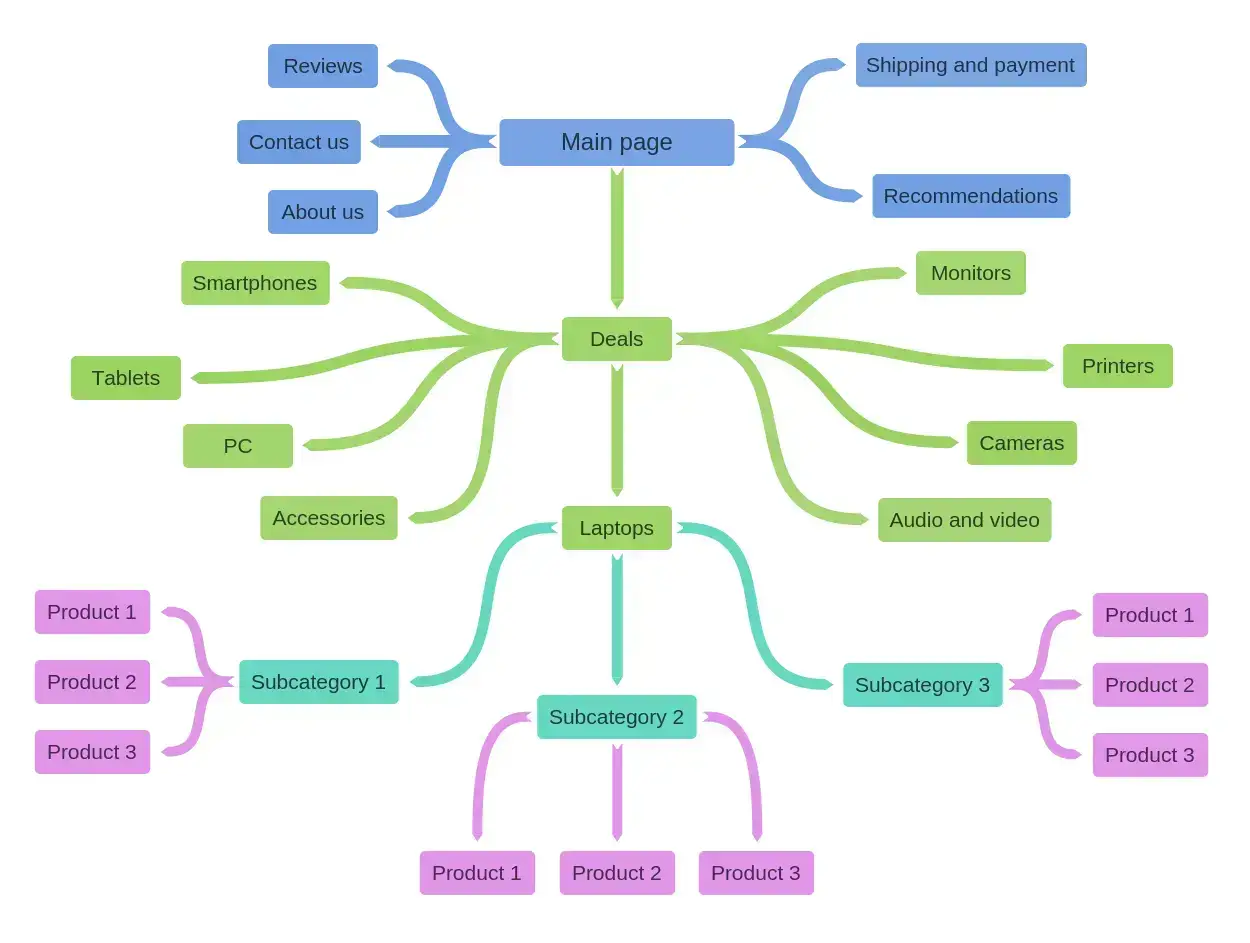
Above is a great illustration by SerpStat on creating a website structure, before keyword mapping, to ensure you have the relevant pages created to help better target the keywords.
At this point you will have a big list. The goal now is turning it into a page plan you can actually build.
Use three filters to prioritise:
- Relevance: does it match what you sell and who you want?
- Intent: does it look like someone wants to hire, compare, or learn?
- Opportunity: can you compete now, or is it a longer play?
Once that’s done, map each keyword theme to a single page. If two pages would target the same theme, combine them and make one page stronger.
Your “hire me” keywords should usually go to service pages. These are your keywords for service pages, like “boiler service Leeds” or “roof repair Bristol”. They should have clear headings, pricing guidance where possible, proof, and a clear next step.
Your “help me understand” keywords usually fit blog posts and FAQs. These topics often support your service pages by building trust and answering common concerns.
Your “compare options” keywords can fit guides, comparison pages, or detailed FAQ sections, depending on your business. Not every small business needs this layer, but it can be useful in competitive niches.
Build one strong service page before you write new blogs
Many small businesses rush into blogging before the core pages are sorted. A strong service page usually does more for enquiries than a generic blog post.
Make sure each main service has its own page. Give it a clear title, strong headings, a short explanation of who it’s for, and the next step. Add a small FAQ section using the question keywords you found during research.
Once those pages are solid, supporting content becomes easier. You know what you are supporting, and you can link to the right page with a clear purpose.
Use keywords in a way that still sounds human
Using keywords well is mostly about placement and clarity, not repetition. Your main keyword should appear in the page title and the H1, in a way that reads naturally. It should also appear early in the page, usually in the first paragraph, because that helps the page feel focused.
Then you use variations through headings and body copy. That includes local variations, related services, and question phrases. This is where long-tail keywords fit well, because they often belong as subheadings or in short FAQ sections.
If your page reads badly, the keyword usage is too heavy. A good check is reading your page out loud. If it sounds like a real person, you are usually fine.
Top Tip
“Add keywords where they help a reader understand the page. If a keyword makes a sentence clumsy, rewrite the sentence. Do not force the phrase.”
Review and adjust, little and often
Keyword research is not a one-time task. Search behaviour changes, competitors change, and your services change. A simple rhythm works well for small businesses.
Once a month, check which pages get organic visits and which pages lead to enquiries. Every quarter, review new queries and questions that show up, then add a few useful sections to your key service pages. Once or twice a year, do a bigger review of your main services and your local pages.
This approach keeps SEO manageable. It also keeps your content accurate, which matters more than people realise. Outdated pages create confusion. Clear pages build trust.
Frequently Asked Questions About SEO Keyword Research
How do I know which keywords should go on service pages?
Service page keywords usually show buying intent, like “price”, “quote”, “near me”, or a clear service and location. The search results often include business sites and service pages, which is a helpful sign. Keep the page focused on one main service, then use related phrases as headings and supporting sections. This makes the page clearer for both visitors and search engines.
What’s a sensible number of keywords to target at once?
A small business can do well by starting with a shortlist of ten to twenty priority terms, then building from there. It’s better to cover a small set properly than spread thin across hundreds of phrases. Once your core pages are performing, add supporting topics through FAQs and blog content. This keeps effort and results aligned.
Are long-tail keywords still worth it?
Long-tail keywords often bring fewer visits, but the intent is usually clearer. That can mean better lead quality, even with lower traffic. They also tend to be less competitive, which can help smaller sites make progress sooner. Group them into topics so your content stays tidy and useful.
Should I create location pages for every town near me?
Location pages work best when they are genuinely useful and reflect where you actually work. Thin pages that only swap place names tend to perform poorly and can create trust issues. Start with the areas that matter most, then expand carefully if you can write pages with real detail. Local keyword research should support your service area, not invent it.
How often should I redo keyword research?
A light review every quarter is enough for many small business sites. You can check new queries, update a few service pages, and add FAQs based on what people are asking. A bigger review once a year helps you catch shifts in services, competitors, and local demand. Keeping the process regular makes it manageable.
The Bottom Line
Keyword research works when it stays practical. Start with the services you sell, expand into real customer phrases, and then use tools to find the wording you missed. Check search intent so you create the right page for the job, then build a shortlist that maps neatly to service pages, local pages, and supporting content.
Most small businesses do not need complicated systems. They need clear pages that match local searches, answer common questions, and make it easy to take the next step. Steady updates, done little and often, tend to beat big bursts of work that never get repeated.
If you’re ready to improve visibility and attract more local customers, get in touch to build a tailored SEO strategy for your business.