When people think about brand consistency, they often think about logos, colours, fonts and tone of voice.
Those things matter, but online brand consistency goes much further.
Your business appears across your website, Google Business Profile, social media, directories, review platforms and other websites. Each appearance contributes to the wider picture of who your business is, what it does and what it is known for.
For SEO, that matters.
The clearer and more consistent that picture becomes, the easier it is for customers and search engines to understand your brand.
This is where brand consistency becomes part of Brand SEO.
Summary
Brand consistency goes beyond using the same logo, colours and tone of voice. From a Brand SEO perspective, it means creating a clear and consistent identity wherever your business appears online. The stronger those connections become, the easier it is for customers, search engines and AI systems to understand what your brand represents.
- Keep your business name, contact information and key details consistent across the web.
- Reinforce the same core services, locations, expertise and brand positioning.
- Adapt descriptions to different character limits without changing their underlying meaning.
- Use your website, Google Business Profile, citations, social profiles and third-party mentions to strengthen consistent brand signals.
- Help search engines connect your brand with the people, places, services and topics associated with it.
- Build recognition by presenting customers with the same identifiable brand across different touchpoints.
- Treat traditional citation consistency as the starting point, not the limit, of brand consistency.
- Review how your brand appears outside your own website to identify conflicting or outdated information.
- Create a clearer foundation for your brand to be understood and retrieved across traditional and AI-powered search.
The simple rule: change the length, not the meaning.
What is brand consistency?
Brand consistency is the practice of presenting your business in a consistent way wherever people encounter it.
Visually, that can mean using the same logo, colours and design style.
But there is another layer that is particularly important for search.
Your business name, services, locations, expertise, people and positioning should all tell the same story.
Imagine a local plumbing company called Hampshire Flow Plumbing.
Its website describes the business as:
Hampshire Flow Plumbing is a family-run plumbing company providing emergency plumbing, boiler repairs and general plumbing services across Portsmouth and South Hampshire.
That description creates several clear associations:
Hampshire Flow Plumbing → plumbing → emergency plumbing → boiler repairs → Portsmouth → South Hampshire → family-run
Those associations shouldn’t disappear when the business is mentioned elsewhere.
Change the length, not the meaning
Different websites have different requirements.
A directory might give you hundreds of characters for a business description, while a social profile may only give you enough room for a short bio.
Brand consistency doesn’t mean forcing the exact same paragraph into every available field.
It means keeping the underlying message consistent.
The full description might read:
Hampshire Flow Plumbing is a family-run plumbing company providing emergency plumbing, boiler repairs and general plumbing services across Portsmouth and South Hampshire.
A platform with a shorter character limit could use:
Hampshire Flow Plumbing provides emergency plumbing, boiler repairs and general plumbing services across Portsmouth and South Hampshire.
A much shorter profile could become:
Family-run plumbers serving Portsmouth and South Hampshire.
The information has been condensed to suit the platform, but the meaning hasn’t suddenly changed.
Change the length, not the meaning.
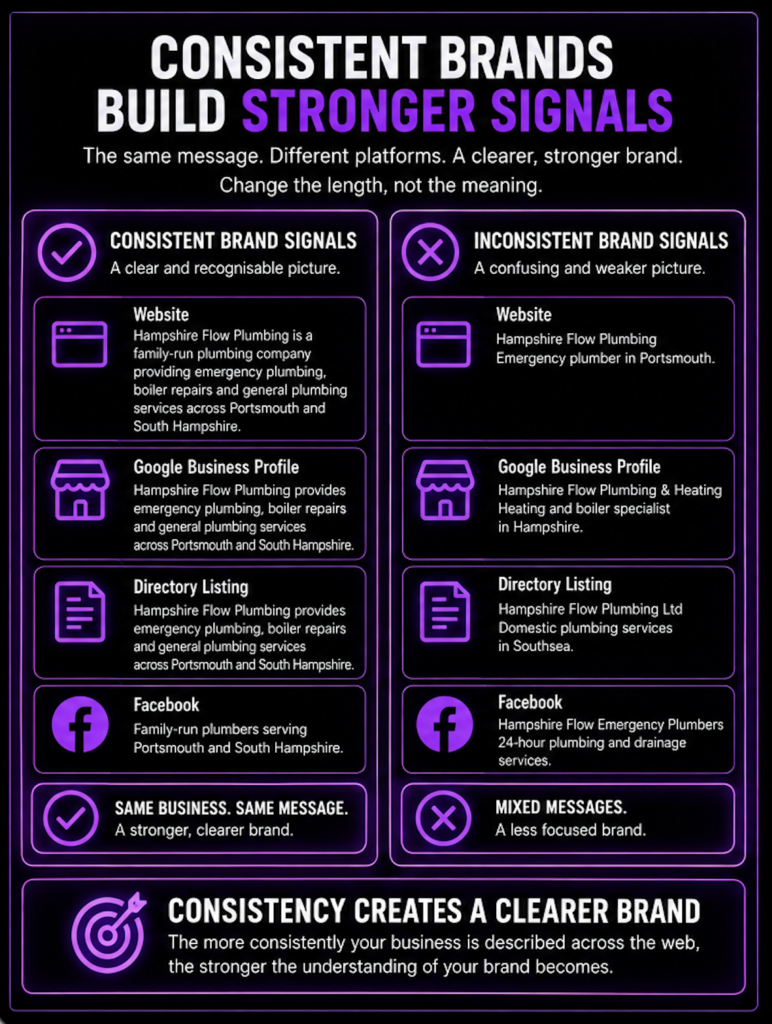
If one profile positions the company as an emergency plumber in Portsmouth, another primarily as a heating engineer in Hampshire and another as a drainage specialist in Southsea, the overall picture becomes less focused.
The more consistently the brand is presented across the web, the clearer its identity becomes.
Brand consistency is also an SEO issue
Brand consistency isn’t traditionally thought of as an SEO task.
It should be.
Google doesn’t encounter your business through your homepage alone.
Information about your brand can appear through your:
- Website
- Google Business Profile
- Business directories and citations
- Social media profiles
- Reviews
- Structured data
- Author and team profiles
- News coverage
- Industry websites
- Links and third-party mentions
Google itself acknowledges that information from outside your website can contribute to its understanding of a business.
Its business profile documentation states that Google can detect category information from a company’s website and from mentions about the business throughout the web.
That’s an important point for Brand SEO.
For our local plumbing company, Google may repeatedly encounter Hampshire Flow Plumbing connected with Portsmouth, plumbing, boiler repairs and emergency plumbing.
Those repeated associations contribute to a much wider picture of the business than any individual keyword on its homepage.
This is where brand signals start to become important.
Before Google can trust your brand, it needs to understand it
SEO has traditionally focused heavily on helping Google understand individual webpages.
We optimise page titles, headings, copy, internal links and structured data to make the subject of a page clear.
Brand SEO takes a wider view.
We also want search engines to understand the business behind those pages.
Who are you?
What do you do?
Where do you operate?
Who is associated with the business?
What subjects are you known for?
What other websites associate you with those subjects?
The answers shouldn’t change significantly depending on where Google encounters your business.
This is one reason consistency matters.
The aim isn’t simply to optimise another page. It’s to create a clear and recognisable identity around the entire business.
From citation consistency to brand consistency
Consistency isn’t a new concept in SEO.
Local SEO has talked about citation consistency for years, particularly around keeping core business information accurate across the web.
Google’s own Business Profile guidelines tell businesses to represent themselves as they are consistently represented and recognised in the real world, including across signage, stationery and other branding. It also says the business name should reflect the real-world name used consistently on the company’s storefront, website and stationery.
For businesses with multiple locations, Google goes even further. It specifically asks brands to maintain consistent names and categories across locations to help customers quickly identify the business in Google Maps and search results.
That’s still important.
But Brand SEO takes the principle further.
We aren’t only trying to establish that Hampshire Flow Plumbing is the same company wherever it appears.
We also want to reinforce what Hampshire Flow Plumbing represents.
If the business wants to become known for emergency plumbing and boiler repairs across Portsmouth and South Hampshire, those associations should appear consistently across its wider online presence.
The business name is consistent.
The contact information is consistent.
The location is consistent.
The services are consistent.
The positioning is consistent.
Together, those elements create a clearer picture of the brand.
Brand consistency and entity SEO
This also overlaps with entity SEO.
Search engines don’t only process individual keywords. They try to understand people, businesses, places, products and the relationships between them.
Your business is one of those entities.
It can have relationships with:
People
Founders, directors, employees and authors.
Places
Your physical location and areas you genuinely serve.
Services
The products and services your business provides.
Topics
Subjects your business demonstrates expertise in.
Organisations
Professional bodies, suppliers, partners and other companies associated with you.
Brand consistency can help make those relationships clearer.
For Hampshire Flow Plumbing, you want the relationship between the company, plumbing, Portsmouth and its main services to be reinforced rather than continually changing.
This isn’t about stuffing the same keywords into every business profile you can find.
It’s about creating a consistent understanding of what the brand actually represents.
Consistency helps build recognition and trust
There is also a much simpler reason brand consistency matters.
People need to recognise you.
A customer might first encounter your plumbing business in Google.
A week later, they see one of your vans.
Later, they see your company recommended in a local Facebook group.
Then they search for a plumber and encounter you again.
Those aren’t necessarily separate interactions in the customer’s mind. Consistent branding helps connect them.
And trust has become a major consideration when people choose brands.
The 2025 Edelman Trust Barometer Special Report: Brand Trust looked at consumers across 15 countries. Edelman’s research found that trust sits alongside considerations such as price and quality when people decide which brands to choose.
It also found that 80% of people trust the brands they use.
That matters when thinking about Brand SEO.
Being visible once isn’t the same as becoming recognised.
Repeated exposure to a consistent brand can help move a business from something a potential customer has simply encountered to something they recognise and potentially trust.
That’s why rankings alone only tell part of the story.
The bigger objective is becoming a business people recognise when you appear.
Brand consistency doesn’t stop with Google
The way people discover businesses is changing too.
Google Search remains hugely important, but brands can now be discovered through social platforms, recommendation websites and AI-powered search and assistants.
Edelman’s research gives us an indication of just how quickly this behaviour is developing.
It found that 55% of respondents use generative AI platforms.
More interestingly, among those people, 91% said they use generative AI for shopping in some way, including researching brands, comparing products and summarising reviews.
That’s a significant shift.
A potential customer doesn’t necessarily need to visit your website, find your Instagram account or even conduct a traditional Google search before encountering information about your brand.
They might simply ask an AI assistant.
These systems also need information to understand businesses and determine which ones are relevant to a request.
If your own website says one thing about your business while the wider web consistently associates you with something completely different, you have less control over how your brand is understood.
The objective should be to create a clear footprint where your website and wider presence reinforce each other.
AI adds another reason to care about brand consistency.
It isn’t the reason to start caring about it.
Where brand consistency fits into Brand SEO
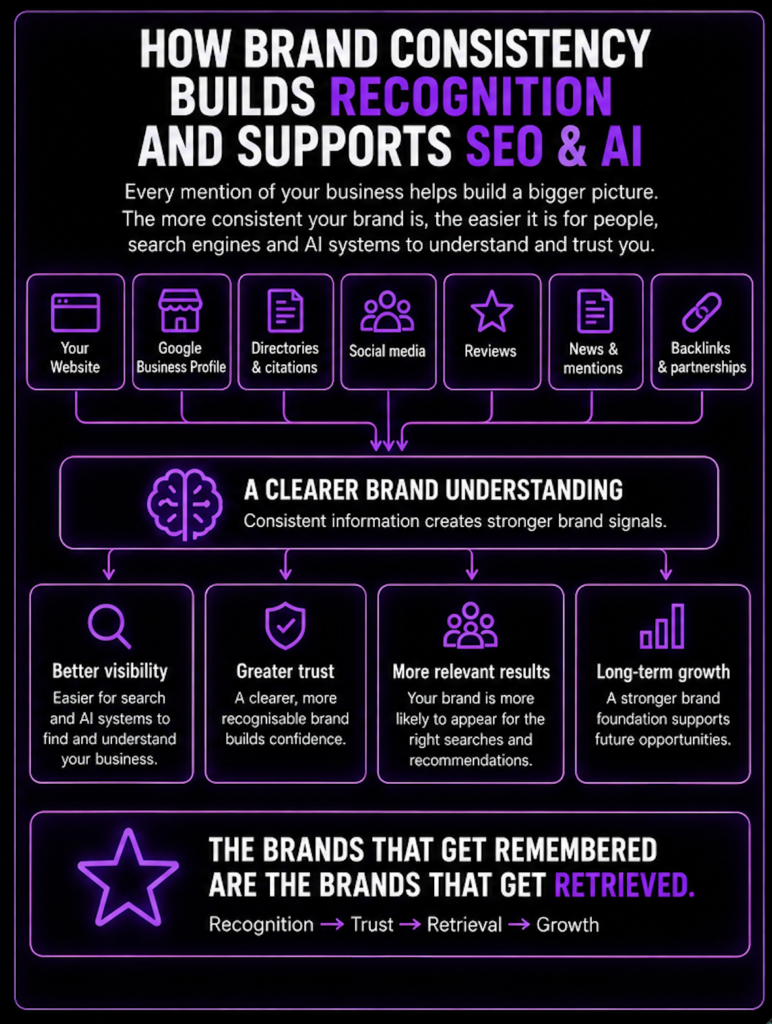
Brand SEO is about building a business that can be found, understood, recognised and retrieved across modern search.
My Brand SEO framework breaks this into five stages:
Presence → Clarity → Recognition → Trust → Retrieval
Brand consistency runs through almost every stage.
Presence
Your brand needs to exist in the places where customers and search engines expect to find it.
That includes your own website, relevant social platforms, business profiles, directories and credible third-party websites.
It’s difficult to build recognition around a brand that barely exists outside its own website.
Clarity
Once your brand is present, it needs to be clear what the business actually represents.
Who are you?
What do you offer?
Where do you operate?
What should you be known for?
Consistency helps answer those questions.
For our plumbing example, repeatedly associating Hampshire Flow Plumbing with plumbing, emergency plumbing, boiler repairs, Portsmouth and South Hampshire helps create a much clearer picture than continually changing how the business describes itself.
Recognition
Repeated exposure to the same brand identity helps build recognition.
Your name, messaging, services and positioning become increasingly familiar rather than appearing as disconnected pieces of information.
This is where Brand SEO starts moving beyond simply being visible.
The objective is to become recognisable.
Trust
Recognition can help support trust.
A business that presents itself consistently across its website and wider online presence creates a clearer picture for prospective customers.
They see the same company name.
The same services.
The same people.
The same location.
The same positioning.
Nothing feels disconnected.
Retrieval
Finally, you want your brand to be associated with the right subjects when someone searches for them.
That could mean appearing prominently in Google when someone searches for a service you provide.
Increasingly, it could also mean being surfaced when someone asks an AI system about businesses related to your field.
The stronger and clearer the associations around your brand become, the better foundation you have for retrieval.
Is your brand actually consistent?
Search for your own business and look beyond your website.
Check your Google Business Profile.
Look at your major directory listings.
Check your social profiles.
Search your company name alongside your main services.
Look at how third-party websites describe you.
Then ask a simple question:
If someone knew nothing about my company, would all of this information give them the same understanding of my brand?
Check:
- Is your business name consistent?
- Are your contact details correct?
- Are your main services described consistently?
- Are the locations you serve clear?
- Are your founders and key people connected with the business?
- Is your positioning consistent?
- Do your profiles use recognisable branding?
- Do third-party mentions broadly reinforce what you want to be known for?
- Does your structured data support the information customers can see on the page?
Don’t change your brand message simply because one platform gives you fewer characters.
Shorten it.
Change the length, not the meaning.
Brand consistency creates a clearer brand
Brand consistency isn’t about making everything look identical.
It’s about making sure everything points back to the same brand.
Your website, profiles, citations, services, messaging and third-party presence should reinforce who you are, what you do and what you want to be known for.
For SEO, that creates clearer brand signals.
For customers, it helps build recognition.
For search engines and emerging AI systems, it provides a clearer picture of the business behind the website.
This is why brand consistency forms an important part of Brand SEO.
Before you can become the brand people search for by name, they need to recognise you.
And before Google can confidently understand your brand, you need to consistently show it what your brand represents.