
I’ve been noticing something recently.
People celebrate branded searches as though they all carry the same meaning.
Someone typed the company name into Google.
Brilliant.
Proof the marketing is working.
Proof the brand is growing.
Maybe.
But I’m not convinced it’s quite that simple.
A first branded search could mean almost anything.
Curiosity.
A recommendation from a friend.
Seeing your van parked outside a neighbour’s house.
Hearing your name mentioned at a networking event.
Someone checking that you actually exist before getting in touch.
The more interesting question might be this:
Did they come back?
Because I think there’s an important difference between someone searching for your brand once and someone actively searching for it again.
The first might reflect awareness.
The second could suggest something deeper.
Familiarity.
Possibly even trust.
And I think that’s the bit many SEO conversations tend to overlook.
We spend a lot of time discussing how to get discovered.
Far less time asking what happens after somebody finds us.
Not all branded searches are equal
Branded search has traditionally been viewed as a positive signal.
Someone knows who you are.
They’ve remembered your name.
They’re looking specifically for your business rather than a generic service.
All good things.
But context matters.
If someone searches your business name once after seeing a social media post, that doesn’t necessarily mean you’ve built a recognised brand.
It might simply mean you’ve captured attention for a moment.
Awareness and recognition aren’t the same thing.
That’s worth repeating because the two terms are often used interchangeably.
Awareness means somebody has encountered your business.
Recognition means they remember it.
Think about the number of businesses you come across each week.
How many could you actually recall by name a few days later?
Probably fewer than you’d expect.
Which is why I’ve started thinking differently about branded search behaviour.
Perhaps the first branded search tells us that awareness exists.
Maybe the second or third branded search tells us something else entirely.
Awareness gets attention. Recognition changes behaviour.
Brand awareness strategies often focus heavily on visibility.
More impressions.
More reach.
More people seeing your name.
There’s nothing wrong with that.
After all, nobody can remember a business they’ve never encountered.
But visibility alone doesn’t guarantee future action.
People forget things remarkably quickly.
Businesses included.
Recognition works differently.
Recognition develops through familiarity.
Repeated exposure.
Consistent experiences.
Clear messaging.
People start associating your name with something specific.
The local accountant who specialises in small businesses.
The plumber who sorted an emergency call-out at short notice.
The SEO consultant who keeps talking about recognition, trust and retrieval.
Those associations matter because they influence future decisions.
The next time somebody needs help, generic searches sometimes become branded ones.
Instead of searching for a service category, they search for the business they remember.
And that’s where branded search behaviour starts becoming more interesting.
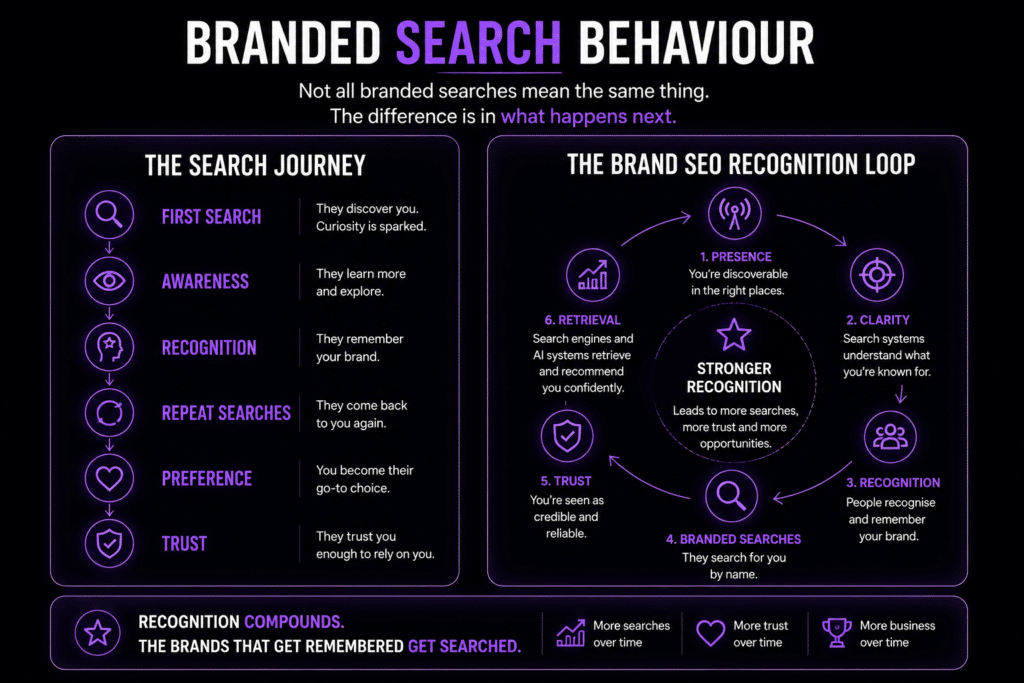
The Branded Search Journey
Why repeat branded searches deserve more attention
I keep coming back to this idea that repeat branded searches might tell us something first-time searches can’t.
They don’t guarantee loyalty.
Search behaviour is messy.
People revisit businesses for all sorts of reasons.
But repeated searches may indicate familiarity is starting to develop.
And familiarity changes behaviour.
People tend to return to names they recognise.
Uncertainty begins to reduce.
Preference may start to form.
Trust often follows.
None of this is a completely new idea.
Ask anyone who’s focused on growth and they’ll usually understand the value of repeat customers.
Starting from zero every single time is hard work.
Search might work in a similar way.
Recognition means you’re not constantly earning attention from scratch.
If somebody actively returns to your business through branded searches, you’re no longer relying entirely on discovery.
Recognition starts doing some of the heavy lifting.
I don’t think enough people talk about that.
Because the conversation around branded search often centres on volume.
How many people searched for the brand?
How quickly is demand growing?
Important questions, certainly.
But perhaps the quality of branded demand deserves a little more attention too.
Research from Ahrefs found that branded searches make up a surprisingly large proportion of Google searches. That alone tells us brands matter. The more interesting question, at least from my perspective, is what happens after that first search. Are people returning because recognition is beginning to develop, or are they simply passing through?
Brand SEO might be more about memory than we realise
The more I think about Brand SEO, the more I wonder if memory is the piece we’ve underestimated.
Traditional SEO Services have done a brilliant job helping businesses get discovered.
Rankings matter.
Visibility matters.
If people can’t find you, very little else happens.
But visibility alone doesn’t guarantee recall.
Someone can land on your website, spend ten minutes reading your content and completely forget your name a week later.
That’s where Brand SEO becomes interesting.
The conversation shifts from:
Can people find you?
Towards:
Will people remember you?
Because the brands people remember are often the brands they search for again.
Search visibility extends beyond rankings.
It extends into familiarity.
And familiarity tends to build gradually.
Small interactions stack up over time until people stop searching generically and start searching specifically.
That doesn’t happen overnight.
It rarely happens because of one campaign.
It often develops through consistency.
Which brings us to something that doesn’t always receive enough attention.
Sometimes the issue isn’t visibility
Sometimes the issue isn’t visibility at all.
It’s clarity.
People land on a website and leave without a clear understanding of what the business actually wants to be known for.
That’s usually where recognition starts to struggle.
This is one of the reasons on-page SEO matters beyond rankings.
Of course, title tags, headings and content structure remain important.
But clarity matters too.
Can visitors quickly understand:
- who you help?
- what you do?
- why they should choose you?
- what makes your approach different?
Confusion rarely creates recognition.
Clear service pages help reinforce the associations people carry away after visiting your website.
Good on-page SEO helps search engines understand your pages.
It can also help people understand what you should be remembered for.
And if recognition is partly a memory challenge, that clarity becomes increasingly valuable.
If this idea resonates, understanding the role of brand clarity within search provides another useful piece of the puzzle.
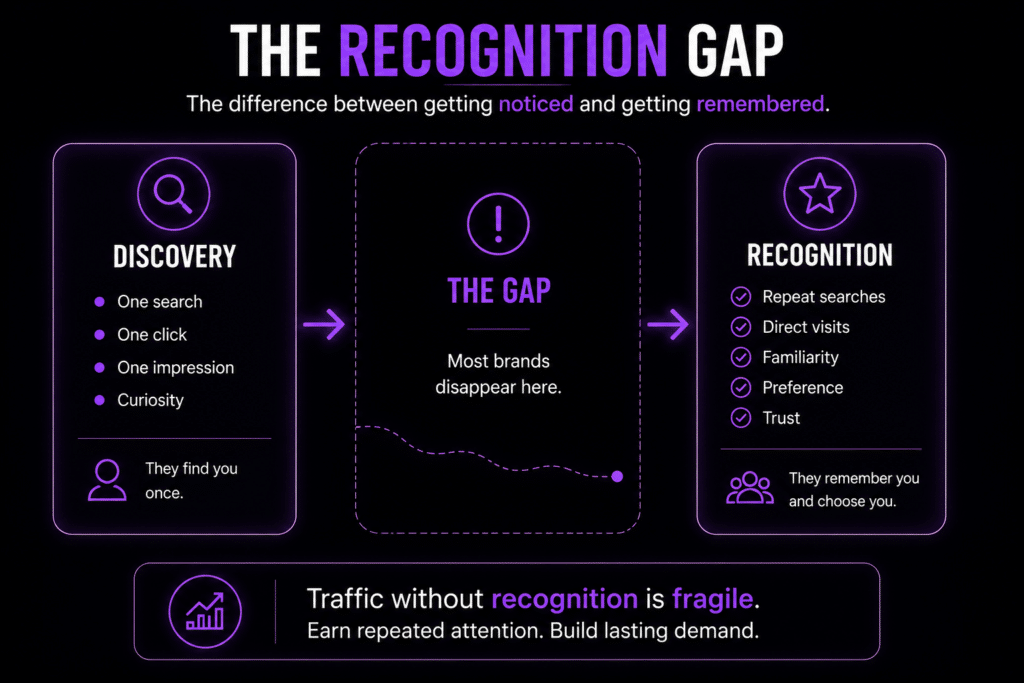
The Recognition Gap
This is probably where things become a little more uncomfortable.
It’s easy to assume visibility naturally turns into recognition.
I’m not sure it does.
People discover businesses every day and forget them just as quickly.
Someone clicks through from Google.
They skim a few pages.
They compare a couple of alternatives.
Then life gets in the way.
The opportunity disappears.
I think this is where the gap exists.
The space between being noticed and being remembered.
And that gap gets overlooked constantly.
It’s tempting to assume that if traffic is increasing, recognition must be improving too.
But they’re not always connected.
A website can attract visitors without creating any lasting impression.
That’s why consistency matters.
The language you use.
The problems you solve.
The way you describe your services.
The experiences people have when interacting with your business.
Over time, those things reinforce associations.
Or they dilute them.
Neither happens instantly.
The Recognition Gap
Local businesses often experience this shift first
Local businesses tend to see this happen in real time.
The first search is usually generic.
“Electrician near me.”
“Coffee shop in Bristol.”
“Accountant nearby.”
Discovery happens.
People compare options.
They make a decision.
Then something changes.
The next search often becomes branded.
Instead of searching for the service category, people search for the business they remember.
The coffee shop they enjoyed.
The plumber who solved the problem quickly.
The accountant who explained everything clearly.
Recognition influences behaviour.
Familiarity changes the way people search.
Which is one of the reasons local SEO extends beyond map rankings and directory listings.
Visibility creates opportunity.
Recognition encourages people to come back.
What repeat searches might tell search systems
It’s important to avoid making assumptions about exactly how search engines interpret behavioural signals.
Google doesn’t publish a rulebook explaining how every interaction influences rankings.
Search is more complicated than that.
Still, recognised brands often share certain characteristics.
People search for them directly.
They revisit them.
They recommend them to others.
Interest extends beyond individual campaigns.
Google has consistently emphasised the importance of creating helpful experiences for people.
Trust matters.
Satisfaction matters.
Confidence matters.
Recognition alone doesn’t guarantee trust.
But trust rarely develops without recognition.
People generally prefer familiar choices when uncertainty exists.
Search behaviour doesn’t seem entirely immune from that tendency.
What should we actually measure?
I don’t think any of this means traditional SEO metrics stop being useful.
Traffic still matters.
Rankings still matter.
Clicks still matter.
The point isn’t to replace those measures.
It’s to broaden the conversation.
If recognition matters, perhaps the signals we pay attention to should evolve slightly too.
Useful indicators could include:
- branded impressions within Google Search Console
- branded clicks over time
- direct traffic trends
- repeat visitors
- local branded searches
- Google Trends data for your business name
None of these provide definitive answers.
Search behaviour is rarely that straightforward.
But they may offer useful clues about how recognition is developing.
Because branded search volume tells one story.
Repeat branded behaviour might tell another.
The stronger SEO strategies don’t stop at discovery
I think this is where the conversation becomes commercially important.
Traditional SEO has often focused on attracting new visitors.
New clicks.
New opportunities.
And understandably so.
Discovery matters.
You can’t build relationships with people who never encounter your business.
But constantly rebuilding awareness has limitations.
Anyone who’s ever tried to generate demand from scratch month after month knows how exhausting it can become.
Recognition creates momentum.
People who remember your business often require less persuasion than people encountering it for the first time.
That’s true within customer relationships.
It may also be true within search behaviour.
Which is why I don’t see Brand SEO as separate from traditional SEO services.
I see them supporting one another.
Traditional SEO asks:
Can people find you?
On-page SEO asks:
Do people and LLMs understand you?
Brand SEO asks:
Will people remember you?
Local SEO asks:
Will people recognise you next time they need you?
Those questions don’t compete.
They build on one another.
Don’t stop celebrating branded searches
They still matter.
They suggest awareness exists.
They show people are discovering your business somewhere along the way.
I just think repeat branded searches deserve a little more attention than they currently receive.
Because the second search may represent something the first one couldn’t.
Recognition.
Familiarity.
Growing confidence.
The possibility that somebody actively chose to return.
That doesn’t happen by accident.
It often develops through clarity.
Consistency.
Helpful experiences.
And repeated reinforcement of what you want to be known for.
Maybe that’s the real opportunity.
Not simply becoming easier to find.
But becoming easier to remember.
Looking beyond rankings
If your SEO strategy focuses exclusively on visibility, it might be worth asking a different question.
What happens after discovery?
Do people understand what you stand for?
Will they remember your business next week?
Will they actively seek you out when the need returns?
Because the strongest SEO strategies don’t stop at helping people find you.
They help people recognise you too.
If you’d like to understand how Brand SEO helps businesses become more recognisable, trusted and retrievable across search ecosystems, explore the Brand SEO framework and see how visibility increasingly extends beyond rankings alone.
The goal isn’t simply to get people to search for your business.
The goal is to become memorable enough that they search for it again.