
SEO pricing confuses a lot of business owners.
One company quotes a few hundred pounds a month. Another quotes several thousand. Both call it “SEO”, but neither really explains what you are paying for or why the gap is so wide.
That is usually the point where people ask the same question:
How much should SEO actually cost?
The honest answer is that SEO is not a fixed product. It is a collection of different types of work, and the cost depends on what your website actually needs.
Some sites need technical repairs before anything else will work properly. Others already have decent foundations but need stronger service pages, better local visibility, or content that answers the questions customers are already searching for.
That is why pricing varies so much.
Most businesses end up paying for SEO in one of two ways. Some invest monthly so the site keeps improving steadily over time. Others pay for specific projects, like a technical clean-up, a detailed audit, or rewriting key pages.
But nearly every worthwhile SEO campaign starts in the same place.
An audit.
Because without one, people often spend money on activity instead of progress.
An SEO audit gives you a baseline. It shows what is holding the site back, where the easiest gains are likely to come from, and what probably does not deserve budget yet. That part gets overlooked constantly.
Semrush explains this quite clearly in their own guidance around SEO pricing. Costs vary because every business starts from a different position, has different goals, and needs different levels of work. The important thing is understanding what you are paying for and why.
Summary
- SEO pricing varies because websites, industries, and competition levels vary.
- Small UK businesses often pay anywhere from a few hundred pounds to several thousand depending on the scope.
- Monthly retainers usually suit ongoing growth and regular improvements.
- One-off projects work well for audits, technical fixes, migrations, or page improvements.
- An SEO audit is normally the best place to start because it shows what actually needs fixing.
- Technical issues, weak content, poor local signals, and site structure problems all affect cost.
- Cheap SEO is not automatically bad, but low-quality ongoing work often creates bigger problems later.
- Good SEO conversations should focus on outcomes, priorities, and scope, not vague promises.
- Nobody credible can guarantee a permanent number one ranking on Google.
- The goal is not rankings alone. It is enquiries, leads, bookings, and sales.
How much does SEO cost in the UK?
There is no single “correct” SEO price, but there are realistic ranges that help set expectations.
For smaller business websites in the UK, ongoing SEO often sits somewhere between £300 and £1,500+ per month. Freelancers, consultants, and agencies all price differently, and the market itself changes depending on competition, location, and how much work is actually involved.
For larger businesses, competitive sectors, e-commerce sites, or companies covering multiple locations, costs usually rise quite quickly.
One-off SEO projects are normally priced separately. Things like technical audits, fixing indexing problems, improving key landing pages, or cleaning up site structure often range from around £300 to £2,500+, sometimes more on larger websites.
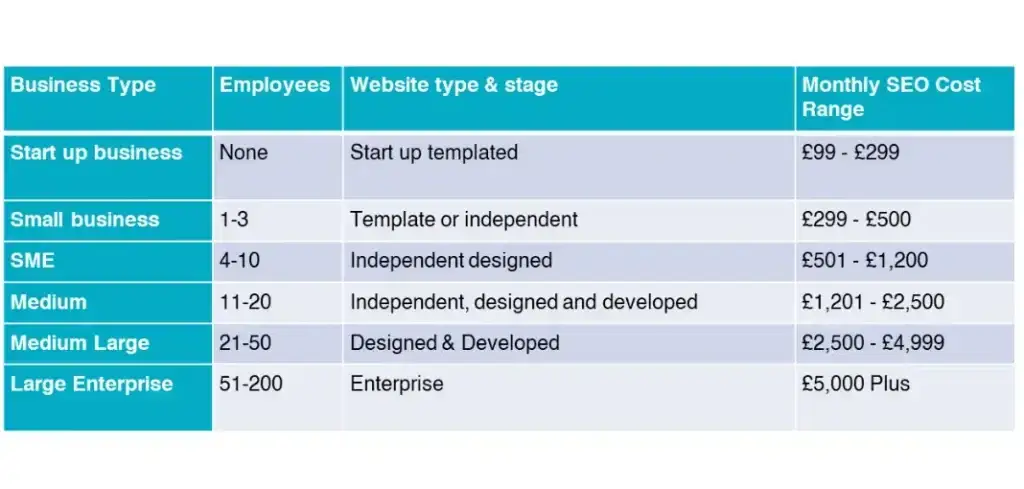
Aqueous Digital published a useful overview of SEO pricing in the UK for 2025, and while every provider will structure pricing differently, it gives a reasonable sense of typical market ranges.
Still, the invoice number on its own does not tell you much.
What matters is the actual work being done.
Are key pages improving?
Is the technical setup being fixed properly?
Are enquiries increasing?
That is where the value sits.
What Actually Changes the Cost?
A handful of things usually drive SEO pricing.
Competition is the obvious one.
A local electrician in a smaller town is not competing with the same level of websites as a London law firm, national retailer, or finance company. The harder the market is, the more work is needed to stand out.
Then there is the condition of the site itself.
Some websites look fine on the surface but have years of technical issues underneath. Broken internal links. Thin pages. Duplicate content. Poor indexing. Slow templates. Weak structure. Honestly, this is where things often become messy.
If the foundations are weak, early SEO budget usually goes into repairs before growth work really starts moving.
Content demand matters too.
If you need stronger service pages, local landing pages, FAQs, buying guides, or supporting articles, the workload increases because somebody still has to plan, write, optimise, review, and publish all of it properly.
This is exactly why audits matter so much.
Without one, people often pay for the wrong work first.
Top Tip
“Ask what is included and what ‘done’ actually means.”
A fair SEO fee depends entirely on scope. Ask how many pages are being worked on, what reporting looks like, and how success is measured beyond rankings.”
Why SEO Audits Usually Come First
A proper SEO audit is not just a report full of screenshots and scores.
It should explain:
- what is broken
- what is slowing growth down
- what is already working
- what needs fixing first
- what can probably wait
More importantly, it gives you a plan.
Without that clarity, businesses often spend the first few months of SEO paying for “setup”, unclear tasks, or generic activity that never really leads anywhere.
A good audit normally reviews:
- indexing and crawlability
- site structure
- page quality
- internal linking
- technical issues
- local visibility
- content gaps
- search intent alignment
- quick wins based on real search data
Then it should prioritise the work.
That part matters.
Because not every issue deserves immediate attention.
Some fixes move the needle quickly. Others barely matter.
Top Tip
“Treat the audit like a budgeting tool, not just an SEO document. It helps you focus spending where the impact is most likely to happen first.”
SEO Consultancy
SEO consultancy works well for businesses that already have people internally who can implement changes.
Maybe you already have:
- a developer
- a content writer
- an in-house marketer
- somebody managing the website day to day
In those situations, paying for strategic direction can make far more sense than outsourcing everything.
Consultancy usually includes things like:
- keyword and page mapping
- technical guidance
- content planning
- draft reviews
- search intent analysis
- regular check-ins
- reporting and prioritisation
Pricing is normally hourly, session-based, or offered as a lighter monthly package.
It tends to suit businesses that need experience and direction more than hands-on delivery.
Technical SEO
Technical SEO covers the behind-the-scenes parts of the website that affect crawling, indexing, speed, and usability.
Some of the work is invisible to visitors, but search engines care about it a lot.
This can include:
- redirect chains
- duplicate URLs
- canonical issues
- broken internal links
- mobile usability problems
- structured data errors
- indexing problems
- slow templates
- bloated page structures
Technical work is often handled as a one-off sprint.
Especially on older websites.
Because once issues build up over several years, spreading tiny fixes across endless monthly retainers rarely makes much sense.
In many cases, fixing major blockers upfront creates faster progress than months of smaller adjustments.
Local SEO
Local SEO focuses on visibility in specific towns, cities, or service areas.
Things like:
- “near me” searches
- town-based searches
- map listings
- location pages
- local service visibility
For many small businesses, local SEO is one of the clearest and most cost-effective ways to increase enquiries.
The work usually includes:
- Google Business Profile optimisation
- local landing pages
- consistent business information
- local relevance signals
- review support
- internal linking between service and location pages
Single-location businesses often see relatively clear returns from this kind of work.
Costs usually rise when there are multiple branches, duplicate listings, or messy local signals already in place.
Still, compared to broader national SEO, local campaigns often produce clearer commercial outcomes faster.
On-Page SEO
On-page SEO is the work done directly on the pages people actually land on.
That includes:
- titles
- headings
- internal linking
- page structure
- service copy
- FAQs
- search intent alignment
- improving clarity and relevance
This is usually where conversion improvement and SEO overlap.
Because attracting traffic means very little if the pages themselves are weak, unclear, or difficult to trust.
On-page work is often priced:
- per page
- per batch of pages
- or inside a monthly retainer
And honestly, it is often some of the highest-value SEO work available because it improves the pages already closest to generating leads.
Monthly SEO vs One-Off SEO Work
Most businesses end up choosing between two broad approaches.
Monthly SEO
Monthly SEO is usually ongoing support.
You are paying for:
- regular improvements
- planning
- technical fixes
- content work
- tracking
- reporting
- prioritisation
This approach suits businesses that want steady growth over time and can consistently approve work, publish content, and improve the site month after month.
SEO compounds when momentum builds.
That is one reason retainers exist.
One-Off SEO Projects
One-off SEO is different.
This is defined work with a clear scope.
Examples include:
- SEO audits
- technical clean-ups
- local SEO setup
- site migrations
- page rewrites
- content restructures
This model works well for businesses that want clarity, fixed deliverables, and staged improvements rather than long-term ongoing support straight away.
A lot of businesses actually combine both approaches.
They start with one-off work to fix the foundations, then move into ongoing SEO once the site is in a healthier position.
Top Tip
“Starting small is usually smarter than trying to do everything at once. One strong service page supported by a few genuinely useful pages often performs better than a huge rushed rollout.”
What Are You Really Paying For?
This is the part many SEO proposals gloss over.
Two companies can both sell “SEO” while delivering completely different levels of work.
One provider might spend the month tweaking titles.
Another might:
- rebuild internal linking
- improve service pages
- fix technical blockers
- create location content
- improve conversion paths
- clean up indexing issues
Same label.
Very different workload.
That is why scope matters so much.
Broadly speaking, SEO work usually falls into three areas:
- technical SEO
- on-page SEO
- off-site SEO
Technical SEO helps search engines crawl and understand the website properly.
On-page SEO improves the actual pages that generate enquiries.
Off-site SEO supports authority and trust signals outside the website itself.
The mix changes depending on the business.
Be Careful With Add-Ons and Guarantees
SEO proposals sometimes include extra services with impressive sounding labels.
Things like:
- “Google penalty protection”
- “guaranteed rankings”
- “review optimisation”
- “authority boosting systems”
Some of these services can have value.
Some are mostly marketing language.
Penalty protection is a good example.
If SEO is being done properly in the first place, the goal is to avoid risky shortcuts entirely. So packaging “protection” as a separate add-on can feel a bit artificial.
Reviews are similar.
You cannot control what customers say. You can encourage reviews fairly and respond professionally, but that sits closer to reputation management than core SEO.
Useful? Sometimes.
Core SEO work? Not really.
So when comparing proposals, focus less on impressive labels and more on the actual tasks being completed.
That is usually where the truth sits.
What Good SEO Pricing Conversations Should Look Like
A good SEO conversation should feel specific.
You should understand:
- what is being worked on
- what happens first
- how progress is measured
- what is included
- what is not included
If the proposal stays vague the entire time, that is normally a warning sign.
It is also worth asking practical questions.
For example:
Does the fee include content writing?
Does it include implementation?
Are technical fixes carried out directly or just recommended?
Is local SEO included?
How many pages are actually being improved?
Those details matter far more than flashy reporting dashboards.
HubSpot also have a useful breakdown of common SEO service models and pricing expectations if you want another general reference point.
Should You Trust Number One Ranking Guarantees?
Short answer?
No.
Or at the very least, approach them carefully.
Some SEO companies use guarantees because they sound reassuring. The problem is that “number one on Google” can mean almost anything.
It could refer to:
- a keyword nobody searches for
- a phrase with no commercial value
- a short-term ranking that disappears a month later
- an extremely niche variation with no real traffic
Google themselves are fairly direct about this.
Their own guidance states that nobody can guarantee a number one ranking.
And realistically, search results change constantly anyway.
Competitors improve.
Markets shift.
Search behaviour changes.
Algorithms update.
Good SEO is usually slower and less dramatic than marketing promises make it sound.
It is structured improvement applied consistently over time.
That is what tends to last.
Questions Worth Asking Before Hiring an SEO Company
Price only means something when you understand the work behind it.
So before choosing an SEO provider, ask practical questions.
Things like:
- Which pages will you prioritise first?
- Why are those pages the priority?
- How much on-page work is included monthly?
- What technical issues need fixing?
- Who actually implements the changes?
- What off-site work is included?
- How is success measured beyond rankings?
You are not just comparing prices.
You are comparing thinking, priorities, and execution.
That part matters far more.
FAQs Around SEO Pricing
Is cheap SEO ever worth it?
Sometimes.
For smaller one-off jobs like audits or focused page improvements, lower-cost SEO can still be useful.
Cheap ongoing SEO becomes risky when the work relies on thin content, spammy links, automation, or generic templates.
That usually causes problems later.
Why do SEO prices vary so much?
Because SEO is not a fixed service.
Competition levels, technical issues, site size, content requirements, and business goals all change the workload.
A clean local site in a quieter market simply needs less work than a large e-commerce site competing nationally.
Do businesses need monthly SEO forever?
Not always.
Some businesses clean up the site, improve core pages, then move into lighter consultancy or occasional maintenance.
Others need ongoing SEO because the market is competitive or the website changes constantly.
Can SEO be bought as a one-off project?
Yes.
Audits, technical fixes, migrations, local setup work, and on-page improvements are all commonly handled as projects.
Long-term growth often benefits from ongoing work, but not every business needs a heavy monthly retainer.
What should happen before paying for SEO?
Tracking should be set up properly.
Goals should be clear.
And ideally, there should be some kind of audit or baseline review first.
Otherwise it becomes very difficult to judge progress properly.
How This All Fits Together
When people ask, “How much does SEO cost?”, what they usually mean is something slightly different.
They are really asking:
“How much will it cost for my business to generate more enquiries from search?”
That answer depends on your market, your competition, and the current condition of the site.
But one thing does stay consistent.
Clarity saves money.
Starting with an audit usually prevents wasted spend.
Prioritising the right pages creates momentum faster.
Fixing technical blockers early often improves everything else that follows.
And focusing on enquiries rather than vanity metrics keeps the work commercially grounded.
If you are comparing SEO options right now, focus less on impressive promises and more on understanding the actual work being proposed.
That is usually the difference between SEO that quietly compounds over time and SEO that simply creates activity.
If you want a tailored SEO strategy and a clearly costed plan, share your website, your main services, and the areas you want to target. From there, it becomes much easier to map out what the site genuinely needs and what can probably wait for later.