
The Costa Coffee test for smarter SEO
Walk into Costa Coffee and say, “I want a coffee.”
You are not getting handed a drink immediately. You are getting questions.
What kind? Large or small? Hot or iced? Dairy or oat milk? Sit in or take away?
That happens because “coffee” is too broad on its own. Costa sells loads of different drinks, and each one solves a different need. Someone grabbing a flat white before work is looking for something completely different from somebody ordering an iced caramel latte on a warm afternoon.
Search queries work in much the same way.
People do not type keywords into Google for entertainment. They search because they want something specific to happen next. Sometimes the goal is obvious. Sometimes it is hidden behind a broad phrase that could lead in several directions.
That’s where Search Intent Content Structure becomes useful. Instead of creating endless pages for tiny keyword variations, you organise content around the actual job the person is trying to get done. If the outcome stays the same, you usually keep things on one page and improve the sections. If the outcome changes, that’s normally the point where a new page makes sense.
Done properly, this usually leads to stronger pages, fewer thin URLs, cleaner internal links, and a site that feels easier to navigate for real people.
Summary
- Search intent is about the outcome behind a query, not the exact wording someone types into Google.
- Broad searches often contain several possible goals hidden inside one phrase.
- A search like “Costa Coffee” could mean locations, menus, opening times, calories, allergens, or prices.
- If several keywords solve the same problem, they usually belong on one page with clear sections.
- New URLs should only appear when the searcher’s goal genuinely changes.
- Publishing lots of near-identical pages often causes cannibalisation and weaker rankings.
- Good content structure gives each search intent one clear “home” page.
- Mixed search results are usually a sign of mixed intent behind the query.
- The goal is not covering every wording variation separately. It’s helping people complete their task quickly and clearly.
Search Intent Explained
Search intent is simply the outcome someone wants after they search for something.
That’s the important part people sometimes miss. The keyword itself is only a clue. The real focus is the reason behind it.
Two people can use completely different phrases and still want the same result. At the same time, one short search can mean several different things depending on the person searching.
Take “Costa Coffee” again.
One person wants the nearest branch. Another wants to check calories. Somebody else wants the menu. Another person might be searching for allergen information before ordering.
Same wording. Different jobs.
This is why structuring content around intent matters more than obsessing over tiny keyword differences.
When you organise content around the actual task, pages tend to become more useful naturally. They answer the core question first, then deal with the related follow-up questions people usually have afterwards. The page feels complete rather than stretched thin across dozens of separate URLs.
That’s really what search intent content structure is trying to solve.
One page per outcome.
Not one page per wording variation.
If the goal stays consistent, improve the page structure and build stronger sections. If the goal changes, split it properly and make the difference obvious through the title, headings, and overall page type.
Honestly, this is where a lot of SEO strategies become messy. Businesses end up publishing pages simply because a keyword tool surfaced another variation, not because the user actually needed a different experience.
The four search intent types
Most SEO frameworks break search intent into four broad categories. The labels themselves are not especially important, but the thinking behind them is useful because it helps you avoid building the wrong type of page.
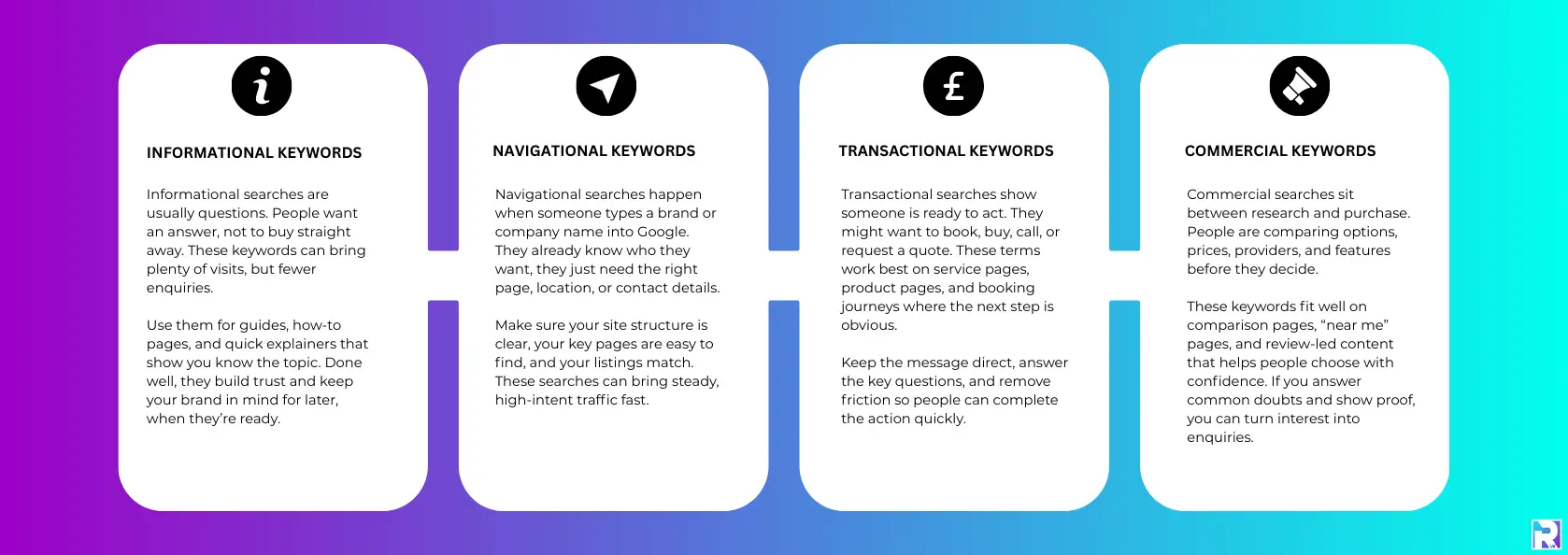
Informational intent
The person wants to understand something.
They may be learning, researching, comparing ideas, solving a problem, or trying to make sense of a topic before taking action later.
These searches usually need explanation, structure, clarity, and enough detail to help somebody move forward confidently.
Navigational intent
The searcher already knows where they want to go.
They are simply using Google as a shortcut.
That’s why people type searches like “Costa menu”, “Facebook login”, or “HMRC contact number” instead of navigating directly through the website itself.
The goal here is speed and clarity. People want the quickest route to the right page.
Commercial intent
This sits in the middle ground before a decision.
The person is getting closer to taking action, but they still need reassurance. They are comparing options, checking reviews, reading opinions, or narrowing choices down.
A lot of “best”, “review”, and “vs” style searches sit here.
Transactional intent
This is the action stage.
The person is ready to buy, book, order, sign up, or contact somebody. They do not want a long educational journey at this point. They want a smooth path towards completing the task.
If the page slows them down unnecessarily, frustration usually follows pretty quickly.
Query breadth matters more than keyword length
One of the biggest mistakes in SEO is assuming longer keywords automatically mean narrower intent.
They don’t always.
Breadth is about how many realistic outcomes sit behind the search.
A single-word query can be extremely broad. “Books” is broad. “Insurance” is broad. “Coffee” is broad.
But even longer searches can still contain multiple meanings if several valid goals exist underneath them.
That’s what makes broad queries difficult.
Using the Costa example again, “coffee” could lead towards drink recipes, caffeine content, coffee beans, nutrition, brewing equipment, coffee shops, or brand-related searches. Those are not minor variations of one task. They are completely different tasks.
Trying to cram all of that onto one page usually creates something bloated and unfocused. Readers end up scanning endlessly trying to find the bit that actually matters to them.
A search like “Costa flat white calories” is much tighter.
The person wants a very specific answer. Maybe they also want supporting details like milk options or serving sizes, but the core outcome is obvious straight away. One focused page can satisfy that properly because the goal is already clear.
That’s why query breadth matters far more than raw word count.
The useful question is this:
How many reasonable interpretations exist behind the search?
If several outcomes make complete sense without stretching logic, the query is broad and your structure should reflect that.
Why keyword variations do not always need separate pages
SEO tools are useful, but they can also create a lot of unnecessary clutter if you follow them too literally.
Platforms like SEMrush, Ahrefs, and AlsoAsked can surface hundreds of related searches around the same topic. That data helps you understand how people phrase things, which is valuable. The problem starts when every variation gets treated like it deserves its own URL.
That’s usually where sites begin creating pages that are almost identical.
The wording changes slightly. The intent does not.
Over time, those pages start competing against each other because Google struggles to understand which one is supposed to be the main answer. Rankings become unstable. Internal linking becomes awkward. And readers land on pages that feel nearly right instead of fully right.
Most businesses have seen this happen without realising it.
You search your own site and suddenly discover:
- “SEO pricing guide”
- “SEO costs explained”
- “How much does SEO cost?”
- “SEO pricing UK”
Four pages. Same job.
At that point, the issue is not keywords anymore. The issue is structure.
A better approach is treating keyword variations as language rather than architecture.
You naturally include different phrasing throughout the copy, headings, and supporting sections, but you only create a new page when the searcher genuinely needs a different experience or outcome.
That one distinction clears up a surprising amount of SEO confusion.
New outcome? New URL.
Same outcome? Improve the page you already have.
Overlap is normal when each page has a clear home
A lot of people worry too much about overlap between pages.
In reality, some overlap is completely natural because humans do not learn in perfectly isolated steps.
People move around topics. They begin broadly, narrow things down, then come back to related questions afterwards. Good content supports that journey instead of trying to force every topic into strict isolation.
The important part is clarity.
Each major outcome should have one clear “home” page where the topic is fully explained in depth. Other pages can reference it naturally where relevant, but there should still be one obvious destination where the complete answer lives.
That structure keeps the site cleaner without making it feel rigid or artificial.
It also helps search engines understand which page carries the primary relevance for that intent.
Without that clarity, pages can drift into competition with each other very easily. And honestly, this tends to happen slowly over time rather than all at once. Businesses publish one extra page here, another variation there, and eventually the structure becomes difficult to manage properly.
What to do when the search results look mixed
Sometimes you search a keyword and the results page looks all over the place.
You might see:
- blog posts
- ecommerce pages
- videos
- local listings
- forums
- comparison articles
That usually signals mixed intent.
Google is effectively saying, “People searching this could want several different things.”
It is the SEO equivalent of walking into Costa and saying, “coffee” without adding any detail.
In situations like that, there are usually two sensible approaches.
The first is choosing one intent deliberately and building the strongest version of that page type possible. If you are writing an informational guide, make that obvious immediately through the title, introduction, headings, and structure. Do not try to squeeze every possible intent into one URL.
Just do one job properly.
The second option is creating a broader hub page that introduces the topic, then directs readers towards more focused pages covering specific outcomes in detail.
That approach works well for genuinely broad subjects where multiple intents deserve dedicated coverage.
What normally fails is trying to satisfy every interpretation on a single page.
Those pages often become exhausting to use. The structure loses focus. Readers cannot quickly confirm they are in the right place. The content becomes vague because it is constantly switching direction.
And usually, the pages ranking well are the ones that stayed focused instead.
Frequently Asked Questions Around Search Intent Content Structure
Quick answers to the questions that come up most often when planning content around intent rather than raw keyword variations.
How do I know if two keyword variations belong on one page?
Look at the outcome behind the searches.
If both searches are trying to achieve the same thing, they usually belong together on one page with strong sections and natural phrasing throughout.
If the outcome changes, split the topic into separate URLs.
What’s the quickest way to spot mixed intent?
Check the search results themselves.
If the top-ranking pages vary heavily in format, angle, or page type, that usually means Google is seeing multiple valid interpretations behind the query.
Can one page rank for lots of keyword variations?
Yes, absolutely.
In fact, strong pages often rank for hundreds or thousands of variations when the underlying intent stays aligned. Good structure, clear sections, and complete topic coverage usually matter more than creating endless separate pages.
What causes cannibalisation most often?
Usually two pages trying to perform the same role.
That overlap creates confusion around which page should rank for the intent. Cleaning it up normally means redefining the purpose of each page, then merging or refocusing content until one clear primary page exists.
How can I use People Also Ask data without turning the page into a giant FAQ?
Use the questions to identify themes and gaps in understanding.
Then build proper sections around those themes naturally instead of copying every question directly into a heading. Readers generally prefer fuller explanations over endless fragmented FAQ blocks anyway.
How This All Ties Together
The Costa Coffee example is useful because it simplifies something people often overcomplicate.
Broad searches usually hide several possible outcomes. Narrow searches normally point towards one clearer outcome.
Once you understand that, content planning becomes much easier.
You stop building pages purely because a keyword tool surfaced another variation. You start thinking about what the person actually needs next, and what type of page helps them complete that task quickly.
Sometimes that means building one strong page with well-structured sections.
Sometimes it means splitting topics properly because the intent genuinely changes.
That’s really the core of search intent content structure.
Not chasing every wording variation.
Not publishing dozens of near-identical pages.
Just matching the content to the job somebody is trying to get done, then making that process feel simple and clear.