

Over the last 18 months, the SEO industry has become increasingly split on what the future of search actually looks like.
Some marketers believe SEO is dying and becoming less relevant as AI-generated search continues growing. Others think platforms like ChatGPT, Gemini and Perplexity will eventually replace Google entirely. Then every few weeks a new acronym appears In reality, the shift is less dramatic than most headlines make it sound. Another new optimisation framework gets introduced, and the whole conversation becomes even noisier.
In reality, the shift is less dramatic than most headlines make it sound.
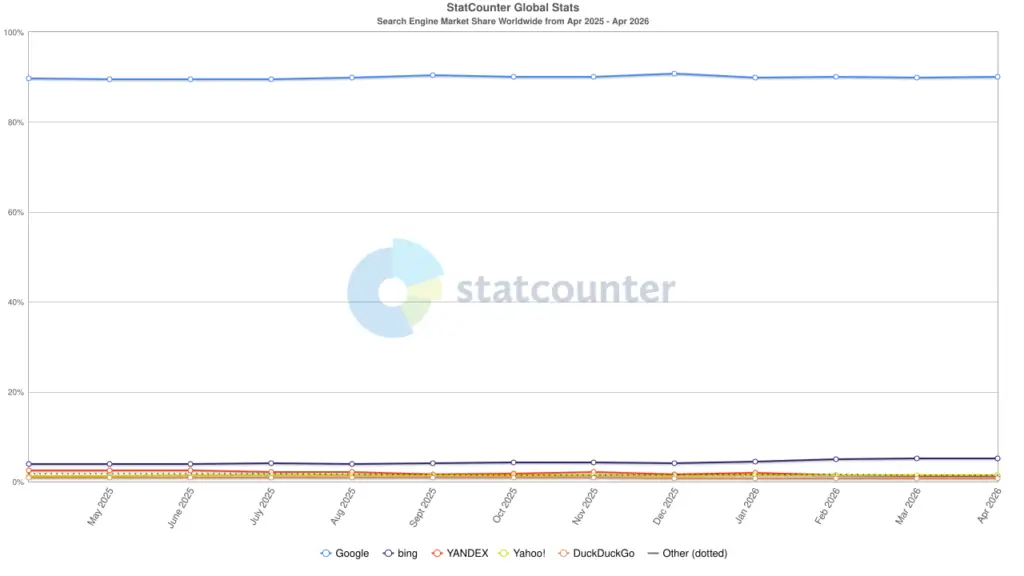
Traditional SEO still drives enormous amounts of online discovery. Google still dominates global search behaviour, with StatCounter data continuing to show Google holding close to 90% of the global search market. Organic visibility still generates traffic, leads and customers for businesses across almost every industry.
At the same time, AI-generated search is clearly changing how people research products, compare services and gather information online. Reporting from both SEMrush AI SEO Statistics 2026 and the Similarweb AI Discovery Report suggests AI-generated search traffic has grown rapidly year-over-year, even though overall traffic volumes still remain much lower than traditional search. More users are starting to ask conversational questions instead of searching purely through keywords, recommendation-led behaviour is growing, and search journeys are becoming more fragmented across platforms.
That does not mean SEO is disappearing.
It means visibility itself is changing.
For years, SEO strategies were heavily focused on rankings, traffic and keywords. The goal was largely to improve discoverability inside traditional search engines. That approach still matters massively, but it is no longer the full picture.
Search engines and AI systems are now placing far more importance on recognition, authority, trust and repeated brand association across the wider web. Businesses are increasingly being understood as entities rather than simply collections of webpages.
This is where Brand SEO is becoming commercially important.
Traditional SEO helps businesses get found.
Brand SEO helps businesses become recognised, trusted and repeatedly associated with specific expertise.
The businesses building stronger visibility signals now will probably be in a much stronger position over the next few years as AI-generated search becomes more integrated into online discovery.
Summary
- AI-generated search is becoming more common across platforms like OpenAI, Google, and Perplexity AI.
- Traditional SEO still matters and continues to drive a huge amount of online visibility and traffic.
- Search visibility is no longer judged purely by rankings.
- Businesses are increasingly judged by:
- brand recognition
- authority
- trust
- consistent brand presence across the web
- Google still drives most online traffic, but AI-generated search is changing how people:
- research products
- compare services
- make buying decisions
- That shift is making Brand SEO far more important.
- Traditional SEO helps businesses get discovered.
- Brand SEO helps businesses become recognised, trusted and recommended.
Traditional SEO Still Matters. A Lot.
Before discussing Brand SEO in more depth, it helps to understand how AI-generated search is changing visibility itself and why recommendation-driven discovery is becoming commercially important – and to separate reality from industry panic.
Google still dominates search.
Organic traffic still drives leads, enquiries, sales and customer discovery across almost every industry. Most businesses are still heavily reliant on traditional search visibility, even if they don’t fully realise it.
A lot of AI search discussions online make it sound like businesses should abandon SEO entirely and start optimising only for LLMs.
That would be a mistake.
– Good technical SEO still matters.
– Good content still matters.
– Clear site structure still matters.
– Internal linking still matters.
Without those foundations, your visibility becomes weaker everywhere.
Even AI-generated search experiences still rely heavily on traditional SEO signals underneath the surface.
AI systems still need crawlable content, structured information, semantic relevance, clear hierarchy and trusted sources to understand websites properly. Most of the fundamentals behind good SEO still apply. The difference is that those foundations now support a much broader visibility environment instead of purely supporting rankings alone.
Most businesses still haven’t fully nailed those basics.
So no, traditional SEO is not disappearing.
But it is becoming one part of a much bigger visibility picture.
And that’s where Brand SEO starts becoming commercially important.
The Problem With Traditional SEO Thinking
Traditional SEO often treated visibility as a traffic equation.
Find keywords.
Create pages.
Rank.
Generate clicks.
Simple enough.
The problem is that modern search behaviour is no longer that linear.
People move between platforms constantly.
A potential customer might discover your business through Google, research you on LinkedIn, check reviews, search Reddit discussions, ask ChatGPT about competitors, watch YouTube comparisons and only then visit your website directly. That journey now happens constantly, especially in service-led industries where trust and credibility heavily influence decision-making.
That journey now happens every day.
Yet many businesses still treat SEO, PR, branding, social media and reputation management as completely separate activities.
They’re not separate anymore.
AI-generated search is pulling all of these signals together.
That changes how visibility works.
What Brand SEO Actually Means
Brand SEO is not just “branding” with a new name.
And it’s definitely not logos, colours and vague marketing slogans.
Brand SEO is about becoming strongly associated with specific topics, services and expertise across the wider web.
It’s the difference between:
“a company that ranks for SEO terms”
and
“a company people instantly associate with SEO expertise.”
That distinction matters much more now than it did a few years ago.
Because AI systems are increasingly trying to understand who businesses are, what they specialise in, how consistently they appear online and how trusted those mentions appear across different sources. Visibility is becoming far more connected to entity understanding rather than simple keyword matching alone.
That means visibility is no longer driven purely by rankings alone.
– Repeated mentions matter.
– Authority matters.
– Recognition matters.
– Consistency matters.
That’s why businesses with strong brands often appear disproportionately across AI-generated answers already. Research and citation analysis published by Search Engine Journal has already shown that AI systems heavily favour authoritative and institutional sources when generating answers and recommendations.
Research shared by Search Engine Journal AI Citation Analysis found that AI systems heavily favour authoritative and institutional sources when generating citations and answers.
AI systems naturally favour brands they understand confidently.
And confidence usually comes from repetition.
– Repeated mentions.
– Repeated associations.
– Repeated expertise.
– Repeated trust signals.
Not just one well-optimised page.
Why AI Search Is Accelerating This Shift
Traditional search engines ranked pages.
AI-generated search increasingly recommends businesses.
That’s a very different environment.
Someone searching:
“best CRM software”
inside Google may still be exploring options.
Someone asking ChatGPT:
“What’s the best CRM for a growing marketing agency with remote staff?”
is often much closer to making a decision.
The intent is usually deeper.
The questions are more specific.
The recommendation layer becomes far more important.
And recommendation-led visibility naturally favours recognised brands.
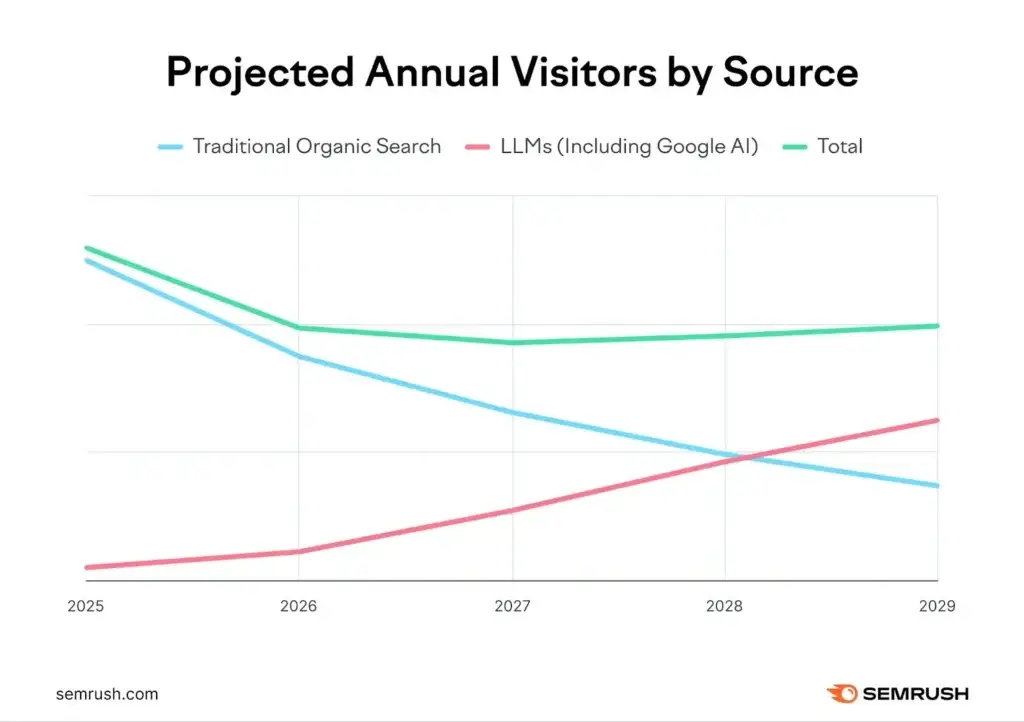
The projected growth data shared by SEMrush reinforces this shift well. Traditional search still dominates overall traffic volumes, but AI-generated discovery is growing quickly enough that businesses should already be thinking about how visibility works inside these environments.
That does not mean only huge companies can win.
In fact, specialist businesses often have a massive advantage here.
That doesn’t mean only huge companies can win.
In fact, specialist businesses often have a massive advantage here.
Smaller brands with clear positioning, strong topical focus and visible expertise can often become easier for AI systems to understand than much larger businesses trying to cover too many areas at once. In many industries, specialist visibility creates far stronger recognition than broad generic marketing.
That’s where Brand SEO becomes such a powerful opportunity for SMEs.
Most smaller businesses are still competing purely on rankings.
Very few are intentionally building entity recognition.
Search Is Becoming More About Recognition
This is the part many SEO discussions still miss.
Visibility used to be heavily page-driven.
Now it’s becoming far more entity-driven.
Search engines and AI systems increasingly attempt to understand brands as entities.
Not just URLs.
That means search engines and AI systems increasingly look for consistency across websites, LinkedIn profiles, podcasts, reviews, PR coverage, business profiles, author bios and wider industry mentions. The more consistently a business is associated with a topic, the easier it becomes for platforms to build confidence around what that business actually does.
The more consistent your positioning becomes, the easier you are to understand.
And the easier you are to understand, the easier you are to recommend.
This is also why businesses with inconsistent messaging often struggle.
One page says they’re a digital agency.
Another says growth consultancy.
LinkedIn says performance marketing.
Their service pages target ten unrelated industries.
There’s no clear association.
No obvious expertise.
No strong topical ownership.
That confusion weakens visibility over time.
Most Businesses Still Ignore Brand Signals
A lot of companies still invest almost entirely in their website while ignoring how they appear everywhere else online.
That’s usually where things start breaking down.
– Your website might position you one way.
– Your LinkedIn says something else.
– Your reviews mention completely different services.
– Your author bios are inconsistent.
– Your social profiles barely explain what you actually do.
From an entity perspective, that creates weak signals.
And weak signals make recommendation visibility harder.
Businesses need to start auditing how their brand appears across the wider web.
Not just their rankings.
That includes areas like Google Business Profiles, LinkedIn descriptions, review platforms, directory listings, podcast appearances, guest contributions and PR mentions. A lot of businesses never review these properly, even though they all contribute to broader brand understanding online.
Consistency matters far more than many businesses realise.
Especially now.
Why “Search Everywhere” Makes Sense
One of the better descriptions of modern visibility is the idea of “Search Everywhere™,” a phrase Ashley Liddell from Deviation Agency has used to describe how modern discovery behaviour now stretches far beyond traditional search rankings alone.
Because that’s essentially what users are doing.
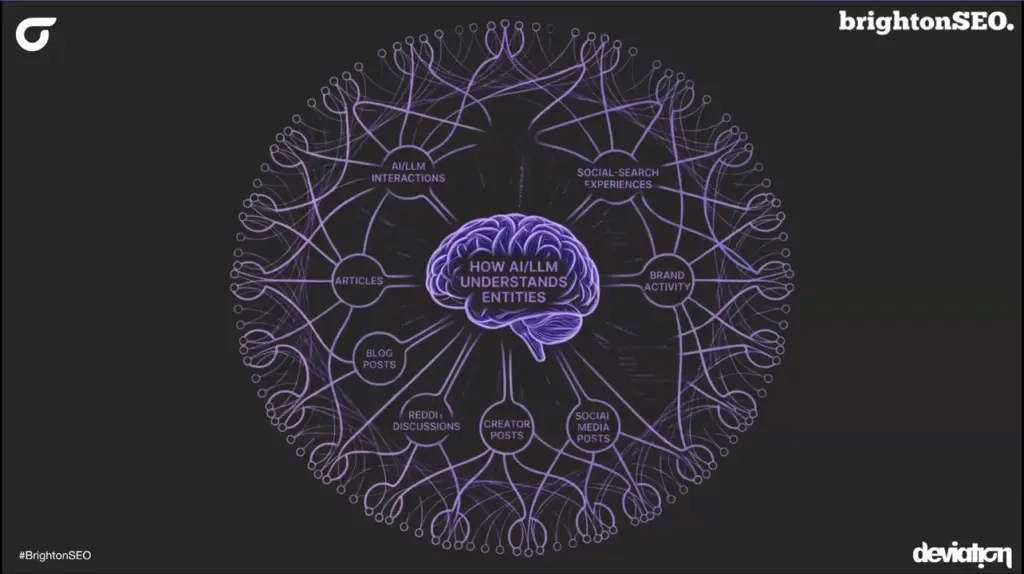
People no longer rely on a single platform for research. They move between Google, ChatGPT, Reddit, LinkedIn, YouTube, TikTok, review platforms and AI assistants during the same buying journey. Search behaviour is becoming far more fragmented than many businesses still assume.
Visibility now behaves more like an ecosystem rather than a rankings spreadsheet.
That means businesses need broader visibility signals. Not because every platform matters equally. They don’t. But because repeated association across trusted places strengthens confidence, and confidence is exactly what recommendation systems rely on.
Good Brand SEO Still Requires Good SEO
This is where some conversations become completely unhelpful.
Brand SEO does not replace technical SEO.
It builds on top of it.
Businesses still need:
– technically sound websites
– clear architecture
– useful content
– internal linking
– topical relevance
– accessible pages
– structured information
Without those foundations, AI systems still struggle to understand content properly.
In fact, AI-generated search arguably makes structure even more important.
Because AI systems increasingly extract summaries, explanations, comparisons and standalone answers directly from within content itself. Poor structure, bloated formatting and weak information hierarchy make that process much harder..
Messy content structures make that harder.
A lot of websites still bury useful information inside:
– vague headings
– giant paragraphs
– filler-heavy introductions
– unclear navigation
– bloated content
That hurts readability for users and AI systems.
Clear communication wins.
Usually the simplest explanation is the strongest one.
Content Quality Looks Different Now
For years, SEO content often became a volume game.
More blogs.
More keywords.
More pages.
That approach created huge amounts of generic content online.
You can see it everywhere.
Articles that sound technically correct but completely forgettable.
The same headings.
The same structure.
The same polished tone.
The same filler explanations.
AI-generated content has made this even worse.
A lot of businesses now publish content that sounds like it was written by someone who has never actually worked with a client before.
Perfectly formatted.
Perfectly balanced.
Completely lifeless.
The problem is that AI systems are increasingly trained on huge amounts of existing content.
If your content sounds identical to everything else online, there’s very little reason for people to remember it.
Or trust it.
Real expertise stands out more now.
Practical observations stand out more.
Clear opinions stand out more.
Specificity stands out more.
That doesn’t mean becoming performative or controversial for attention.
It just means sounding like an actual human being with experience.
Honestly, many businesses still underestimate how important this is becoming.
Why Brand Awareness Is Becoming The Advantage
Traditional SEO focused heavily on discovery.
Brand SEO focuses far more on preference and recognition.
That distinction matters because recommendation-led search changes user behaviour.
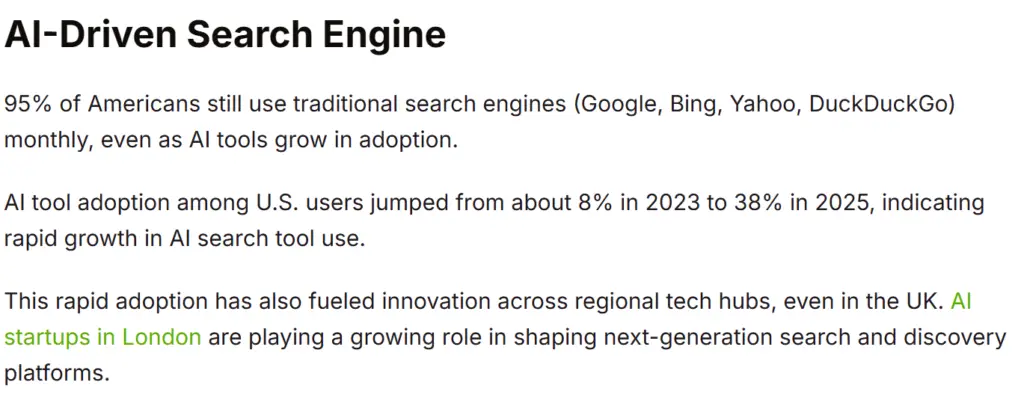
Statistics shared by Limelight Digital AI SEO Statistics suggest many consumers now use AI tools during buying decisions for comparisons, recommendations, and product research.
AI systems are far more likely to surface brands that already:
– appear regularly in SEO discussions
– have topical authority
– are mentioned by trusted sources
– have strong reviews
– show consistent expertise
– own a recognisable position
This creates a compounding effect.
The more visible and trusted a brand becomes, the easier it becomes for search systems to recommend confidently.
And once recommendation visibility starts compounding, brand strength becomes a huge advantage.
That’s one reason brand-led businesses often continue growing visibility faster over time.
Recognition creates momentum.
Smaller Businesses Can Still Win Here
This part gets overlooked constantly.
A lot of SMEs assume AI search will only favour massive global brands.
That’s not necessarily true.
Specialist expertise still matters.
In many industries, smaller businesses actually communicate more clearly than larger competitors.
They often:
– specialise more narrowly
– speak more directly
– create more focused content
– have clearer positioning
– build stronger niche authority
That focus becomes incredibly valuable.
Broad visibility is harder to understand.
Clear expertise is easier.
A smaller business that consistently owns one topic often builds stronger topical association than a huge company trying to rank for everything.
That creates opportunity.
Especially for businesses willing to become genuinely known for something specific.
What Businesses Should Focus On Now
Most businesses do not need to completely rebuild their marketing strategy because of AI-generated search, but they do need to think more broadly about visibility.
The businesses likely to perform best over the next few years will probably combine strong SEO foundations with clearer positioning, stronger authority signals and more consistent visibility across multiple platforms.
For many SMEs, improving visibility starts with simplifying how the business presents itself online.
A lot of companies still sound completely different depending on where users find them. Their website says one thing, LinkedIn says another, their reviews mention completely different services, and their wider content lacks any clear topical focus.
That inconsistency makes it harder for search engines and AI systems to confidently understand what the business actually specialises in.
TOP TIP
“Audit how your business is described across the wider web.”
Look at your:
– LinkedIn descriptions
– Google Business Profile
– author bios
– directory listings
– review platforms
– PR mentions
– podcast appearances
The more consistent your positioning becomes, the easier it becomes to build stronger entity association and topical authority over time.
Digital PR is also becoming increasingly valuable asset to Brand SEO, because repeated mentions across trusted publications, interviews and podcasts contribute to broader visibility signals. Businesses relying entirely on their website for visibility will probably find themselves at a disadvantage as recommendation-led search grows.
At the same time, none of this removes the need for strong SEO fundamentals.
Technical SEO still matters.
Useful content still matters.
Internal linking still matters.
Search intent still matters.
The difference is that those areas now support a much wider visibility ecosystem.
Traditional SEO Isn’t Dying. It’s Becoming Infrastructure.
This is probably the simplest way to frame the shift.
Traditional SEO is not disappearing.
It’s becoming foundational.
Expected.
Like having a usable website.
Technical SEO and content optimisation still matter massively, but they’re increasingly the starting point rather than the full competitive advantage.
Brand recognition is becoming the differentiator.
Because when AI systems, search engines and users all start relying more heavily on recommendation behaviour, recognised businesses naturally gain more visibility.
And visibility compounds.
The businesses building strong recognition now will likely be in a much stronger position over the next few years.
Not because rankings stop mattering.
But because trust, familiarity and authority start influencing visibility much more heavily than before.
TOP TIP
“Make your content easier for AI systems to understand.”
A lot of websites still bury genuinely useful information inside vague headings, overly long introductions and filler-heavy copy.
AI systems increasingly extract summaries, comparisons and standalone answers directly from content itself. Clear structure, logical formatting and concise explanations make that process much easier.
The strongest content still combines expertise with clarity. Businesses do not need robotic SEO copy. They need content that explains things naturally, demonstrates experience and answers questions properly.
TOP TIP
“Build visibility beyond your website.”
Most businesses still rely almost entirely on their website for discoverability.
Going forward, visibility will increasingly come from repeated brand association across trusted platforms. That includes industry publications, LinkedIn, podcasts, interviews, PR coverage and wider community discussions. There is a valid reason podcasts like Search With Candour, The SEO Mindset Podcast and SEO Office Hours continue growing in popularity within the industry. Repeated discussion and topical association help strengthen recognition over time.
The more consistently your business appears across relevant spaces online, the easier it becomes for search engines and AI systems to understand what your brand represents.
How This All Ties Together
Traditional SEO still matters enormously.
But rankings alone are no longer the full visibility strategy.
Search is becoming more recommendation-led.
AI systems are becoming more entity-focused.
And visibility increasingly depends on recognition, trust and repeated authority signals across the wider web.
That’s why Brand SEO is becoming such an important advantage.
Businesses that become clearly associated with specific expertise, services and industries will usually become easier for search engines, AI systems and users to trust.
And trust influences visibility.
Probably far more than most businesses currently realise.
If your business still treats SEO purely as rankings and traffic, now is probably the time to rethink visibility more broadly.
Because the businesses that become recognised before competitors catch up will likely have a huge advantage over the next few years.