
Local SEO is rarely a one-off job.
You do the setup. You optimise the profile. You build the location pages. Everything starts moving in the right direction.
Then, quietly, attention drifts elsewhere. The profile gets ignored a bit. Reporting slows down. Nobody really checks what is improving and what is starting to slip.
That is usually where momentum starts slowing.
The businesses that continue growing locally tend to approach SEO more like ongoing maintenance than a completed project. They monitor what is happening, notice patterns early, and make smaller adjustments consistently rather than waiting until visibility drops or enquiries slow down.
Without proper tracking, it becomes very easy to read the situation completely wrong.
Traffic can look stable while leads gradually decline. Rankings might fluctuate while phone calls increase. A local page may start building visibility months before it becomes obvious in broader reporting.
Local SEO works best when you look at everything together rather than treating each task separately. Reviews influence visibility. Visibility affects engagement. Engagement influences conversions. It all overlaps.
This article forms part of the wider Local SEO For Beginners Blogs, where we break that bigger picture down in more detail.
Summary
- Local SEO becomes much easier to improve once you start tracking patterns properly.
- Rankings matter, but actual business activity matters far more.
- Calls, enquiries, bookings, and direction requests usually tell a more useful story than keyword screenshots.
- Google Business Profile Insights, GA4, and Search Console are enough for most businesses to start making better decisions.
- Paid tools can help later, but most companies do not need a huge software stack straight away.
- Good reporting should simplify things. If somebody needs twenty minutes to understand the dashboard, something has probably gone wrong.
- Strong local visibility usually comes from consistent adjustments over time rather than one huge SEO push.
What Tracking And Refining Local SEO Performance Actually Means
Tracking local SEO means monitoring how visible your business is locally, how people interact with your listings and website, and which actions eventually turn into real customers.
That part matters more than many businesses realise.
A lot of people become overly focused on rankings because rankings feel simple to measure. But local SEO rarely behaves that neatly.
You can sit in position one and still generate very little business.
At the same time, a well-managed Google Business Profile can quietly generate calls, bookings, and direction requests long before website traffic changes dramatically.
That is why visibility on its own is never really the goal.
It is visibility that actually leads somewhere useful.
Tools & Programs For Monitoring Local Search Performance
Most businesses already have access to more data than they know what to do with.
That is usually not the issue.
The difficult part is figuring out which numbers genuinely matter and which ones simply look impressive inside a dashboard.
Your Google Business Profile is normally the best place to begin because the signals are tied closely to real behaviour. You can see how people discovered the business, which actions they took afterwards, and how often the profile contributed to calls, website visits, or direction requests.
That tells you far more than a generic ranking report ever will.
Google Analytics fills in the next part of the picture. Once somebody lands on the website, you can start understanding what they actually do afterwards. Which pages they visit. Which locations attract traffic. Which content keeps people engaged long enough to make contact.
Then there is Search Console.
Honestly, a lot of businesses barely use it properly even though it quietly contains some of the most useful SEO information available.
It shows which searches generate impressions, which pages attract clicks, and where visibility may be slipping without anybody noticing yet.
Once those platforms are connected together properly, patterns start becoming much easier to spot.
You stop looking at isolated metrics and start understanding how visibility connects to actual customer behaviour.
The paid tools become useful later.
Moz Local helps manage listings and citation consistency across multiple directories. BrightLocal is popular because the reporting is straightforward and much easier for non-technical businesses to follow. Semrush gives broader SEO tracking including backlinks, keywords, and competitor visibility.
Whitespark is still one of the stronger tools for local rank tracking and citation monitoring specifically.
You do not need everything immediately though.
Most businesses can go surprisingly far with Google’s free platforms once they start using them consistently and paying attention to the right signals.
How To Present Results
Most businesses can collect data.
That part is not usually difficult.
Presenting it clearly is where things often become messy.
A report should help somebody understand performance quickly. It should not feel like an exercise in decoding spreadsheets.
That happens constantly in SEO reporting.
Google Looker Studio (Since April 2026 Google has reverted the name back to Google Data Studio)
Looker Studio, formerly Google Data Studio, still remains one of the more practical reporting platforms available.
It connects directly with Analytics, Search Console, and Google Business Profile, allowing businesses to build live dashboards that update automatically.
That alone removes a huge amount of repetitive reporting work.
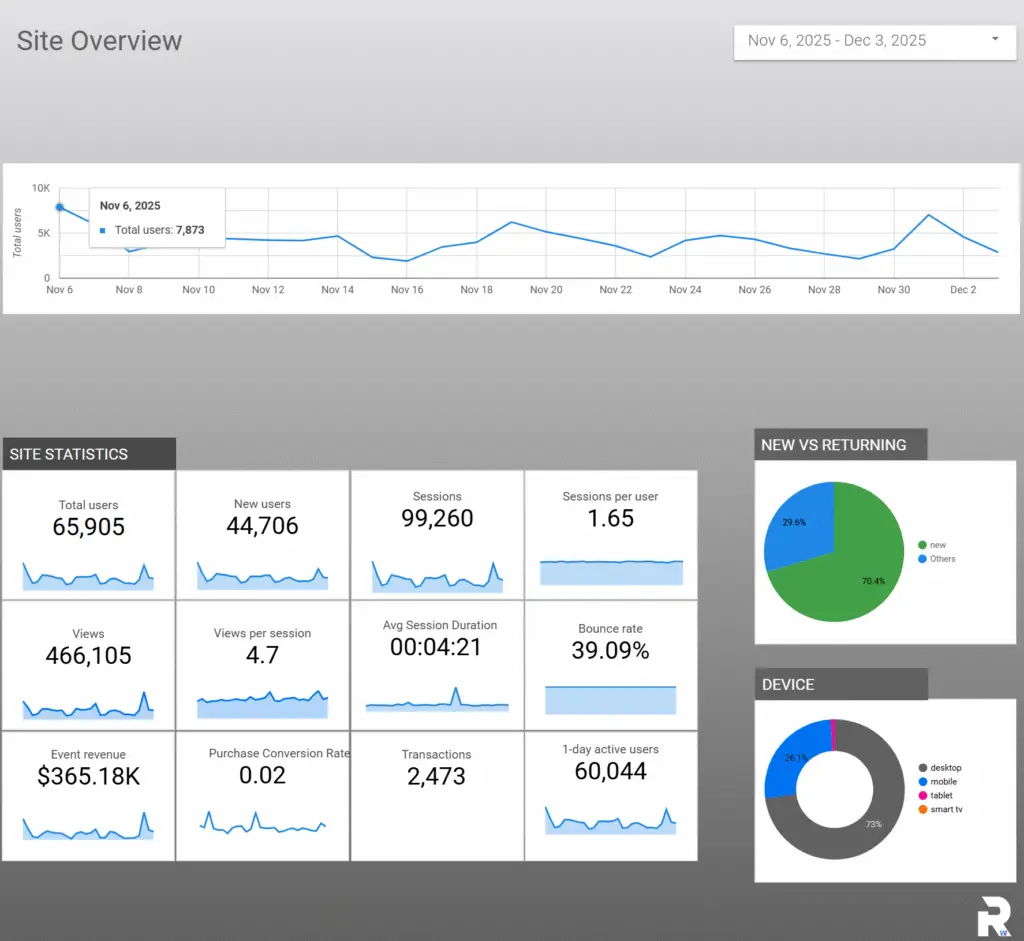
Instead of manually exporting figures every month, you can build visual summaries that make trends, comparisons, and movement much easier to understand.
The important part is tailoring the report to the audience.
A business owner usually cares about leads, bookings, sales, and return on investment.
A marketing team may care more about engagement, conversion quality, traffic behaviour, or visibility trends.
The mistake many SEO reports make is assuming everybody wants the same information.
They do not.
Good reporting focuses on business goals first and SEO metrics second.
Top Tip
“The automatic updates are probably the biggest advantage though. Once a dashboard is live, performance tracking becomes much easier to maintain consistently.“
What To Report On
In local SEO, rankings rarely tell the full story.
They move constantly.
Sometimes those changes matter.
Sometimes they are just noise that people panic over unnecessarily.
Local SEO also behaves differently from traditional organic SEO in a lot of situations. Calls, map visibility, and direction requests often increase before website traffic catches up.
That is why local reporting needs to include offline behaviour as well as website metrics.
Otherwise, businesses end up measuring visibility without measuring actual outcomes.
A rise in calls or profile engagement may signal strong local growth even if traffic itself still looks fairly flat.
Organic Traffic
Organic traffic is still one of the clearest indicators that local visibility is improving steadily over time.
When traffic from unpaid search grows consistently, it usually reflects broader keyword reach and stronger local presence.
Month-on-month reporting helps identify shorter-term movement.
Year-on-year comparisons normally provide much better long-term context.
Conversions
A lot of businesses obsess over traffic while barely paying attention to what visitors actually do afterwards.
That is usually backwards.
Visibility only becomes commercially useful once people start taking action.
For some businesses that means phone calls. For others it may be bookings, quote requests, completed forms, or even people physically visiting a location.
The important part is tying those actions back to something measurable.
Otherwise reporting ends up full of graphs that look impressive but do not really explain business performance.
Engagement Metrics
Engagement metrics help you understand if people actually find the content useful once they arrive.
That part gets overlooked constantly.
A page can rank well and still fail completely if visitors leave immediately because the content does not answer the question they searched for.
Time on site, bounce rate, click-through rate, and page journeys all help add context around behaviour.
If people stay longer, explore additional pages, or continue navigating through service areas, that is usually a strong indication the content is doing its job properly.
If they leave within a few seconds, something is probably misaligned somewhere.
Maybe the page is targeting the wrong intent.
Maybe the content feels thin.
Maybe the page simply loads too slowly and people lose patience before they even start reading.
Local Interactions
Google Business Profile interactions often tell you more about local intent than website traffic alone.
Calls, website clicks, and direction requests all show how people interact with your business directly from search results.
Tracking those actions helps reveal which profile updates or visibility improvements are actually influencing behaviour.
A good report should summarise these figures clearly and explain why they matter.
The numbers themselves are not enough.
Everything should connect back to real business outcomes like sales, enquiries, bookings, or footfall.
And finally, include a simple overview of completed work and upcoming priorities.
A lot of SEO activity happens quietly behind the scenes, so transparency helps build trust.
Key Metrics To Track In Local SEO
Local SEO growth is normally quite slow.
At least compared to what people expect when they first start looking at rankings and traffic graphs.
You rarely see dramatic overnight movement.
Most progress comes through smaller improvements that compound over time as visibility, engagement, reviews, and trust begin reinforcing each other.
That is why consistency matters far more than reacting emotionally to short-term fluctuations.
Here are the core metrics worth monitoring regularly.
Local Traffic Volume
One of the clearest indicators of local SEO progress is understanding where your traffic actually comes from.
Not just how much traffic exists overall.
That distinction matters.
Google Analytics allows you to segment visitors by location, which helps you see how much traffic is coming from your real service area rather than random locations that are unlikely to convert.
If surrounding towns or nearby postcodes gradually start appearing more often, there is a good chance your local visibility is improving.
If local traffic starts dropping while rankings remain stable, competitors may be improving their map visibility or generating stronger engagement signals.
This is why local SEO reporting needs context.
Traffic alone never tells the whole story.
A smaller amount of highly relevant local traffic is normally far more valuable than a large volume of visitors who will never become customers anyway.
Google Business Profile Insights
Your Google Business Profile remains one of the strongest local visibility signals available.
The Insights dashboard shows how users discover your profile, which actions they take afterwards, and which searches triggered your appearance.
Pay close attention to the difference between direct searches and discovery searches.
Direct searches usually mean people already know your business name.
Discovery searches often indicate broader local visibility because users are searching for services rather than specific brands.
Monitor actions carefully too.
Calls, website clicks, and direction requests all help reveal how users behave once they find your listing.
Sometimes the patterns tell a much bigger story.
For example, rising calls combined with declining direction requests may suggest stronger awareness but weaker local accessibility or confusion around location details.
Citations And NAP Accuracy
Citations are references to your business name, address, and phone number across the web.
They still matter.
Probably not with the same weight they carried years ago, but they still help reinforce legitimacy and consistency across the web.
Regularly review listings across platforms like Yelp, Yell, Apple Maps, and Facebook.
Even minor inconsistencies can create confusion.
Something as small as “Street” versus “St.” sounds harmless, but those inconsistencies build up surprisingly quickly.
Tools like Whitespark and Moz Local can help automate much of this process by identifying mismatches and missing listings.
Consistent business information reinforces trust for both customers and search engines.
Review Count And Sentiment
Reviews still influence local visibility heavily, but the conversation around reviews has changed quite a bit over the last few years.
It is not only about collecting five-star ratings anymore.
Search engines are getting better at understanding context, detail, and overall sentiment inside reviews themselves.
That means the wording matters.
If customers regularly mention specific services, locations, staff members, or positive experiences, those details help reinforce trust and relevance naturally.
Consistency matters too.
A steady flow of genuine reviews tends to look far healthier than fifty reviews arriving in one month followed by complete silence for the next year.
Most businesses also overlook the operational side of reviews.
Recurring complaints often point towards problems the business already knows exist but has not properly addressed yet.
Recurring praise tells you what customers actually value most.
And people absolutely read your responses.
Not only the unhappy customers.
Potential customers quietly judge those interactions all the time before deciding if they trust the business enough to make contact.
Top Tip
“As AI-driven search continues developing, platforms like ChatGPT and Gemini are increasingly assessing businesses using broader trust signals including review sentiment and overall reputation.”
That makes consistent positive feedback and authentic customer interaction far more important than many businesses realise.
The clearer and more trustworthy your online reputation appears, the more likely these systems are to recognise your business as a reliable recommendation.
Social Interaction And Engagement
Social engagement does not directly improve local rankings, but it still contributes to visibility and brand familiarity.
An active local social presence often leads to stronger brand recognition, more branded searches, and better community engagement.
Monitor metrics like comments, shares, follower growth, and interaction levels.
These signals help indicate how connected your business feels locally.
Location-focused content tends to work particularly well here.
Community involvement, team updates, behind-the-scenes posts, and local events usually feel far more authentic than heavily promotional content.
That usually feels more believable to people as well. Most audiences can spot forced promotional content almost immediately now.
Conversions And Real Outcomes
Conversions are where local visibility finally becomes measurable business value.
This is the point where visibility either turns into business or it does not.
Track every meaningful action possible including calls, quote requests, purchases, bookings, contact forms, and direction requests.
Call tracking and form analytics tools can help identify which channels actually generate leads.
That makes future optimisation decisions much easier.
A lot of businesses become distracted by vanity metrics.
Traffic spikes.
Impression growth.
Ranking screenshots.
But meaningful local SEO performance usually comes down to much simpler outcomes.
A phone call.
An enquiry.
A booking.
A sale.
That is the part that actually matters.
How To Approach Change In Response To Performance Data?
Once proper tracking becomes part of the routine, decision-making usually becomes much less reactive.
You stop guessing quite so much.
Patterns start appearing.
Some changes are obvious. Others take a while before they become noticeable.
That is why trends matter far more than isolated spikes or dips.
One quieter week rarely means very much on its own.
But if conversions gradually decline for three months while traffic remains stable, that tells a very different story.
The same applies in reverse.
Sometimes visibility barely changes while enquiries suddenly increase because a profile update, stronger reviews, or clearer calls-to-action improve conversion behaviour.
This part of local SEO is never really finished.
You test changes, monitor the outcome, adjust where needed, then repeat the process again.
Sometimes the adjustments are technical.
Sometimes they are surprisingly simple.
Better images.
Clearer location pages.
Faster response times.
More useful content.
Businesses often expect SEO improvements to come from huge strategic changes when quite a lot of local growth actually comes from smaller refinements repeated consistently.
Keeping an eye on Google updates matters too because local search and traditional organic search do not always react the same way.
A change that barely affects standard rankings can still shift map visibility quite noticeably.
The businesses paying attention usually spot those changes much earlier.
How This All Ties Together
The businesses that continue improving locally are usually the ones paying attention consistently.
Not obsessively checking rankings every few hours.
Just paying attention often enough to notice patterns before problems become obvious.
That is normally the difference.
They review performance regularly, notice what is creating enquiries, test improvements, and keep refining things gradually over time.
Nothing dramatic.
No magic trick.
Just steady maintenance and better decision-making.
The tools themselves are only part of it anyway.
Most platforms can collect huge amounts of data now. Interpreting that information properly is the harder part.
Local SEO rarely improves because of one massive change.
It is usually smaller adjustments repeated consistently for months.
A better landing page.
More accurate listings.
Stronger reviews.
Clearer calls-to-action.
Better photos.
Faster responses to enquiries.
Individually, none of those changes feel revolutionary.
Together, they gradually strengthen visibility, trust, and customer confidence in ways that compound over time.