Search Has Changed, and Your Reporting Needs to Catch Up
Search used to be simple.
A couple of words. Maybe three or four if someone felt specific. You typed the rough idea, scanned the results, then refined the search if needed.
That’s not really how people search anymore.
More users now start with a complete thought. They search the way they speak. They add context, limitations, follow-up questions, and details about what they actually need.
And once people get used to using LLMs, that behaviour sticks.
Very few people open ChatGPT or Gemini and type a tidy keyword phrase. They write a sentence. Sometimes a full paragraph. They explain the situation, ask for options, ask for comparisons, then narrow things down from there.
That shift matters because it changes the shape of search demand.
It also changes the shape of reporting.
Query data becomes messier. Attribution becomes harder to track cleanly. The results page now answers more of the question before someone even clicks, so traffic patterns do not behave the way they did a few years ago.
On top of that, two searches are rarely identical now.
Even when two people want the same thing, they describe it differently.
One person searches for “best”. Another searches for “most reliable”. Someone else searches for “good for a team of 20”. Another wants pricing breakdowns, setup time, or comparisons.
Same underlying need. Different wording.
That’s why an AI SEO strategy for 2026 has to fit modern search behaviour, not the version of search many reporting models were built around.
A quick note before we start.
There are a lot of moving parts here. Industry, competition, seasonality, device type, and intent all affect what happens in the results.
What works for one business can completely miss the mark for another.
Still, there are a few clear pressure points worth paying attention to because they sit very close to how people search now, and how AI-led search experiences are assembling answers.
Summary
– Search behaviour is shifting away from short keyword phrases and towards longer, conversational queries.
– Search Console data now looks far more fragmented because people describe the same need in dozens of different ways.
– That does not automatically mean SEO performance is dropping.
– AI Overviews are changing how impressions, clicks, and CTR behave.
– Pages can appear more often while receiving fewer clicks because users get enough information directly on the results page.
– CTR still matters, but it is no longer a clean standalone quality signal.
– Reporting needs to focus on visibility, selection behaviour, and outcomes together.
– Strong AI SEO strategies now prioritise clarity, structure, brand familiarity, and genuinely useful pages.
– Topic coverage and intent matter more than obsessing over individual keyword variations.
– Brand demand is becoming increasingly important because users often return later through branded searches after seeing AI summaries or citations.
How searches have changed, and why keyword lists feel less useful
This shift is not only changing how people search.
It is changing how businesses need to interpret demand.
Older SEO models relied heavily on tidy keyword groupings and predictable query behaviour. That worked reasonably well when most searches were short, repetitive, and fairly consistent.
Now the same intent can appear through dozens of different phrasings, all slightly shaped by context, devices, AI tools, or the way someone naturally speaks.
That makes reporting noisier, but it also gives you a much clearer picture of how people actually think through decisions.
Short phrases are no longer the default
Traditional search rewarded shorthand.
People typed a topic, skimmed a list of results, then worked things out from there.
Conversational search has been nudging behaviour in the opposite direction for years.
Voice search started that shift. Spoken searches naturally became longer and more descriptive because people talk differently than they type. LLM-style search pushes this even further because the interface encourages explanation rather than shorthand.
People describe situations now.
They explain constraints.
They ask follow-up questions immediately instead of starting over.
That changes what appears in your data.
You still see head terms, obviously. Those are not disappearing.
But you also see far more highly specific queries appearing once or twice and then never appearing again.
That can make Search Console feel chaotic if you are still looking at it through an older keyword model.
Two searches are rarely identical, even when the intent is
This is usually where teams start getting confused.
One service page can generate hundreds of different search variations, all circling around the same decision.
Someone searches for pricing.
Someone else searches for setup time.
Another person searches for support.
Then integrations.
Then reliability.
Then compliance.
Then “best for small teams”.
The wording changes constantly, but the underlying intent is often closely connected.
If you treat every Search Console row like a separate target keyword, things get messy quickly.
You end up creating thin pages, overlapping content, and endless repetition.
A far better approach is treating those searches as signals.
Signals about what people care about.
Signals about the decision points they are working through.
An AIO strategy mindset matters far more in 2026 than obsessing over exact-match keyword groups.
What AI Overviews are changing on the results page
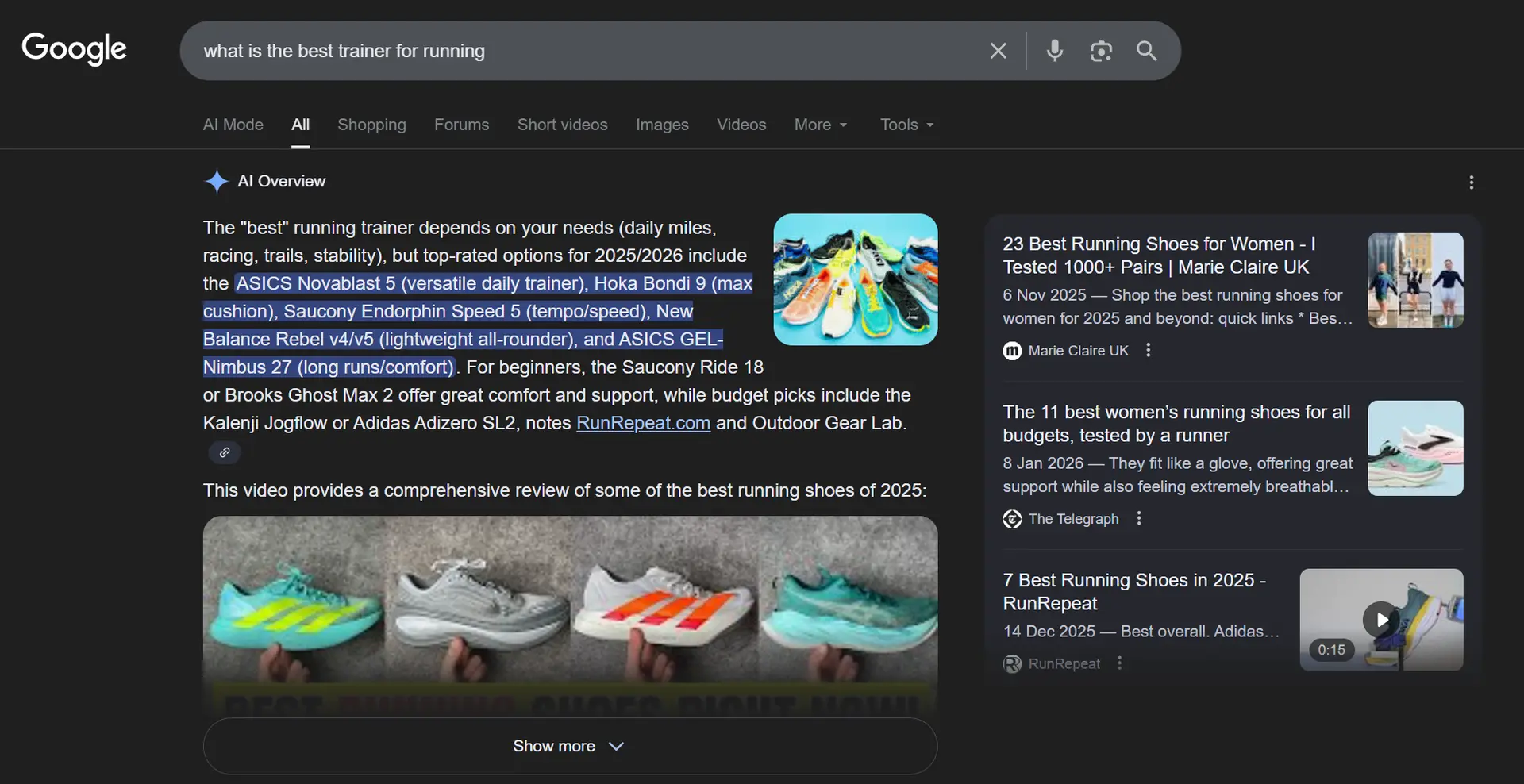
Google still ranks pages.
But the results page now does much more of the explanation work itself.
AI Overviews are part of that shift.
Semrush and Search Engine Land analysis throughout 2025 suggested AI Overviews first appeared heavily around long-tail informational queries before gradually expanding into more commercial and navigational intent areas.
The important bit is not the rollout timeline.
It’s the separation between visibility and clicks.
Those two things are drifting further apart.
You can appear more often while receiving fewer clicks.
That sounds backwards at first, but it makes sense once the results page starts handling more of the early research stage.
What this means for your GSC reporting
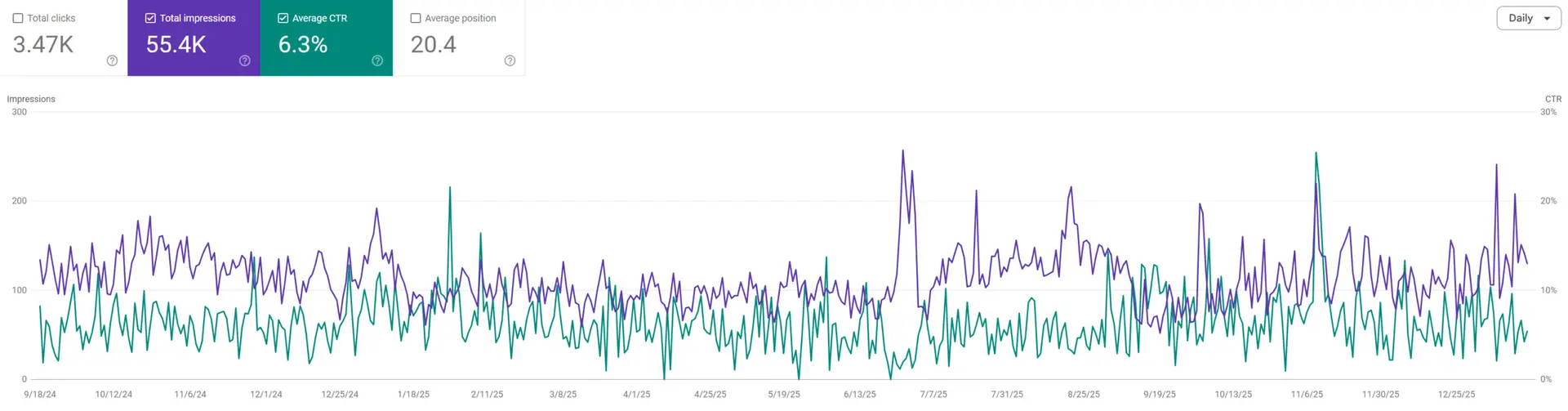
If you spend time inside Search Console, you have probably already seen this happening.
Impressions look healthy.
Sometimes better than expected.
Meanwhile clicks flatten out.
CTR trends downward.
That does not automatically mean your pages became weaker.
Often, it means the search experience changed around them.
Several large datasets published during 2025 pointed towards noticeable CTR drops on informational searches showing AI Overviews.
The exact percentages vary by industry and query type.
That part matters.
But the broader trend is difficult to ignore.
AI-generated elements absorb attention before users reach organic listings.
Why impressions can rise while clicks fall
An impression simply means your result appeared.
AI Overviews can increase how frequently results appear while reducing how often users need to click through.
Someone might read the overview.
Skim the cited sources.
Take a note.
Search your brand later.
Or leave entirely because they already got enough information.
So impressions remain stable, or even grow, while clicks fail to rise alongside them.
That naturally drags CTR down.
This is why CTR is becoming harder to use as a standalone content-quality metric.
It is now partly a reflection of SERP layout behaviour.
Not just page quality.
What you should actually do with that information
The first thing is simple.
Stop treating falling CTR as automatic failure.
Segment the data properly.
Look at:
– Query themes
– Page types
– Intent groups
– Informational vs commercial searches
– Brand vs non-brand behaviour
You will often find some areas remain stable while others soften heavily.
Informational searches usually feel the impact first because AI Overviews are strongest there.
High-intent commercial searches can behave very differently.
The second shift is changing the question entirely.
Instead of asking:
“How do we get CTR back up?”
Ask:
“What would make someone click after seeing the overview?”
That question tends to lead towards much more useful strategy discussions.
TOP TIP
“If CTR is still your main KPI, you will spend most of your time arguing with the layout of the results page”
A more useful reporting model for 2026 combines three areas together:
– Visibility: impressions and overall search presence
– Selection behaviour: branded searches, direct visits, repeat traffic
– Outcomes: enquiries, leads, bookings, sales, sign-ups
CTR still matters.
It just cannot carry the entire conversation anymore.
When reporting evolves this way, internal discussions usually become calmer and far more practical.
You stop assuming every traffic shift is a content problem.
Brand demand is becoming the tie-breaker
There is still a simple model that works surprisingly well.
Non-branded search drives discovery.
Branded search reflects selection.
Non-branded visibility introduces you to people who have never heard of you.
Branded searches happen later, when someone wants reassurance, wants comparisons, or simply wants to go directly to the source.
AI Overviews push more of that early discovery process onto the search results themselves.
That can reduce clicks.
But it can still increase awareness.
A user might see your brand mentioned in an overview, remember the name, then search for you later.
That’s one reason branded demand matters more now.
It is a much stronger sign that people remember you and actively choose you.
And realistically, if AI-driven search continues growing, being recognised by name becomes increasingly valuable.
Citations and mentions are becoming the middle layer
This is the part many reporting setups still miss.
AI visibility does not always behave like traditional organic rankings.
You might rank well but rarely get cited.
You might get cited frequently but receive fewer direct clicks.
You might simply be mentioned often enough that branded searches increase later.
That creates a middle layer of visibility many businesses are not measuring properly yet.
So an AI SEO strategy for 2026 really needs to support three different layers at once:
– Traditional organic visibility
– AI citations and references
– Brand demand and branded search growth
You do not need to obsess over every mention.
That gets exhausting quickly.
But you do need a wider web presence that makes your brand easy to confirm and easy to trust.
The current split in AI SEO advice
Right now, there is a noticeable divide in the advice floating around.
Some of it is useful.
Some of it feels built around one isolated experiment that people immediately turned into universal truth.
Two ideas appear constantly.
The “chunking” argument
One side pushes chunking heavily.
The theory is straightforward.
If AI systems extract passages from pages, then smaller self-contained sections supposedly make extraction easier.
At a sensible level, that just means good structure.
Clear headings.
Focused paragraphs.
One main idea per section.
That’s completely reasonable.
But sometimes the advice gets pushed too far.
Pages become fragmented.
Every few lines become another heading.
The writing starts feeling engineered purely for extraction.
That’s usually where the reading experience starts falling apart.
Google’s pushback on writing for LLM extraction
Google has openly pushed back on overly engineered “bite-sized” formatting.
Danny Sullivan specifically discouraged creating fragmented chunks purely because people assume LLMs prefer them.
That distinction matters.
Good structure helps readers.
Writing purely for extraction patterns is a far riskier long-term strategy.
Once the page stops feeling natural, trust usually suffers too.
And honestly, readers notice faster than people think.
A more grounded approach
The more practical approach is usually much simpler.
Answer quickly.
Then expand naturally.
That often means adding a short summary or overview near the top of a page.
Some people call it a TLDR.
The label does not matter much.
The job matters.
A strong overview helps people confirm relevance quickly.
It also helps systems understand the page clearly without forcing the entire article into fragmented blocks.
Most importantly, it improves the user experience first.
That’s the part many people skip.
My view: this is still SEO, just with different pressure points
Call it AI SEO.
Call it GEO.
Call it answer engine optimisation.
Underneath the labels, most of the fundamentals are still familiar.
Good SEO has always been about clarity, usefulness, trust, and matching intent properly.
That part has not changed.
What has changed is the pressure.
The results page now explains more.
Users compare faster.
Clicks are more selective.
Brand familiarity matters more.
So the sensible adjustments are usually the ones that improve readability for humans first while also helping machines interpret the page more clearly.
That’s a far safer direction than chasing extraction hacks.
Start with an overview near the top when the topic suits it
People are less patient with slow introductions now.
AI summaries have trained users to expect the main point quickly.
A short overview near the top of a page can do a surprising amount of work.
It reassures readers immediately.
It confirms relevance.
It helps scanners decide if the page is worth continuing.
It also reduces the chance of your core message being misunderstood.
Keep it concise.
Two to five sentences is usually enough.
And make it specific.
If the overview sounds vague or slogan-heavy, it loses the point entirely.
Keep paragraphs focused without turning the page into fragments
This is where the chunking discussion often becomes messy.
I do not think pages should become endless tiny sections.
It makes reading tiring.
It also creates writing that feels nervous and over-managed.
But keeping paragraphs focused on one core idea absolutely helps.
When a paragraph tries to do three jobs at once, clarity disappears.
Readers skim past important points.
Systems misinterpret context.
Quotes lose accuracy.
So the goal is not fragmentation.
The goal is clean meaning.
That fits both human readability and modern search systems surprisingly well.
Use schema and FAQs where they genuinely help
Schema is useful when it adds clarity and reflects the visible content honestly.
It is not a magic switch.
FAQs can help too.
Especially when they address:
– Objections
– Comparisons
– Timelines
– Pricing concerns
– Practical next steps
The problem starts when FAQs become filler.
If nobody genuinely asks the question, the section usually feels artificial.
Readers can feel that.
So can search systems eventually.
TOP TIP
“If a page is still earning impressions but CTR keeps falling, there is a good chance the results page is doing more of the explanation work before the click.”
That’s usually where a short answer block becomes genuinely useful.
It helps visitors immediately once they land.
It also gives external systems something clear and accurate to reference.
You do not need to roll this out across every page immediately.
Start with pages already sitting close to important decision stages:
– Service category pages
– Explainer content
– Comparison pages
– “How it works” pages
– Keep the summary concise.
Then let the rest of the page provide the detail, proof, and nuance.
A practical AI SEO strategy for 2026
This is the simplest framework I keep coming back to.
Not because it sounds exciting.
Because it reflects how people actually search and decide now.
Step 1: Track how your query mix is changing
Start by reviewing Search Console through three separate lenses.
First, broad head terms and classic category searches.
Second, longer conversational searches.
Things like:
– “how much does it cost”
– “what should I choose”
– “how does this compare”
– “what’s the difference between”
Third, branded searches.
That includes:
– Brand name only
– Brand plus pricing
– Brand plus reviews
– Brand plus comparisons
– Brand plus contact or login queries
Then compare CTR and impression behaviour across those themes.
If impressions remain stable while clicks soften heavily in one area, it may indicate stronger AI feature presence around that query set.
The point here is not blaming AI.
It is identifying where the click is becoming harder to earn.
Step 2: Build pages that earn the click, not just the impression
If search results now explain more upfront, the click itself has to become more valuable.
Pages earn clicks when they offer something summaries cannot fully provide.
Usually that means one of four things:
– Proof
– Depth
– Utility
– Confidence
Proof makes claims believable.
Depth explains trade-offs properly.
Utility gives readers something usable.
Confidence removes uncertainty around pricing, timelines, process, or expectations.
This is also where brand strength starts showing.
When several options look similar, people usually choose the name they already recognise or trust.
That part is becoming more important, not less.
Step 3: Make pages easier to summarise without writing for machines
This is where structure matters.
Use headings that match real questions.
Add concise summaries where useful.
Keep paragraphs focused.
Place examples close to claims.
Simple things.
Not gimmicks.
The goal is removing ambiguity.
That tends to help readers and systems at the same time.
Step 4: Build stronger branded demand
When someone searches your brand directly, they are usually much closer to action.
Or they are checking credibility before acting.
If AI-driven experiences reduce some non-branded clicks, branded demand becomes one of the clearest signs that people still remember and choose you.
That kind of demand grows through consistency.
Consistent messaging.
Consistent visibility.
Consistent positioning across the places your audience already spends time.
Step 5: Create a wider citation footprint
AI visibility is not only shaped by your own website anymore.
External references matter too.
That includes:
– Industry publications
– Interviews
– Expert commentary
– Community discussions
– Reviews
– Forum conversations
– Social platform mentions
Reddit and Quora conversations already appear regularly in AI-driven search experiences because they reflect real-world discussions.
That doesn’t mean spamming threads.
But it does mean your wider presence matters.
Especially if people are actively discussing your category.
The goal is not “be everywhere”.
It is being consistently visible where your audience already looks for reassurance.
FAQs about AI SEO strategy for 2026
Why are impressions rising while clicks are falling?
Because visibility and clicks are separating.
AI features can satisfy part of the search directly on the results page, which reduces the need to click through.
So impressions remain strong while CTR falls.
Does lower CTR automatically mean weaker content?
No. CTR now reflects both content quality and SERP layout.
If AI Overviews appear heavily around certain searches, organic listings naturally receive less attention even when rankings stay stable.
Should I use chunking to appear in AI answers?
Clear structure helps.
Over-fragmenting content usually hurts readability.
A better approach is keeping paragraphs focused, using natural headings, and making the page easy to follow.
Are quick summaries worth adding?
Usually, yes.
Especially on pages where readers want fast reassurance before deciding if they should continue.
A concise overview improves clarity without forcing the rest of the page into shallow formatting.
How do I improve my chances of appearing in AI citations?
Focus on clarity, specificity, and wider brand presence.
Pages that explain ideas clearly tend to travel better across AI systems.
External mentions and trusted references also help reinforce credibility.
How This All Ties Together
An AI SEO strategy for 2026 is not really about chasing a brand-new checklist.
It is about adapting to two connected changes.
Searches are becoming more conversational and more varied.
At the same time, AI Overviews are changing what visibility actually looks like.
That affects reporting.
Impressions can rise while clicks and CTR soften because the results page now answers more questions before someone visits your site.
That does not automatically mean your SEO is failing.
Usually, it means user behaviour and SERP behaviour are changing together.
The sensible response is still surprisingly straightforward.
Write for people.
Help readers understand things quickly.
Use summaries where they genuinely improve the experience.
Keep paragraphs focused.
Structure pages clearly.
Avoid turning content into fragmented blocks just because someone claims an LLM prefers it.
The businesses that handle this transition best will probably not be the ones chasing every AI visibility tactic.
They will be the ones building genuinely useful pages, strong brand familiarity, and reporting models that reflect how modern search actually behaves.
If you want help building a practical AI SEO strategy around your own Search Console data, market behaviour, and visibility trends, get in touch and I’ll help map out a clearer direction based on what’s actually happening in your search landscape.